All species › Caryophyllales › Tropical pitcher plant family › Nepenthes attenboroughii
Nepenthes attenboroughii
One of the largest pitcher plants in the world, discovered only in 2007 on the summit of a mountain massif in central Palawan. Missionaries who climbed the mountain in 2000 reported seeing large pitcher plants there; in June 2007 Alastair Robinson, Stewart McPherson and Volker Heinrich investigated during an expedition surveying the pitcher plants of the Philippine archipelago. The description followed in February 2009 in the Botanical Journal of the Linnean Society. The species is named after the British natural history broadcaster Sir David Attenborough, an enthusiast of the genus. It made the list of the top ten new species of 2009 and, in 2012, the list of the world's hundred most threatened species.
Identification
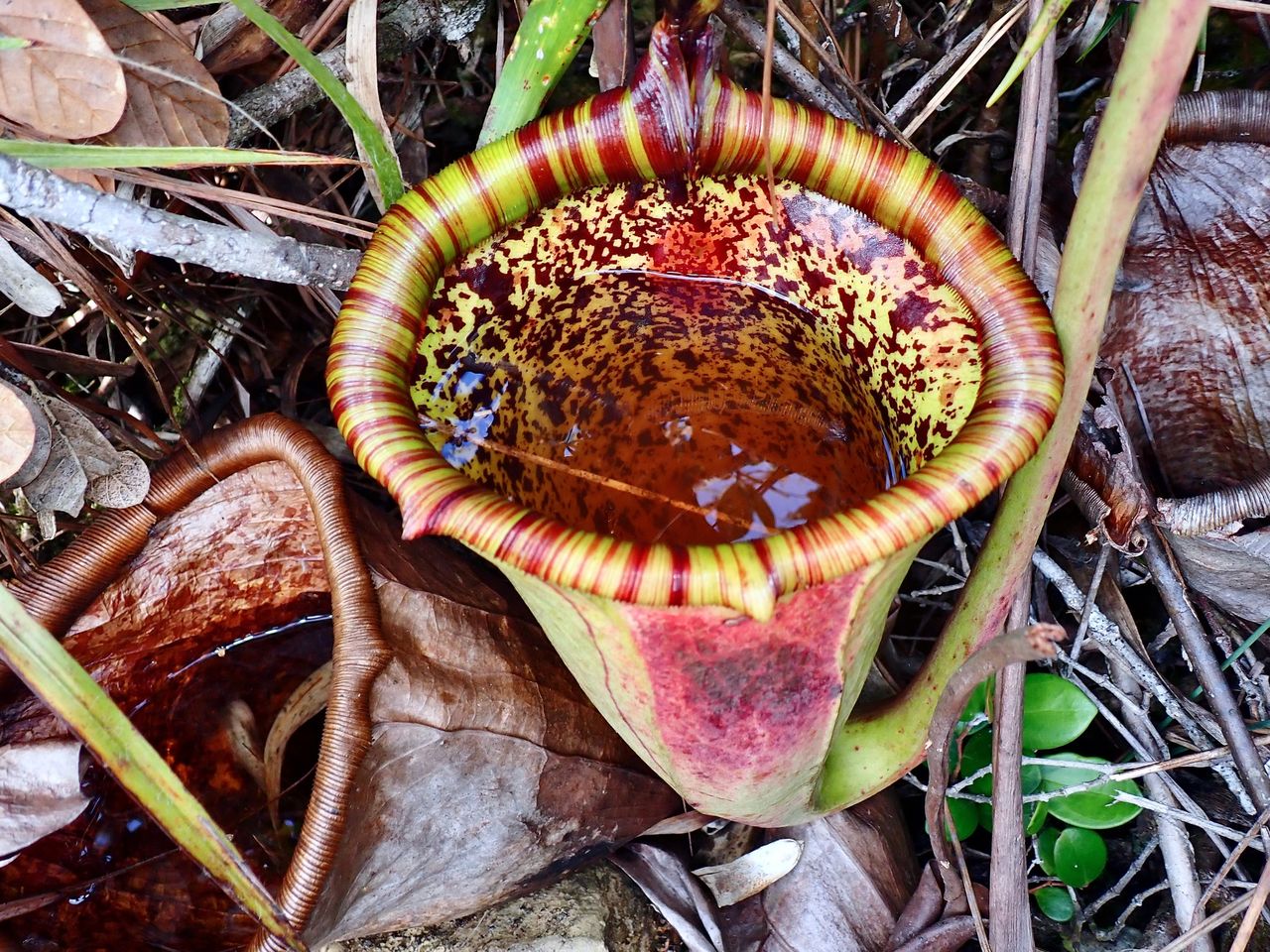
A robust, upright to scrambling shrub to one and a half metres, rarely branched, with a strikingly thick stem of 2.5 to 3.5 cm. The leaves are large and leathery: rosette leaves 25 to 30 cm long and 8 to 10 cm wide, leaves of the scrambling stem 30 to 40 cm long and up to 15 cm wide. Tendrils are 30 to 50 cm long. Lower pitchers are bell-shaped to tubular, up to 30 cm tall and 16 cm wide, with a broad peristome of 0.8 to 2 cm bearing teeth on the inner edge. Upper pitchers are tubular to funnel-shaped and slightly smaller, up to 25 cm tall and 12 cm wide. Characteristic is the narrow, upright lid, which barely covers the mouth. Plant and pitchers are dotted with reddish-brown sessile glands. The exterior is pale yellow to light green, sometimes dark purple, and the interior heavily flecked maroon.
Similar species
Its closest relatives are other giant species of Palawan, such as Nepenthes deaniana, Nepenthes mantalingajanensis, Nepenthes mira and Nepenthes palawanensis; the last produces even larger pitchers. There is also affinity with Nepenthes peltata from Mindanao and with Nepenthes rajah from Borneo. The authors suggest these species arose by radiation from a common ancestor in Borneo. Nepenthes attenboroughii is recognised by the combination of bell-shaped pitchers, a narrow, upright lid and the thick, upright stem. Since no other pitcher plants grow on its mountain, confusion on site is ruled out.
The trap and how it works
A large trap with layered fluid. Because the lid is narrow and upright, rain falls into the pitcher; the fluid therefore consists of a viscous lower layer and a watery upper layer that do not mix. The upper layer supports its own community of organisms, mainly mosquito larvae, and the plant benefits both from captured prey and from the waste of these inhabitants. The usual catch is large bugs and flying insects; in October 2012, however, a dead shrew was found in a pitcher, which by December of that year had been digested to a skeleton with a tuft of hair. The largest pitcher measured held over one and a half litres; pitchers of two litres are expected.
Habitat and ecology
Stunted summit vegetation on rocky, ultramafic soil: a continuous thicket 0.8 to 1.8 m tall, between about 1450 m and the summit at 1726 m (R3, B1). The plants grow there in scattered populations among shrubs, together with Leptospermum, Vaccinium, Medinilla, Pleomele and the orchid Spathoglottis kimballiana, among others. The ultramafic rock yields a nutrient-poor soil rich in heavy metals that maintains a low, open vegetation. The summit climate is cool and damp, with much wind and fog.
Distribution and elevation
Endemic to Palawan, Philippines, where it is known only from one mountain massif in the centre of the island and its connecting ridges. Our own species list gives 'Palawan, 2009', which matches the literature; 2009 is the year of description. At first the species was known from only one summit; it has since been found on a neighbouring summit and the connecting ridges. Because the species is listed as Critically Endangered, this guide gives no more precise location.
- Recorded (one-degree cells)
Forms and variation
No varieties or forms have been described, and no natural hybrids are known. The latter is logical: no other pitcher plants grow on the mountain where the species occurs. Pitcher colour does vary greatly, from green and yellow to entirely dark purple, and plants in full sun are usually darker. Between lower and upper pitchers the difference is mainly in shape, bell-shaped below and more tubular or funnel-shaped above, and in size.
Where and when to see it
This species is critically endangered and targeted by illegal collectors. This guide therefore describes no route or site. Access to the mountain areas of central Palawan is regulated by local government and requires permits and accredited local guides; follow those rules strictly. If you see the species in the wild: do not touch the plants, take no seed, stay on existing trails and share no coordinates or recognisable landscape photographs. Photographs of the plants themselves are no problem.
Conservation status
Listed on the Red List as Critically Endangered, because of its tiny range and the threat from plant poachers. A newly described species with a single small habitat is especially vulnerable to the removal of plants and seed. As a member of Nepenthes it is listed in CITES Appendix II, so international trade in wild plants requires a permit; Philippine law also protects the species. Climate change is a further risk: the species already grows at the summit and cannot move any higher.
Scientific name
Nepenthes attenboroughii | Robinson, McPherson & Heinrich, 2009
Nepenthes attenboroughii was described in February 2009 by Alastair Robinson, Stewart McPherson and Volker Heinrich, in the Botanical Journal of the Linnean Society. The type material (A. Robinson AR001) is held at the herbarium of Palawan State University (PPC), Puerto Princesa City. The summit of Mount Victoria, an ultramafic mountain range in central Palawan, Philippines. The species is named after the celebrated broadcaster and naturalist Sir David Attenborough, a keen enthusiast of the genus.
World Checklist of Vascular Plants (WCVP), via Plants of the World Online (POWO), Royal Botanic Gardens, Kew.