All species › Lamiales › Bladderwort family › Pinguicula albida
Pinguicula albida
Pinguicula albida is the white-flowered butterwort of the lowland savannas of western Cuba — one of the older names in the Cuban group, collected in the nineteenth century by Charles Wright and described by Grisebach. Unlike most of its Cuban relatives, which sit on wet rock in the eastern mountains, this species belongs to the flat, seasonally waterlogged sand savannas and marsh edges of Pinar del Río.
Identification
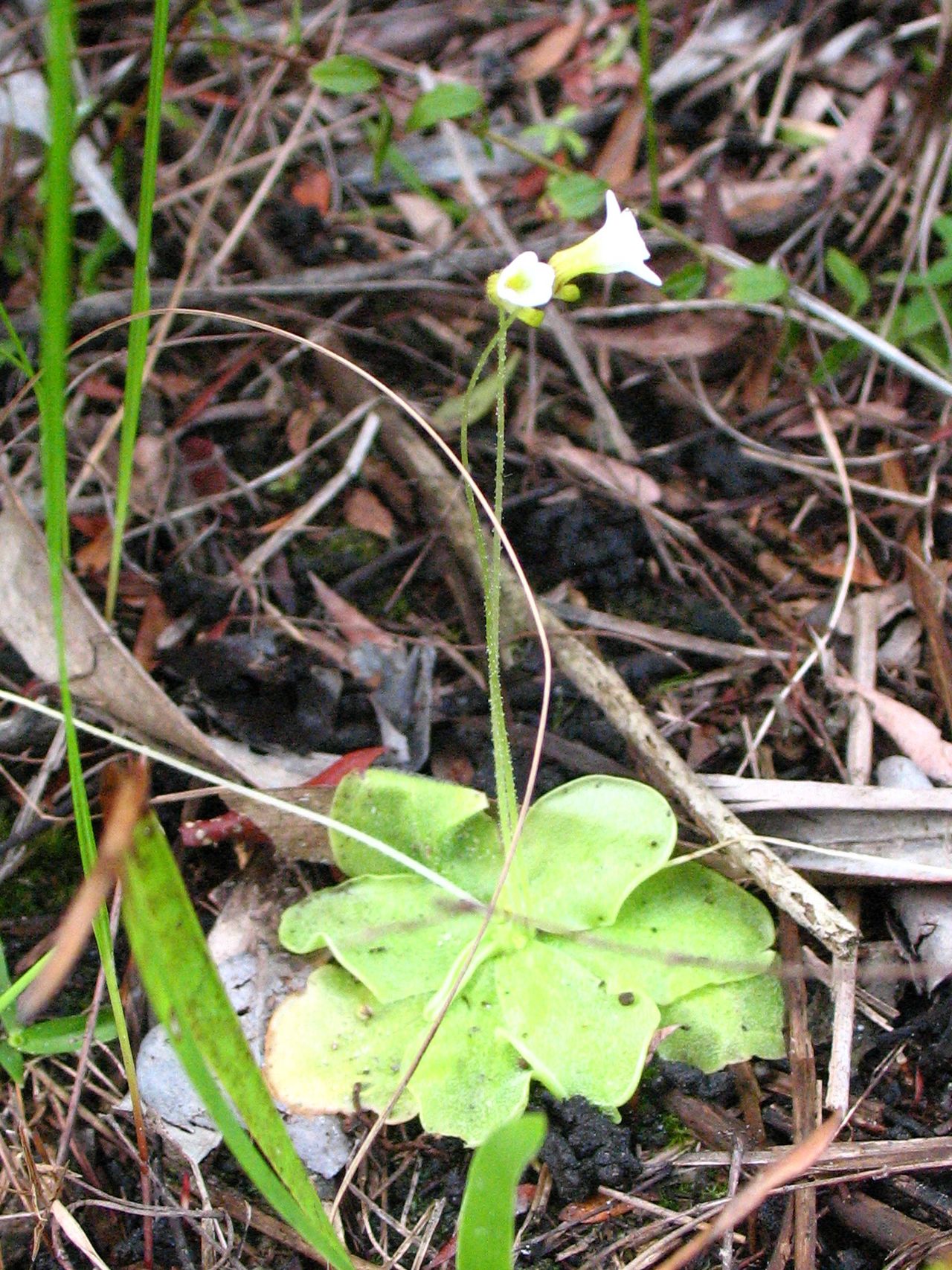
A flat rosette of entire, pale green leaves lying close to the wet sandy ground and glistening on top with glandular droplets. Slender, glandular-hairy scapes rise from the centre, each with a single flower. The flower is white — that is both the name and the chief field character — and two-lipped with a spur behind, as in all butterworts. Out of flower the rosette is small and inconspicuous and vanishes among the grasses and sedges of the savanna; the wet, glossy leaf surface is then the only handle. The scape in this group is itself glandular-hairy, something a hand lens shows clearly and which helps separate the plant from grassy neighbours. After flowering a small capsule of dust-fine seed remains, splitting open in dry weather.
Similar species
In western Cuba the scope for confusion is limited. Pinguicula filifolia grows in the same savanna type but has thread-like, erect leaves and is separated at once; its white-flowered subspecies does mean flower colour alone is not enough. P. cubensis and P. lithophytica are plants of wet rock and waterfalls and belong to another landscape. The white-flowered butterworts of eastern Cuba, such as P. jaraguana, grow hundreds of kilometres away on serpentine and do not overlap. So look first at leaf shape and situation, only then at the flower.
The trap and how it works
The leaf is a flypaper trap with two gland types: stalked glands carrying a clear sticky droplet, and sessile glands releasing digestive enzymes once prey lies on them. What sticks is mostly the small flying insects that swarm in waterlogged savanna — midges, mosquitoes, small flies. In a broad leaf the margin rolls slowly towards the prey so the digestive fluid does not run off the flat surface; afterwards the leaf flattens again. On white sand, where almost no available nitrogen exists, that catching is not a side income but the core of the food supply.
Habitat and ecology
The species belongs to the low sand savannas and marsh edges of western Cuba: ground that stands wet in the rains and bakes dry in the dry months, on strongly leached, acid white sand. Labels mention, among others, the marshes of San Ubaldo in western Pinar del Río. This landscape is among the poorest on the island and therefore holds a striking assembly of carnivorous plants, with sundews and bladderworts as constant neighbours. The plant tolerates no shade: scrub encroachment ends a site.
Distribution and elevation
Endemic to Cuba and restricted to the west of the island: Pinar del Río province, with records from Guane, Sandino, Mantua and Los Palacios. The range therefore roughly coincides with the western sand-savanna belt, a lowland strip between the limestone ranges of the Sierra de los Órganos and the coast. Elevation data are largely missing; this is flat lowland close to sea level. Outside Pinar del Río the species is not reliably reported. That this is an old name, from the collections of Charles Wright, means observations span a century and a half — but it also means some of the historical sites have since disappeared or can no longer be relocated.
- Recorded (one-degree cells)
Forms and variation
No wild subspecies or varieties are recognised. What differs between sites is mainly size and leaf colour: in full sun on lean sand the rosettes stay small and yellow-green, while in the sheltered transition to marsh vegetation they grow larger and fresher green. Among the white-flowered Cuban butterworts this species has been used in recent work as a reference point when describing new eastern species, which means the exact limits of its variation are still moving.
Where and when to see it
Go during or just after the rains, while the savanna is still wet, and search the lowest open ground: edges of temporary pools, bare sand between the tussocks, and the transition to marsh vegetation. The white flower is easiest to see from half a metre; the rosette is not. Kneel and look into the sun. Combine the search with looking for sundews and bladderworts — where those grow, the ground is poor and wet enough for this butterwort.
Conservation status
The species has not been assessed for the global IUCN Red List and is not listed in CITES. What is known: a Cuban endemic of the western lowland, with a handful of documented municipalities and a clear tie to a habitat type under heavy pressure on the island. Sand savannas have been drained on a large scale, converted to pine plantation or built over, and an altered fire regime lets scrub close the open vegetation. There is no international category; that the species has been known since the nineteenth century and is still being recorded is the only encouraging signal in an otherwise thin file.
Scientific name
Pinguicula albida | Wright ex Grisebach, 1866
Described by Charles Wright, published by August Grisebach in 1866, in “Catalogus Plantarum Cubensium”. The type area lies in western Cuba, in the area around Pinar del Río. The species name albida is Latin for "whitish" and refers to the white to pinkish-white flower colour, as also noted in the original description ("albida vel roseo-albida").
World Checklist of Vascular Plants (WCVP), via Plants of the World Online (POWO), Royal Botanic Gardens, Kew.