All species › Lamiales › Bladderwort family › Pinguicula casabitoana
Pinguicula casabitoana
Hispaniola has exactly one butterwort, and it is at once one of the strangest in the world. Pinguicula casabitoana grows not on the ground but on trees: a true epiphyte of the cloud forests of the Cordillera Central in the Dominican Republic. Together with a Cuban species it forms the world's only pair of epiphytic butterworts, and in both a mode of reproduction has been demonstrated that occurs nowhere else in the genus.
Identification
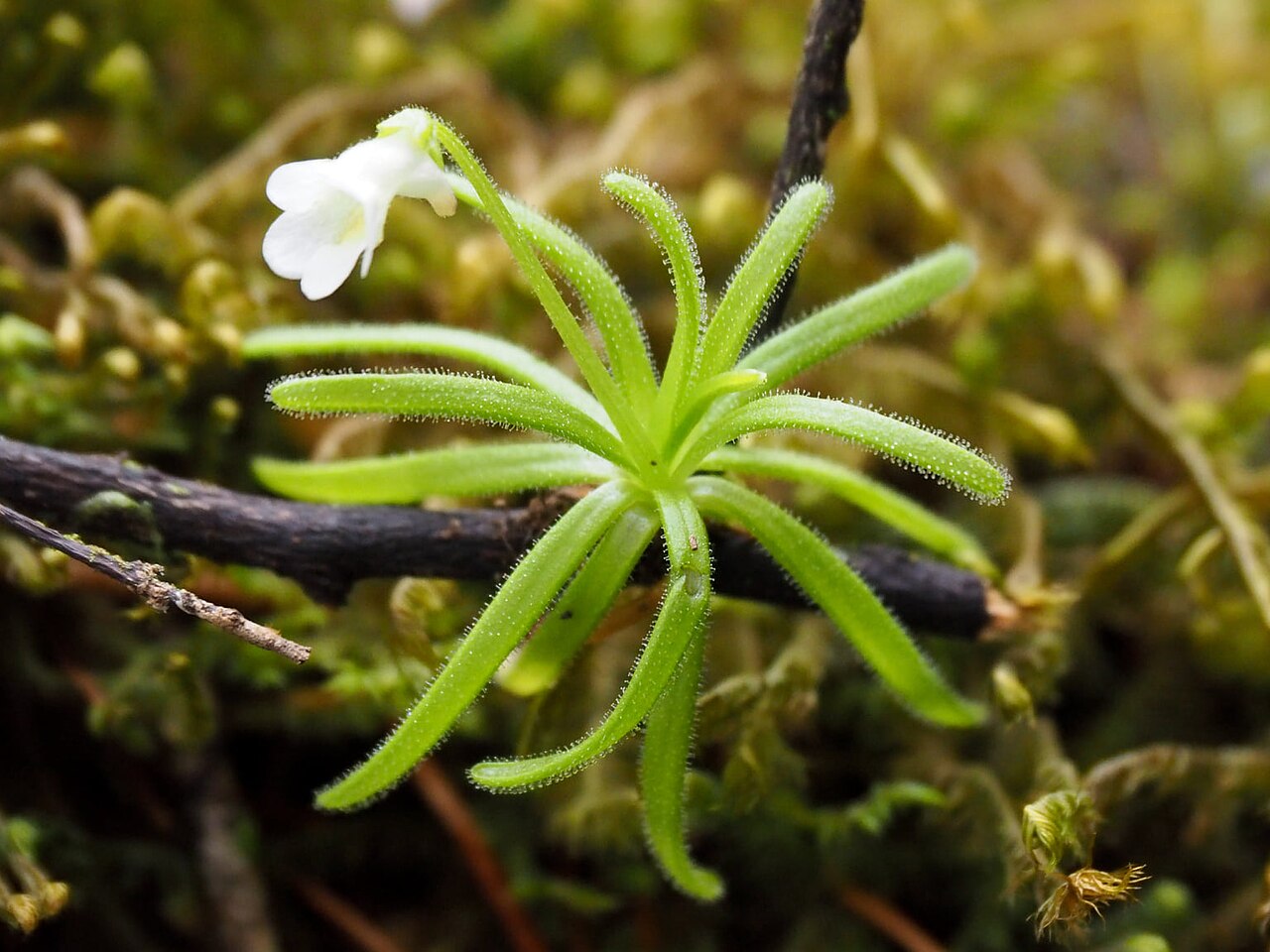
A small rosette of entire, fleshy leaves lying flat against the bark of a trunk or branch, with a glandular coat that makes the blade look wet. The plant sits not in soil but attached to the bark by rootlets and root hairs. Slender scapes rise from the centre, each with a single two-lipped, spurred flower. In cloud forest, where every trunk is covered in mosses, ferns and orchids, you have to search deliberately: the greasy, glossy leaf surface is what gives the plant away. Because the plant lives on bark, the rosette rarely sits horizontally but against a sloping or vertical surface, which makes prey capture slightly different from a ground dweller's. The scapes are short and keep the flower close to the trunk.
Similar species
There is no other butterwort on Hispaniola, so anyone finding a rosette with glossy, sticky leaves on a trunk has this species. The risk lies with the neighbours on the same bark: small ferns, liverworts and young epiphytic orchids resemble a butterwort rosette from a distance. Look at the surface and the leaf margin — entire, fleshy, and set with clear droplets that catch the light. The only other epiphytic Pinguicula in the world lives on Cuba and does not overlap.
The trap and how it works
The glandular coat works as in every butterwort: stalked glands with a sticky droplet, sessile glands with digestive enzymes, and a leaf skin that reabsorbs what has been digested. On bark that is the only way to obtain mineral nutrition, because an epiphyte has no soil. The micro-habitat is characterised by permanently high humidity and frequent wetting by cloud and rain, so the droplets never dry out. The catch is the small fauna of the trunk layer: springtails, mites, midges and small flies.
Habitat and ecology
Cloud forest in the middle elevations of the Cordillera Central: woodland where cloud runs daily against the slopes and the bark of the trees seldom dries. Localities lie in and around protected areas such as the Ébano Verde scientific reserve and Loma Barbacoa, and around Jarabacoa and Constanza. These are exactly the belts where the island has its own cloud climate; outside that zone the permanent humidity this way of life requires is missing.
Distribution and elevation
Endemic to Hispaniola and within that island restricted to the Dominican Republic, centred on La Vega province — Jarabacoa, Constanza and the Ébano Verde reserve — with an additional record in San Cristóbal province on Loma Barbacoa. It is thus the only Pinguicula of the whole island, and the only representative of the genus between Cuba and mainland South America. That one island has just one butterwort while neighbouring Cuba counts fifteen is among the unsolved questions of Caribbean plant geography.
- Recorded (one-degree cells)
Forms and variation
No wild subspecies or varieties are recognised. The most remarkable thing about this species is not a form but a mode of reproduction: in it and in the Cuban epiphytic butterwort true vivipary has been demonstrated. What the plant releases are not seeds but seedlings, formed inside the calyx, with the cotyledons remaining within the seed coat — the first record of that germination type in the genus. The young plant attaches to bark with an unbroken ring of root hairs, without first forming a true root. That way of life has a clear logic: a dust-fine seed falling from a branch has little chance of landing on suitable bark, whereas a ready-made seedling able to attach immediately does.
Where and when to see it
Look up. Search cloud forest on the dampest slopes, on the north and east side of trunks and on low branches, and use mosses and liverworts as guides: where they lie thick on the bark, the bark stays wet. Binoculars are useful, since many rosettes sit above eye level. Go preferably during or just after mist, when the glandular coat shines most. Most sites lie in protected reserves; arrange access in advance and leave the bark undisturbed.
Conservation status
The species has not been assessed for the global IUCN Red List and is not listed in CITES. What is known: it is the only Pinguicula of Hispaniola, with a small number of known sites in the cloud forest of the Cordillera Central, wholly dependent on host trees and on a permanently humid forest layer. With such a way of life, felling, forest fragmentation and a rising cloud base in a warming climate are the main risks. That part of the sites lie inside scientific reserves is the most encouraging thing this file has to offer.
Scientific name
Pinguicula casabitoana | Jiménez Almonte, 1960
Described by José de Jesús Jiménez Almonte in 1960. The species is known from a few localities in the Cordillera Central of the Dominican Republic. The species name casabitoana refers to Loma Casabito, a mountain in the Cordillera Central of the Dominican Republic.
World Checklist of Vascular Plants (WCVP), via Plants of the World Online (POWO), Royal Botanic Gardens, Kew.