All species › Lamiales › Bladderwort family › Pinguicula fontiqueriana
Pinguicula fontiqueriana
It is easy to forget that the range of the butterworts does not stop at the Mediterranean. In the Moroccan mountains grows Pinguicula fontiqueriana, the only species in this group on the African continent, and one of the few North African carnivorous plants that belongs in a guide at all.
Identification
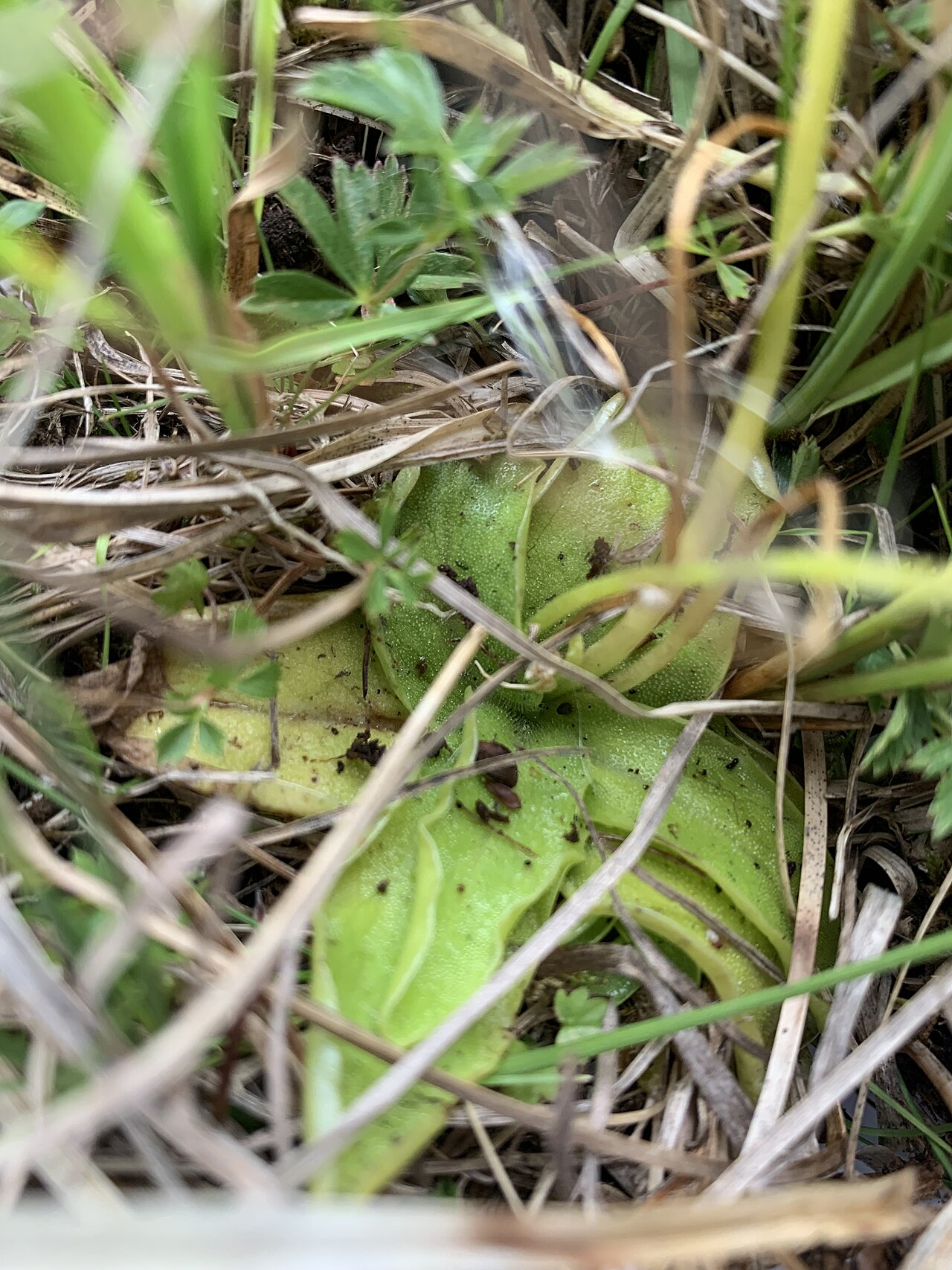
A rosette of yellow-green, oblong leaves with a dense glandular coat that glistens and feels greasy; the margin is curled upward and on a steep wall the leaves are held obliquely. Glabrous scapes rise from the centre, each with one two-lipped flower, with a two-lobed upper lip, a three-lobed lower lip with throat markings and a spur behind. Reliable measurements for plant, corolla and spur, and an exact flower colour, could not be traced to a checkable source for this guide and are therefore not given; the species was described in the 1990s and the original publication was not freely available while this account was compiled.
Similar species
There is no second butterwort in Morocco, so confusion with another species does not arise: a rosette of sticky, glistening leaves on a wet rock face in the Moroccan mountains is this plant. The comparison that matters is with the Iberian rock butterworts across the Strait of Gibraltar — species such as P. vallisneriifolia and the newly described Andalusian taxa — which occupy comparable dripping limestone and with which the Moroccan populations share a history predating the opening of the strait.
The trap and how it works
A flypaper trap in a climate hostile for much of the year. The leaf bears stalked glands with a sticky droplet and, between them, sessile glands that release digestive enzymes only once prey is lying on them. Midges, gnats and springtails from the humid air along a wet wall make up the catch. After a catch the leaf margin rolls slowly over it so the digestive fluid stands in a shallow dish instead of running away. In a setting where water constantly flushes the rock and soil is all but absent, that is the only source of nitrogen.
Habitat and ecology
Permanently wet limestone rock in the Moroccan mountains: dripping faces, spring mouths and the damp zone along mountain streams, in shaded north-facing sections of gorges. The surrounding landscape is Mediterranean to semi-desert, with long hot summers, and only where limestone takes in the winter's water and releases it gradually can such a wet wall persist year-round. The sites are therefore rare, small and far apart, and they serve as refugia for a whole suite of moisture-loving species.
Distribution and elevation
Morocco, where the species is an endemic of the mountains. The number of known sites is small. For this guide it was not possible to confirm from a freely available source which massif exactly is involved, and it seemed better to leave that open than to name something uncheckable; our own species list gives 'Morocco' and there we leave it. That this species is the genus's only representative in North Africa makes it biogeographically notable: it is the southern end of a group otherwise at home in Europe.
- Recorded (one-degree cells)
Forms and variation
No wild varieties are recognised. What makes the species interesting is not variation within the taxon but its position outside it: it is the African representative of a largely European group, and thus a pointer to how the range looked in cooler, wetter periods, when the humid habitats of southern Spain and northern Morocco formed a continuum. What remains of that connection is a few wet walls on either side of the Strait of Gibraltar, each with its own species.
Where and when to see it
Spring, while the winter's water still emerges from the walls; in summer the mountains are too dry. Search the shaded, north-facing parts of the gorges, at the springs and along the stream headwaters, watching for dark wet bands on the limestone. Look up and use binoculars rather than climbing. This is a vulnerable species with few sites: touch nothing, dig nothing up, and record any observation with a photograph and a coarse locality rather than a precise point.
Conservation status
The species is listed as Vulnerable. That fits what is known: a small number of sites in the Moroccan mountains, all tied to permanently wet limestone faces wholly dependent on the discharge of a single spring. The risks in this part of the world are easy to name: the capping of springs for drinking water and irrigation in a region of growing water scarcity, falling water tables in longer droughts, and grazing pressure and wood-cutting that reduce the shade and humidity of the gorges. CITES does not apply.
Scientific name
Pinguicula fontiqueriana | Romo, Peris & Stübing, 1996
Described by Angel Manuel Romo, Juan Bautista Peris and Gonzalo Stübing in 1996. The type area lies in Morocco, with sites including Jbel Tidighine and Jbel Lerz. The species name fontiqueriana honours the Spanish botanist Carlos Font Quer.
World Checklist of Vascular Plants (WCVP), via Plants of the World Online (POWO), Royal Botanic Gardens, Kew.