All species › Lamiales › Bladderwort family › Pinguicula cubensis
Pinguicula cubensis
The name suggests the Cuban butterwort, but Pinguicula cubensis is in fact one of the most site-bound: it was described in 2003 from the southern slope of the Sierra de Cajálbana in western Cuba, beside a waterfall, and is known from little more. Cajálbana is a serpentine massif — a plateau of ultramafic rock with its own strongly endemic flora — and that explains both the plant's rarity and the reason it can grow there at all.
Identification
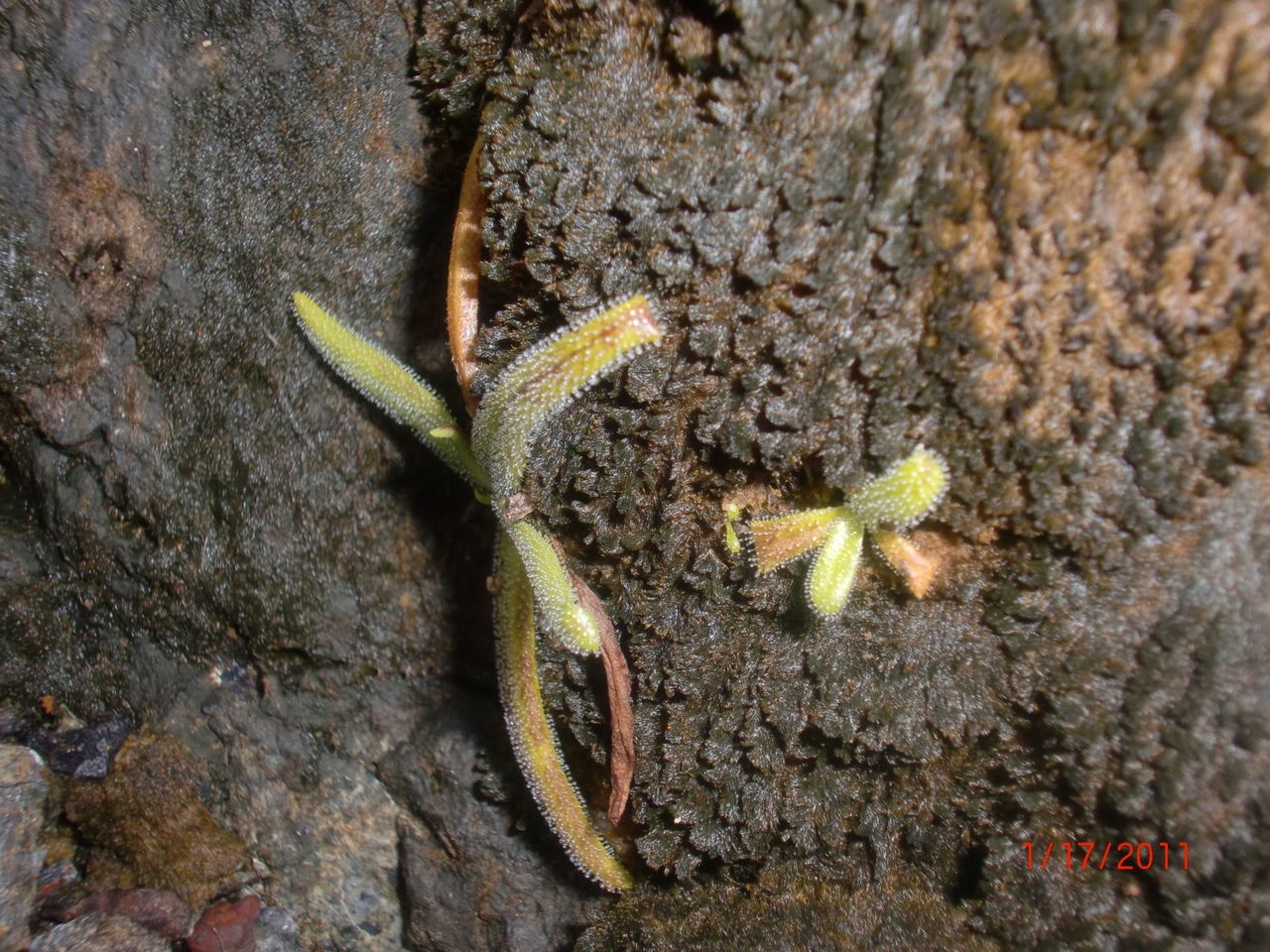
A flat rosette of entire, fleshy leaves lying against wet rock, set above with stalked glands that give the blade a moist sheen. From the centre rise slender, glandular-hairy scapes, each with a single two-lipped, spurred flower. The plant is small and hides easily in the mossy, dripping rock face. To be sure, look at the leaf surface: it looks wet and feels greasy, and that distinguishes it from the mosses and small ferns the rosette sits among. The rosette is usually no more than a few centimetres and consists of a handful of leaves overlapping like tiles. Around a flowering plant you often see the remains of earlier scapes, dried but still upright.
Similar species
In western Cuba there are few alternatives. Pinguicula albida and P. filifolia belong to the flat lowland sand savannas rather than wet rock faces, and the latter is in any case recognised at once by its thread-like leaves. P. lithophytica, also a rock dweller, grows on limestone in the mountains of central Cuba and does not overlap with Cajálbana. Anyone finding a butterwort at a waterfall on serpentine in Pinar del Río may therefore reasonably think of this species — but always document the find photographically.
The trap and how it works
The rosette is a classic flypaper trap. Stalked glands produce a sticky droplet; sessile glands secrete digestive enzymes once prey lies on them, after which the dissolved material is absorbed through the leaf skin. In a broad leaf the margin rolls slowly inward so the fluid pools in a shallow dish instead of running off the wet rock. At a waterfall the prey supply is excellent: clouds of small midges and flies hang permanently over running water, and they make up the bulk of the catch.
Habitat and ecology
The known habitat is a wet rock face beside a waterfall on ultramafic ground: rock permanently washed or sprayed by water, in half shade. Serpentine is poisonous terrain for most plants — much magnesium, nickel and chromium, little calcium, nitrogen and phosphorus — and it is exactly that combination of permanent wetness and extreme nutrient poverty in which carnivorous plants can hold on. Labelled material comes from a little over two hundred metres on the southern flank of the plateau. Serpentine massifs like Cajálbana are islands within the island: their flora is separate from that of the surrounding limestone and sand country, and species occurring there can establish nowhere else. That explains why a plant with such modest requirements nevertheless grows in only one place.
Distribution and elevation
Endemic to Cuba and restricted to Pinar del Río province in the west of the island, in La Palma municipality: the Sierra de Cajálbana and its immediate surroundings, including Las Vueltas. The Cajálbana serpentine plateau is one of the classic botanical hotspots of western Cuba, with dozens of species found nowhere else. For this butterwort that means a range of a few square kilometres, concentrated where surface water runs over rock.
- Recorded (one-degree cells)
Forms and variation
No wild subspecies or varieties are recognised. Variation in size follows mainly the water regime of the precise spot: on continuously sprayed rock the rosettes are fuller than on faces that dry out in the dry months. Because the species was only described in 2003 and few populations have been studied, the breadth of its variation is not yet well mapped — one more reason to document finds carefully.
Where and when to see it
Search where the water is: waterfalls, seeping rock faces and the wet edges of streams on the serpentine plateau, preferably on north and east aspects that dry out less. The best time is the rainy season and the months after it, when the faces are genuinely wet. Get low and look into the light; the glandular coat betrays the plant sooner than the flower does. The area is easily reached from La Palma, but much of the plateau is protected land — check access rules beforehand.
Conservation status
The species has not been assessed for the global IUCN Red List and is not listed in CITES. What is known: a western Cuban endemic with an extremely small range, tied to permanently wet rock on a serpentine massif that is botanically exceptional as a whole. The risks to such a species are easy to name — mining and quarrying on ultramafic rock, road building, reduced run-off in drier years, and the simple fact that a single event can hit much of the population. There is no international category because the species has not been assessed, not because there is nothing to worry about.
Scientific name
Pinguicula cubensis | Urquiola & Casper, 2003
Described by Siegfried Jost Casper and Armando Urquiola Cruz in 2003, in Willdenowia 33(1): 167–172. The type area lies in the Cajálbana region, not far from La Palma, in Pinar del Río Province in western Cuba, on wet limestone cliffs at 220 metres elevation. The species name cubensis refers to Cuba, where the species is endemic, close to the related P. albida.
World Checklist of Vascular Plants (WCVP), via Plants of the World Online (POWO), Royal Botanic Gardens, Kew.