All species › Lamiales › Bladderwort family › Pinguicula gypsicola
Pinguicula gypsicola
Of all the Mexican butterworts this may be the strangest: a plant with long, narrow, almost grass-like summer leaves growing on white gypsum in a cactus landscape. Pinguicula gypsicola was described in 1911 from material in San Luis Potosí and carries its habitat in its name. It is a species of heat, dew and a soil almost no competitor can tolerate.
Identification
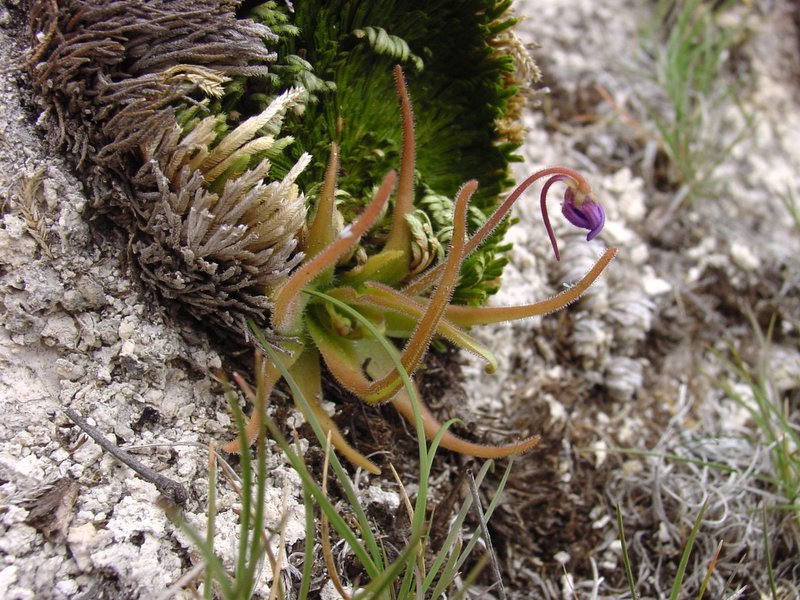
Summer and winter differ so much you would suspect two species. The winter rosette consists of short, thick, fleshy leaflets 4 to 10 mm long, overlapping like tiles and bearing few glands. The summer rosette makes long, linear to spathulate leaves 40 to 70 mm long and only 4 to 8 mm wide, held somewhat erect and rolled at the margin — a shape recalling a narrow-leaved aloe and unusual in the genus. Leaf colour runs from bright green to reddish. The scape reaches 7.5 to 12.5 cm and carries one flower 34 to 42 mm long including the spur. The flower is violet-purple with a paler throat; the spur is remarkably slender and, at 20 to 26 mm, longer than tube and lips together. Flowering coincides with the start of summer growth, roughly June to September.
Similar species
The long narrow summer leaves make the species virtually unmistakable in the field; no other butterwort of the dry Mexican highlands has such leaves. In the winter rosette matters are harder: it resembles that of P. ehlersiae and P. esseriana, which partly share the same gypsum banks. The flower then decides, since the very long thin spur of P. gypsicola is much shorter in those two. Hybrids with relatives have been reported from mixed sites and show leaves of intermediate width.
The trap and how it works
A flypaper trap on a narrow leaf, and that shapes how it catches. Where broad-leaved relatives roll the margin over the prey, in P. gypsicola it is mainly the channelled leaf half that curves inward, so the digestive fluid stands lengthwise. Stalked glands hold the insect, sessile glands deliver the enzymes as soon as the prey makes contact. In this landscape the catch is mostly small flies, midges, ants and springtails moving over the gypsum in the cool morning hours. Outside the rainy season catching all but stops, because the winter rosette carries almost no glands.
Habitat and ecology
Gypsum. The species grows on damp, usually shaded gypsum rocks and banks in a xerophytic landscape of cacti, agaves, Dasylirion and Hechtia (R1, R2, D4). Summers are very hot and rainfall slight and brief, but heavy dew falls at night, and it is that dew plus the seepage down the gypsum face that keeps the plants alive. In winter it can freeze and almost no rain falls; the plant then waits as a closed bud. Gypsum, with its high sulphate and low fertility, is unusable for most plants, and that is precisely the room this butterwort exploits.
Distribution and elevation
A Mexican endemic, known from a few areas in San Luis Potosí, among them Minas de San Rafael and Santa Gertrudis west of the city of San Luis Potosí. Our species list gives only 'Mexico'; the literature consistently treats it as an endemic of San Luis Potosí, and that is what we follow here. The range is small and fragmented, because it coincides with the distribution of the gypsum deposits themselves: where the gypsum ends, the species ends.
- Recorded (one-degree cells)
Forms and variation
Variation in the wild is slight and no varieties are recognised. What differs is mainly leaf colour — bright green on shaded walls, reddish in full sun — and the length of the summer leaves, which grow considerably longer in wet years. Natural hybrids have been described from sites where the species grows alongside other gypsum-dwelling butterworts; those plants have broader leaves and a spur of intermediate length, and in this guide they are placed with the parents. Cultivated forms are left out of account here.
Where and when to see it
July and August, shortly after the first heavy rains, is the best moment: the long summer leaves are then fully out and the flowers appear. Search the shaded side of gypsum banks and shallow hollows where the surface still feels damp, and follow the foot of small gypsum cliffs rather than the open slope. Among dry grass the narrow leaves look very much like a grass seedling; watch for the shine of the glands. Go early, while the dew is still down and the gypsum darkens where water sits.
Conservation status
Not assessed for the global IUCN Red List and not listed in CITES. What is known is that the species is tightly bound to gypsum and comes from a limited number of places in a single state. Gypsum is quarried in that area, and the combination of quarrying, road building and grazing is the obvious pressure; there are, however, no published counts on which a trend could rest. Collecting for the trade is named as an additional risk, although the species is common in cultivation. The absence of an assessment is a real gap here: a strongly soil-bound endemic with few sites is exactly the kind of case an assessment would suit.
Scientific name
Pinguicula gypsicola | Brandegee, 1911
Described by Townshend Stith Brandegee in 1911. The type area lies west of the city of San Luis Potosí, in the Mexican state of the same name. The species name gypsicola combines the Latin gypsum ("gypsum") and -cola ("dweller") and refers to the gypsum-rich soil this species grows on.
World Checklist of Vascular Plants (WCVP), via Plants of the World Online (POWO), Royal Botanic Gardens, Kew.