All species › Lamiales › Bladderwort family › Pinguicula infundibuliformis
Pinguicula infundibuliformis
The epithet tells you what to look at: infundibuliformis means funnel-shaped, and it refers to the build of the flower. The species was described in 2003 from material collected as long before as 1968 on the plateau at Mina Iberia, in the cloud forest behind Baracoa — a neat illustration of how the Cuban butterworts became scientific names: decades in the herbarium, and only then a name.
Identification
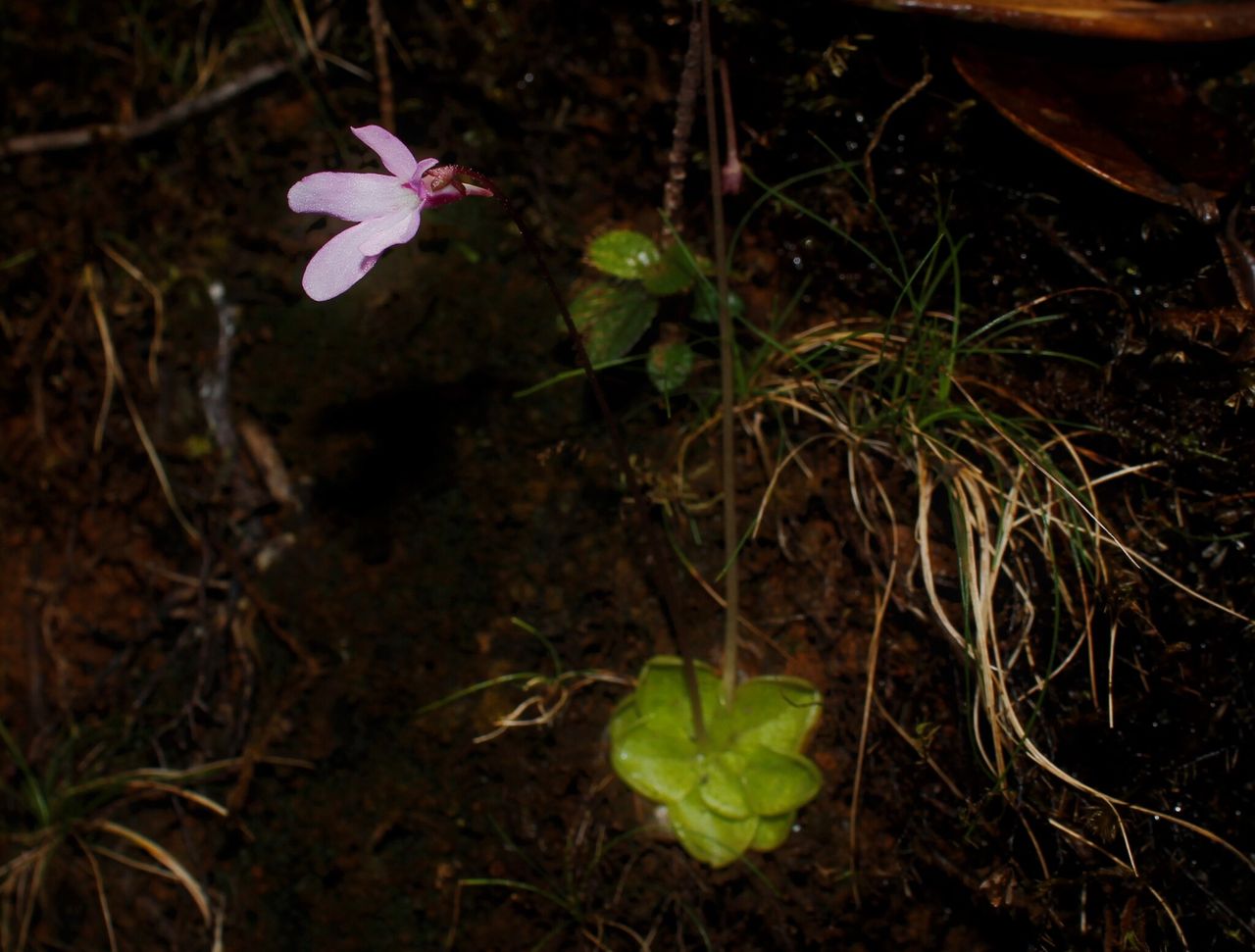
A flat rosette of entire, fleshy leaves lying against damp soil or rock, densely set above with stalked glands. From the centre rise slender, glandular-hairy scapes, each with a single flower. The distinguishing character is in that flower: the corolla widens from back to front like a funnel, the shape that earned the name in the original description. In the field, out of flower, the plant is a small glistening rosette that you find only by looking for it deliberately. As in all butterworts the leaf and the scape carry the same glands; with a hand lens you see the same glistening droplets on the stalk as on the blade. The fruits are small capsules of dust-fine seed.
Similar species
The same eastern hill country holds several closely related butterworts — among them Pinguicula jaraguana and P. moaensis — which cannot be told apart with certainty without flowers. The best field character is flower shape combined with situation: this species has been collected on the cool, misty plateau and along a river slightly lower down, while P. moaensis typically sits in the serpentine scrub along streams at lower elevations. When in doubt photograph the flower from the side so the shape of the corolla tube and spur is visible.
The trap and how it works
The leaf works as a flypaper trap with two gland types: stalked glands with a clear sticky droplet and sessile glands releasing digestive enzymes once prey lies on them. The leaf margin rolls slowly towards the prey so the digestive fluid pools in a shallow dish; afterwards the blade flattens again. In cloud forest the humidity is permanently high and the droplets almost never dry out, keeping the trap in service all year. The catch is mostly midges and other small two-winged insects of the damp forest understorey.
Habitat and ecology
The type locality is described on the label simply as monte nublado: cloud forest, at six to seven hundred metres on the plateau at Mina Iberia. To that is added a collection from the banks of the río Jiguaní near La Melba. So this means permanently damp places in a mountain forest that spends much of the year inside the clouds, on the poor, metal-rich soils of the Moa–Baracoa massif. In such a setting water is never the limiting factor, but mineral nutrition is — and that is exactly the gap carnivory fills.
Distribution and elevation
Endemic to Cuba and confined to the far east: Guantánamo province (the plateau at Mina Iberia, Baracoa municipality) and Holguín (the río Jiguaní near La Melba). That is an area of a few tens of square kilometres in the middle of one of the most endemic-rich landscapes in the Caribbean. Recent Cuban monitoring data confirm the species in both provinces, which means the historical sites are not merely museum history. That the type locality lies on the plateau and the second find along a river several hundred metres lower means the species need not be tied strictly to one altitudinal belt but to a condition: ground that stays wet all year.
- Recorded (one-degree cells)
Forms and variation
No wild subspecies or varieties are recognised. In a species known from so few places the breadth of variation has simply not been established; what differs on the labels is mainly elevation, with the type locality on the plateau and the paratype locality lower along the river. Whether that difference translates into morphology is a question for anyone who can set the two populations side by side. The species certainly stands close to the other small-flowered butterworts of eastern Cuba, and that group is taxonomically unsettled.
Where and when to see it
This is cloud-forest country: expect mud, steep slopes and days without a view. Search permanently wet spots — earth banks along trails, the foot of boulders, stream edges — and note mossy places where water keeps seeping. Look into the light so the glandular coat catches; from above the rosette reads as a tuft of moss. The area lies in and around protected land; a local guide and permission are not a formality here but a condition.
Conservation status
The species has not been assessed for the global IUCN Red List and is not listed in CITES. What is known: an eastern Cuban endemic recorded from two areas in the Moa–Baracoa massif, tied to permanently damp cloud forest and river banks. The threats in that region are not abstract: nickel extraction on the serpentine soils, logging and road building affect exactly the altitudinal belt in which the species was collected, and a drying climate lifts the cloud base the forest depends on. There is no international category; that is a gap in the file, not a conclusion.
Scientific name
Pinguicula infundibuliformis | Casper, 2003
Described by Siegfried Jost Casper in 2003. The type area lies on the Iberia plateau near Baracoa, in Guantánamo Province, eastern Cuba, at 600 to 700 metres elevation; the type material was collected in 1968 by J. Bisse and E. Köhler. The species name infundibuliformis combines the Latin infundibulum ("funnel") and -formis ("shaped") and refers to the funnel-shaped corolla.
World Checklist of Vascular Plants (WCVP), via Plants of the World Online (POWO), Royal Botanic Gardens, Kew.