All species › Lamiales › Bladderwort family › Pinguicula kondoi
Pinguicula kondoi
A butterwort of the dry highlands of northeastern Mexico, described in 1974 by Siegfried Casper and named after the Japanese botanist Katsuhiko Kondo. That name has caused confusion outside the literature — the species is regularly looked for in Japan, where it does not occur. Pinguicula kondoi belongs in the Sierra Madre Oriental, among the limestone rocks of Nuevo León, Tamaulipas and San Luis Potosí.
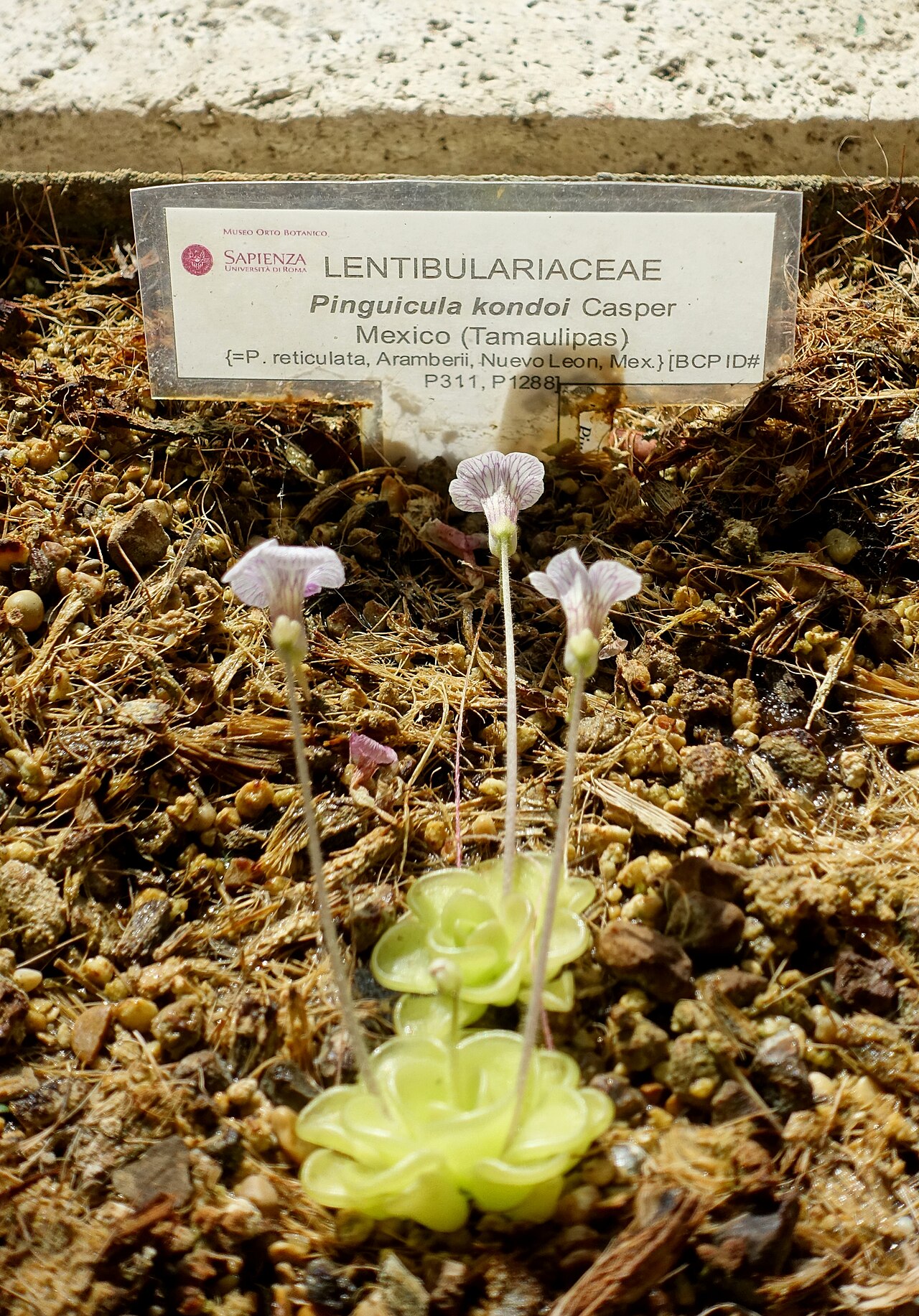
Identification
One of the Mexican butterworts with two leaf forms a year: in the wet season a rosette of flat, sticky summer leaves, and in the dry season a much smaller, compact rosette of thicker, almost succulent winter leaves with far fewer glands. That winter rosette is not a dormant bud as in the northern species but a working, drought-resistant form. The flower is two-lipped with a spur, as in all butterworts. Because the original description appeared in a specialist journal and reliable field material is scarce, no measurements have been entered in this guide — the figures in circulation come almost entirely from cultivation, not from the wild.
Similar species
Northeastern Mexico is the richest butterwort region in the world, and identification is hardest precisely there: the Sierra Madre Oriental holds dozens of closely related species, often on limestone and often with the same two leaf forms. Species such as Pinguicula gracilis, P. ehlersiae, P. esseriana and P. gypsicola look much alike in rosette and in practice can only be separated in flower and with the original descriptions at hand. For the field-guide reader the honest rule is: record the place, the substrate and the flower, and leave the name to those who can compare the material.
The trap and how it works
A flypaper trap adapted to a climate with a sharp wet and dry season. In the wet season the summer leaves are large, flat and densely glandular; they catch the gnats and small flies that hang in clouds above wet limestone after the rains. As soon as it turns dry the whole rosette is replaced by small, fleshy leaves with few glands, which mainly hold water and hardly catch at all. The plant therefore switches between two modes: a catching season and a surviving season. On bare limestone, with next to no soil, that catch in the wet season is the main source of nitrogen and phosphorus.
Habitat and ecology
Limestone rock and steep mossy walls in the highlands of northeastern Mexico (R2), in places where in the wet season water runs over the rock or seeps from crevices (R1). The plants sit directly on the stone with little or no soil, often in the shade of an overhang or in the shelter of a gorge. The climate is semi-arid with a pronounced summer rainy season; winter is dry and cool. The surrounding vegetation is low and open — succulents, ferns and mosses that tolerate the same alternation.
Distribution and elevation
Endemic to Mexico and confined to the states of Nuevo León, Tamaulipas and San Luis Potosí, in the northern Sierra Madre Oriental. Our own species list names Japan, which rests on the name and not on the distribution: the major reference works place the species unambiguously in northeastern Mexico. Within that area the distribution is fragmented, as for almost all Mexican butterworts: every limestone ridge and gorge is an island, and many species in this region are known from only a few mountains.
- Recorded (one-degree cells)
Forms and variation
No wild varieties are recognised. The most striking change of form is seasonal and applies to the whole species: the switch from flat summer leaves to small fleshy winter leaves. Anyone seeing a plant in the dry season sees something quite different from one found after the rains, and among Mexican butterworts that has repeatedly led to unnecessary species names. In cultivation numerous selections and crosses of this species circulate, but those have no place in a field guide. Natural hybrids in the wild have not been reliably described.
Where and when to see it
Search in the wet season, because in the dry months the plant has drawn back into an inconspicuous bud. The best places are shaded limestone walls in gorges and at the foot of scarps, where moss grows and water comes out of a crevice. Look at eye level and below, and watch for the sticky sheen on the stone. Photograph rosette, flower and substrate; in this region that is the only way to arrive at a name afterwards. Leave plants where they are — Mexican butterworts are heavily targeted by collectors.
Conservation status
The species has not been assessed for the global IUCN Red List and is not in CITES, so there is no international category. What is known of the species is thin: a handful of sites in three states, with no counts and no documented trend. The general pressure on butterworts in this region is well described, however, and undoubtedly applies here too: the loss of water-bearing crevices through groundwater abstraction, clearance and burning of the surrounding vegetation, quarrying in the limestone ridges, and illegal collecting for the plant trade, for which the Mexican butterworts are especially attractive. The absence of an assessment does not mean the absence of risk.
Scientific name
Pinguicula kondoi | Casper, 1974
Described by Siegfried Jost Casper in 1974, in Feddes Repertorium 85: 1, based on a specimen collected in 1971 by Seiichi Osada. Pinguicula reticulata, described in 1991 by Jan Schlauer, is considered a synonym of this species. The holotype was found in the eastern Sierra Madre, in the Mexican state of Tamaulipas, on a wet cliff at the roadside. The species epithet honours the Japanese botanist Katsuhiko Kondo.
World Checklist of Vascular Plants (WCVP), via Plants of the World Online (POWO), Royal Botanic Gardens, Kew.