All species › Lamiales › Bladderwort family › Pinguicula pumila
Pinguicula pumila
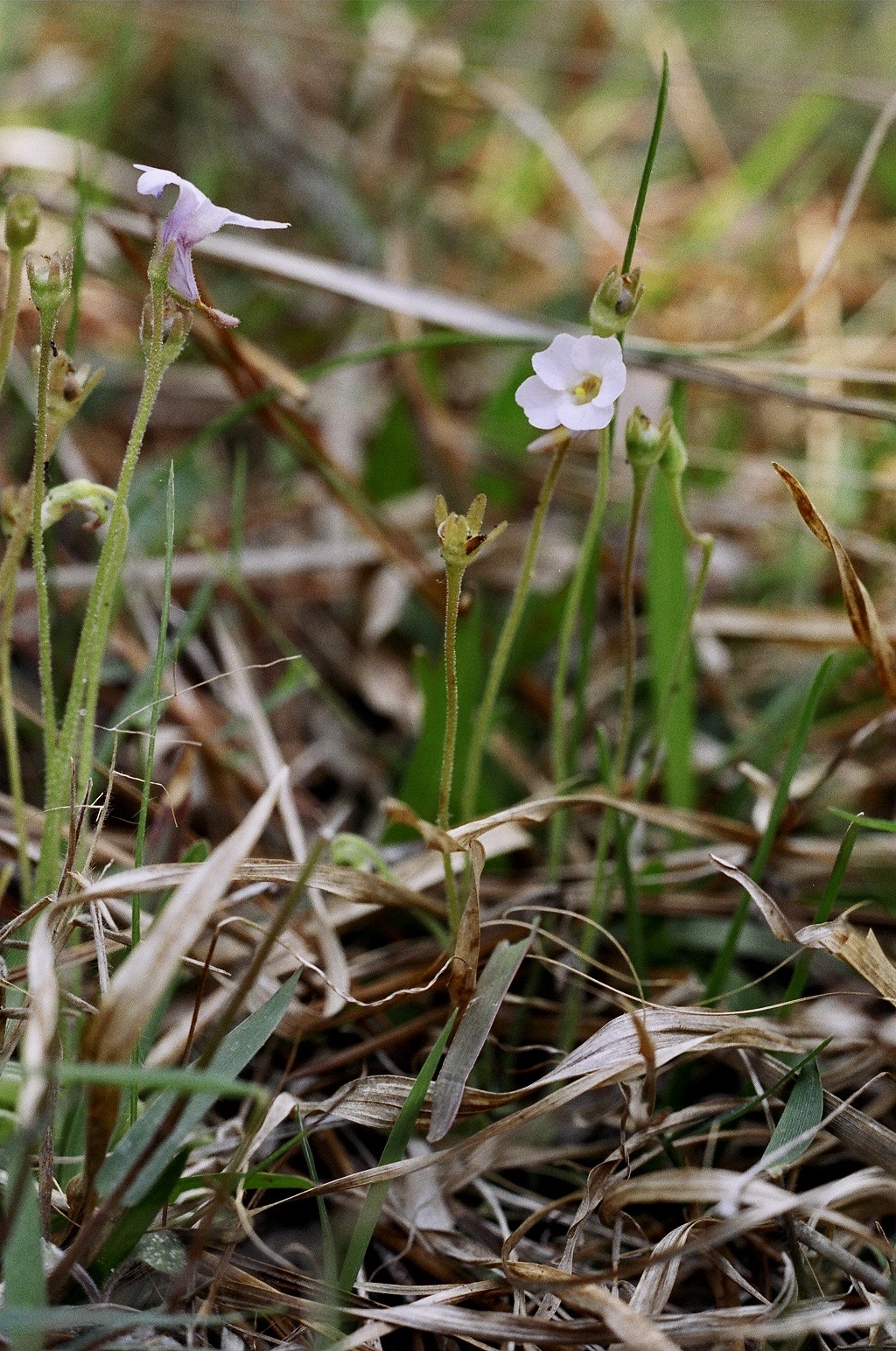
The smallest butterwort in North America is also the easiest to miss: a rosette of two to three centimetres, the size of a thumbnail, with a thin stalk above it and a flower barely a centimetre across. Pinguicula pumila makes up for that with numbers and with colour — in a single population white and violet flowers may stand side by side, and sometimes even on the same plant.


Identification
A miniature rosette about two to three centimetres across, with sticky, pale green leaves lying flat on muddy or sandy ground. The scapes are seven to twelve centimetres tall and each carries one flower whose spreading lobes together span about a centimetre. The throat is yellow with a hairy ridge and reddish nectar guides, and a spur sits behind. Flower colour varies widely: white and violet occur together, a bright yellow form is rare, and some white flowers turn violet during their life. Each flower opens around ten or eleven in the morning and closes in late afternoon.
Similar species
All the other butterworts of the south-eastern United States are considerably larger, so size alone usually settles it. Where this species grows with Pinguicula caerulea or P. lutea the difference is immediate: those have rosettes of five to fifteen centimetres and flowers several centimetres across. The greater risk is confusion with the small sundew Drosera capillaris, often growing right beside it, but that has stalked traps with long red tentacles instead of an evenly sticky leaf.
The trap and how it works
The trap works as in all butterworts, but at miniature scale: stalked glands with a sticky droplet and sessile glands releasing digestive enzymes once prey lies on them. With a trapping surface of at most a couple of square centimetres the species depends on the very smallest insects, and the rosette must take them in quickly — the plant usually lives only a single season. Pollination is a separate matter: the species is self-compatible but hardly self-pollinates spontaneously, so open pollination determines seed set.
Habitat and ecology
Sunny to lightly shaded muddy, sandy or marly places that flood in the wet season and dry out later. A striking feature is its preference for lightly disturbed ground: open pine woods, ditches, shores, roadsides and powerline corridors. Constant companions are the small sundew Drosera capillaris and the bladderwort Utricularia subulata; locally larger butterworts join them. The combination of annual flooding and summer drought keeps competition short, giving this small plant exactly the room it needs. The marly, lime-bearing spots this species tolerates are exceptional within a company of acid-loving carnivorous plants; it explains why it reaches further south than the other coastal-plain butterworts and also persists on the limestone soils of the Bahamas.
Distribution and elevation
From the Bahamas to Texas, centred on Florida, where it occurs almost throughout; in addition there are populations in South Carolina and along the Gulf coast into Texas. Records reach Palm Beach County in southern Florida. It is thus the most widespread of the south-eastern American butterworts and the only one also found in the Bahamas — which is why this guide does not count it as endemic to a single area.
- Recorded (quarter-degree cells)
Forms and variation
No wild subspecies are recognised, but colour variation is considerable. White and violet flowers occur together, often at the same site and sometimes on the same rosette; a bright yellow form has in the past been distinguished as var. buswellii and appears to be largely restricted to the southern Florida peninsula. Vegetative increase has not been detected in this species: all reproduction runs through dust-fine seed dispersed by wind, water and animals.
Where and when to see it
Get low and search in winter: that is when the species flowers and the only period when those tiny flowers stand out from half a metre. Roadsides, ditch edges, open sandy patches and the margins of temporary pools are the most promising places. Plan the visit for the middle of the day — the flowers only open towards the end of the morning and close again in late afternoon. Expect a short life: a rosette seen in March is usually gone by summer.
Conservation status
The species has not been assessed for the global IUCN Red List and is not listed in CITES. What is known gives a relatively reassuring picture: the range is large, the species is widespread in Florida, and it likes lightly disturbed ground such as ditches and roadsides, so it depends less on pristine savanna than most of its relatives. Against that, it dies off almost annually and so depends entirely on seed set and pollinators, and its sites — seasonally wet, open sandy ground — are the first to go under drainage and development. Anyone wanting to help the species does so most effectively by arguing for the retention of seasonally wet hollows and for restrained roadside mowing during the flowering season.
Scientific name
Pinguicula pumila | Michaux, 1803
Described by André Michaux in 1803, in Flora Boreali-Americana 1: 11. The species occurs in the southeastern United States, including Florida. The name "pumila" is Latin for "dwarf, small" and refers to this species' small size — one of the smallest in the genus.
World Checklist of Vascular Plants (WCVP), via Plants of the World Online (POWO), Royal Botanic Gardens, Kew.