All species › Lamiales › Bladderwort family › Pinguicula rotundiflora
Pinguicula rotundiflora
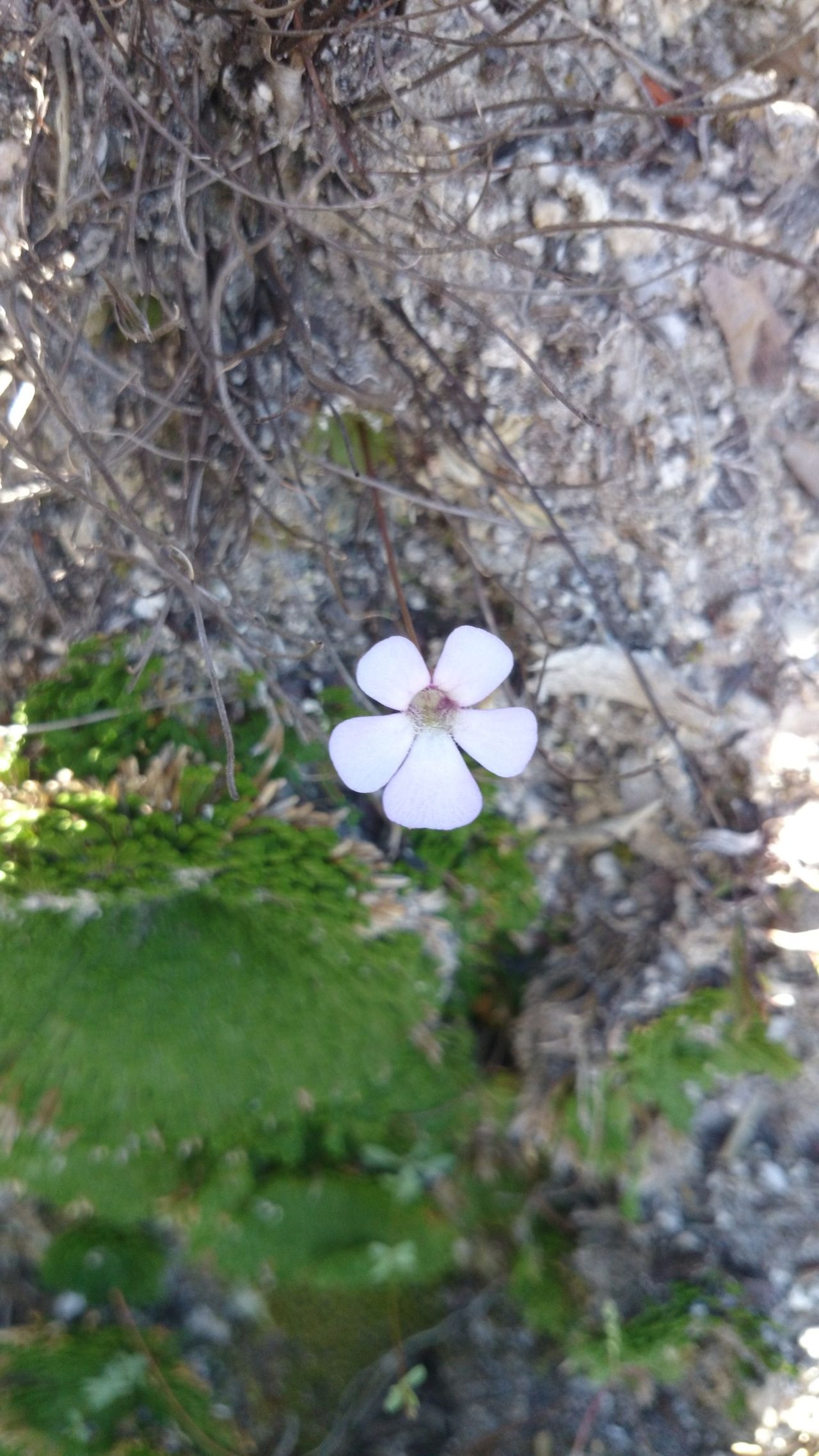
The name refers to the flower: the corolla lobes are so broad and so round that the bloom looks almost circular, unusual within the genus. Pinguicula rotundiflora was described in 1985 and grows in north-eastern Mexico, where it is found both on limestone in cool mountain forest and on gypsum in dry scrub — an unusually wide choice of site for so small a plant.
Identification
A small flat rosette of thick spathulate leaflets. In the dry season the rosette is compact and fleshy with few glands; in the growing season it becomes flatter and broader and takes on a thin glandular coating. The flowers come from the winter rosette, on slender scapes standing well above it. The flower is pale lilac to pink, with a white or yellowish throat, and has broad, rounded, overlapping lobes; that makes it look circular rather than two-lipped, and gives the species its name. The spur is slender and projects clearly behind the flower. The species readily makes new rosettes from detached leaflets.
Similar species
The original description compares the species with Pinguicula parvifolia, with which it shares the small size and pale flower; that one, however, comes from western Mexico and has narrower corolla lobes. In the north-east confusion is possible with P. immaculata, which grows on the same gypsum slopes near Rayones and Galeana but has a white flower with a yellow-green throat mark. The small gypsum dwellers of San Luis Potosí are also similar, but their range lies further south. The broad round corolla lobes remain the best character.
The trap and how it works
A flypaper trap on a small flat leaf, active mainly in the growing season. The stalked glands carry a sticky droplet; the sessile glands between them release enzymes once prey makes contact, after which the margin bends slightly inward to hold the fluid. On the compact fleshy winter rosette catching all but stops — those leaves are a water store for the dry months. Given the plant's size, prey consists mainly of springtails, midges, small flies and ants. Because the species flowers in winter and grows in summer, the catching season does not run parallel with flowering: the plant first invests in flowers from stored reserves and only afterwards earns that back with the summer rosette. That rhythm occurs in several small Mexican butterworts and suits a site where the summer rains are short and unpredictable.
Habitat and ecology
Two very different environments. At the higher sites, around two thousand metres and above, the species grows on limestone in cool mountain forest with Liquidambar styraciflua, pine and beech (B5, R2). Lower, around thirteen hundred metres, it grows on gypsum soils in dry xerophytic scrub (D4, R2). The common factor is a shallow, lime- or sulphate-rich soil with little competition where water drains quickly; the plants sit on shallow ledges, in grit and in the lee of boulders and shrubs. That one species can stand both in cool mountain forest at two thousand metres and in dry scrub seven hundred metres lower is exceptional within this genus; most Mexican butterworts are tied to a far narrower belt of elevation and climate. Probably the soil matters more here than the climate.
Distribution and elevation
Endemic to Mexico, with sites in Tamaulipas — among them Minas de Asbesto and the Jaumave area — and in Nuevo León, in the Rayones–Galeana region and near Aramberri. Our species list gives Chiapas; that does not match the published sites, which all lie in north-eastern Mexico, hundreds of kilometres further north. We follow Tamaulipas and Nuevo León here. The range is small and fragmented over separate limestone and gypsum areas in the Sierra Madre Oriental.
- Recorded (one-degree cells)
Forms and variation
No wild varieties are distinguished, but plants from the two habitat types differ noticeably: those from the cool limestone forests are somewhat larger and greener, those from the low gypsum slopes smaller and more strongly flushed red. Whether that is heritable or merely a response to light and drought has not been investigated. Flower colour runs from nearly white to distinctly pink. Where the species grows on the same gypsum slope as other small butterworts, intermediates should be treated as possible natural hybrids.
Where and when to see it
Flowering falls in winter and early spring, which is also the pleasantest season for walking in this part of Mexico. Search north-facing slopes, the foot of limestone or gypsum banks and the edge under shrubs, where grit and moss gather. The flower is larger than the plant beneath it and gives it away quickest. Sit down and work a small area systematically; anyone staying upright walks over a colony without seeing a thing.
Conservation status
Not assessed for the global IUCN Red List and not listed in CITES. It is known that the species comes from a limited number of areas in two states and is bound there to unusual soils. Pressure differs by site: in the mountain forest it is logging and grazing, on the gypsum slopes quarrying, road building and trampling. There are no published population figures, and the species is so easily overlooked in the field that the known distribution is probably incomplete. An assessment here would above all need targeted fieldwork.
Scientific name
Pinguicula rotundiflora | Studnicka, 1985
Described by Jiří Studnička in 1985, in Folia Geobotanica et Phytotaxonomica 20(2): 201–204, as related to Pinguicula parvifolia. The species occurs in southern Mexico; the precise type locality could not be established with certainty. The name "rotundiflora" is Latin for "round-flowered" and likely refers to the shape of the corolla.
World Checklist of Vascular Plants (WCVP), via Plants of the World Online (POWO), Royal Botanic Gardens, Kew.