All species › Lamiales › Bladderwort family › Pinguicula spathulata
Pinguicula spathulata
The most brightly marked flower of all the northern butterworts. Pinguicula spathulata — known in older literature as P. variegata — has a flower that is white, yellow and blue at once, with violet stripes pointing into the throat. The plant is barely larger than a thumbnail and grows in the tundra and high mountains of Siberia and the Russian Far East, as far as Kamchatka, Sakhalin and the Kuriles.

Identification
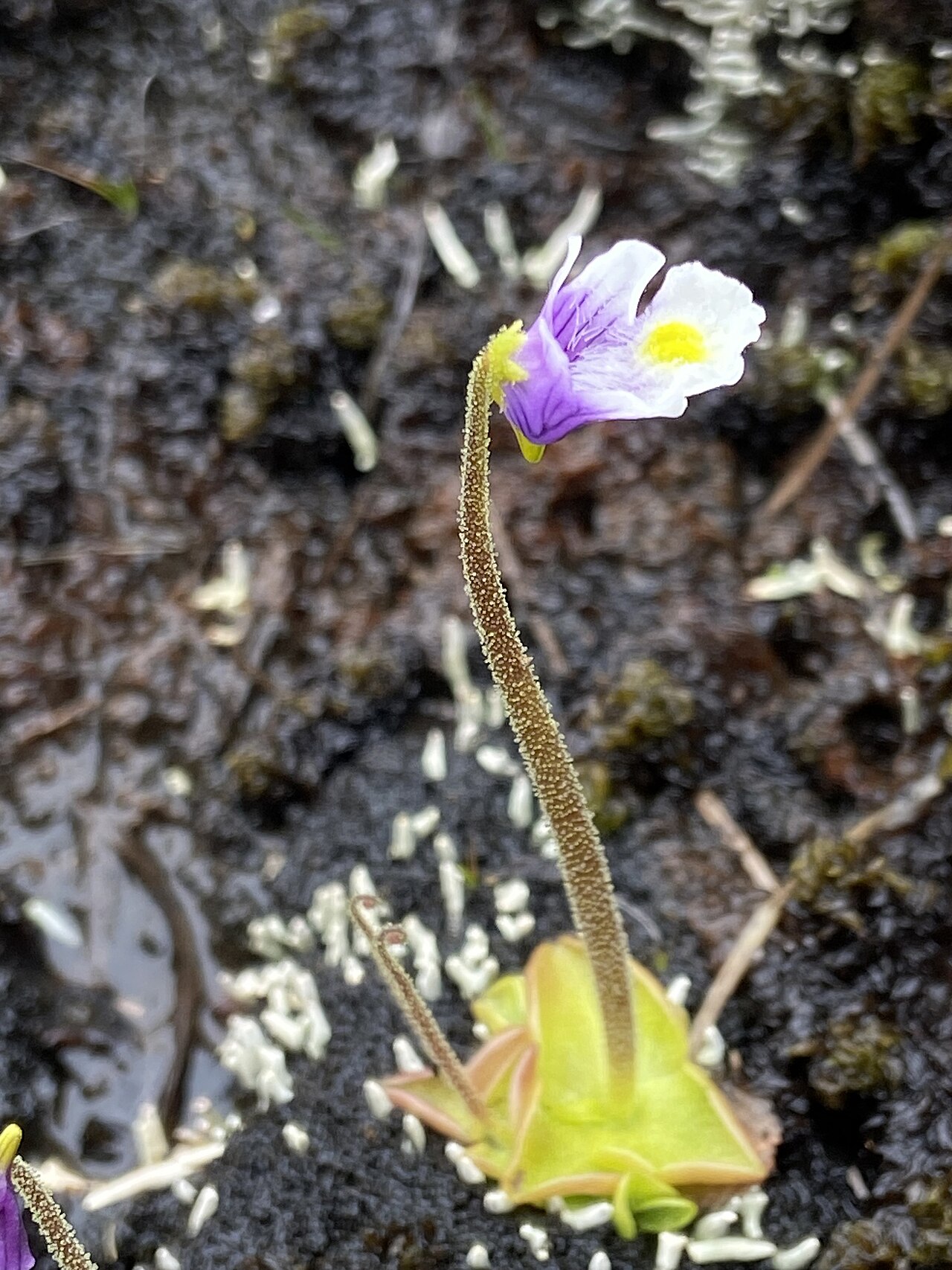
A small rosette of spathulate leaves six to nine millimetres long and five to seven wide, with a fringed margin — a character obvious at once under a lens and one that separates the species from its nearest relatives. Including the spur the flower is eight to twelve millimetres, similar in shape to that of Pinguicula alpina but smaller, and conspicuously three-coloured: white with yellow in the throat and blue on the lips, with violet stripes as a nectar guide. The spur is short and conical, two to four millimetres, clearly shorter than the rest of the flower. Flowering is June and July. The plant overwinters as a winter bud and forms numerous small brood buds around it, so that colonies quickly become dense.
Similar species
Pinguicula alpina has a similarly shaped but larger, pure white flower with yellow blotches and yellow-green leaves without a fringe. P. villosa, which grows in bog moss in the same country, has a pale lilac flower on a distinctly hairy scape. P. algida is the third small northern species here and the hardest to separate; the three-coloured flower of P. spathulata is then the most usable character. Out of flower the fringed leaf margin helps. Anyone meeting a name in older Russian literature should be aware that P. variegata and P. sibirica both refer to this species.
The trap and how it works
A flypaper trap for a season of ten weeks at most. The leaf carries stalked glands with a sticky droplet and sessile glands that release digestive enzymes as soon as prey is lying there; the margin then rolls slowly over the catch. The fringed leaf margin is not decoration but function here: the long marginal hairs catch dew and mist and keep the droplets moist in a climate that in the short summer can be surprisingly dry and windy. The prey consists of mosquitoes, midges and springtails, which in the Siberian summer hang in enormous density above the wet tundra.
Habitat and ecology
Sphagnum peat and wet tundra (W1), open mossy slopes above the treeline (R5), and more base-rich sedge mires and flushes (W2). In the mountains west of Lake Baikal the species sits between fourteen hundred and twenty-two hundred metres; in the northern coastal region the habitat descends to sea level, where tundra takes over the role of the high mountains. The substrate is cold, acid to weakly base-rich and permanently wet through the growing season. Competition from taller plants is absent, because the climate does not permit it.
Distribution and elevation
Southern and eastern Siberia into the Russian Far East, with records from Buryatia, Chita, Amur, Yakutia, Khabarovsk, Magadan, Kamchatka, Sakhalin and the Kuriles. The range therefore lies almost entirely within Russia, but across an enormous area. Our own species list also names Norway; that is not borne out by the standard reference works — the western end of the range is in Siberia, and in Fennoscandia it is P. alpina and P. villosa that play the northern part.
- Recorded (quarter-degree cells)
Forms and variation
No wild varieties are recognised, although the intensity of the three flower colours is quite variable: some plants are mainly white with only a yellow throat patch, others show clear blue on the lips. That is variation within populations and not a geographical pattern. More important is the history of names: P. variegata and P. sibirica were described as separate species and later merged with this one, so that older distribution data lie scattered under three names. No natural hybrids have been described.
Where and when to see it
Go in June or July, soon after snowmelt, and search two kinds of place: the wet mossy slopes above the treeline, and the edges of tundra mires and spring-fed rills. The rosette is small and vanishes into the moss, but the three-coloured flower is unusually conspicuous for a butterwort and gives away whole colonies at once — through its brood buds the species often forms dense patches. Use a lens for the fringed leaf margin. And keep the site intact: wet tundra soil recovers extremely slowly from footprints.
Conservation status
The species has not been assessed for the global IUCN Red List and is not in CITES, so there is no international category. What is known gives no cause for concern at the level of the species: the range covers much of northeastern Asia, mostly in thinly settled country. The uncertainty lies elsewhere. Many sites sit on ground underlain by permafrost, and that ground is changing: where permafrost thaws, the impermeable layer that keeps meltwater at the surface disappears and the habitat dries out. On top of that the distribution has been written up under three historical names, which makes a reliable picture harder to assemble — an assessment would have to work through that first.
Scientific name
Pinguicula spathulata | Ledebour, 1812
Described by Carl Friedrich von Ledebour in 1812. The species occurs in the Caucasus. The name "spathulata" is Latin for "spatula-shaped" and refers to the shape of the leaves.
World Checklist of Vascular Plants (WCVP), via Plants of the World Online (POWO), Royal Botanic Gardens, Kew.