All species › Falcons › Falcons › American kestrel
American kestrel | Falco sparverius
Amerikaanse torenvalk | Cernícalo americano
The smallest and most numerous falcon of North America, where it sits on a wire along almost every country road. In Europe it is an extremely rare vagrant, and every sighting raises the same question first: did this bird cross the ocean under its own power, or did it escape from an aviary?

Voice
At the nest and in excitement a shrill, rapidly repeated klee-klee-klee, higher and sharper than a Common Kestrel's call. There is also a drawn-out plaintive whee-er and a soft chittering between the pair. A European vagrant is normally silent, so do not count on sound.
Recording: Jonathon Jongsma — CC BY-SA 4.0 · Wikimedia Commons
Identification
A small, short-winged falcon, clearly smaller than a Common Kestrel and shorter-tailed. Both sexes show a pale cheek with two crisp black stripes — a moustache and a second bar behind the ear — and two black spots on the nape that read as false eyes. The male has a blue-grey crown and a blue-grey wing panel above a rufous, black-spotted back, and a rufous tail with a single broad black band. The female is rufous-brown, barred across wing, back and tail, and streaked below.
Confusion species
Common Kestrel is the only serious confusion, and the difference starts with size. The American bird is much smaller and more compact, shorter-tailed, with faster and jerkier beats, and it hovers more briefly and lower. The head settles it: two crisp black stripes on a pale cheek against the single broad, soft moustache of a Common Kestrel. On the male add the blue-grey wing panel above the rufous back, whereas a male Common Kestrel is blue-grey on head and tail and keeps a brown wing. Lesser Kestrel: also small and, in the male, blue-grey panelled, but with no cheek stripes, an unspotted back, and almost always in company over southern European towns. Merlin: darker and stockier, without cheek stripes, and it does not hover.
Habitat
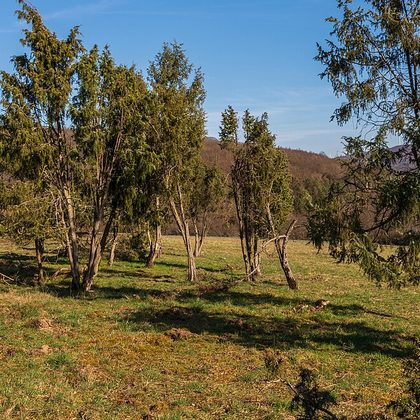
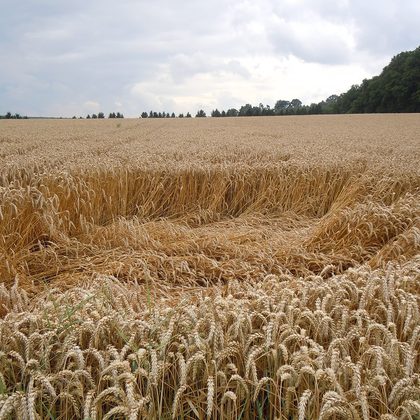
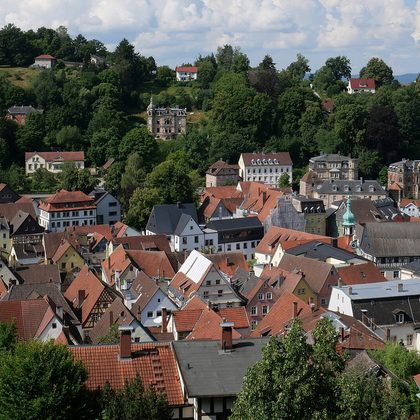
In its own range, open and semi-open country: prairie, rough pasture, arable land, desert edge and young clear-fell, and also town edges, verges and car parks. It hunts grasshoppers, mice and small birds from wires, posts and dead branches, with brief hovers over rough strips. It nests in cavities: old woodpecker holes, rock crevices, building niches and nestboxes.
Where the bird is most at home, classified with EUNIS — the European standard for habitats.


Range and movements
Breeds from Alaska and Canada to Tierra del Fuego; only the northern birds migrate, and those are the only serious candidates for a crossing. In Europe it is a genuine vagrant, with no breeding, wintering or passage. Britain holds two accepted records, both from 1976: a male on Fair Isle in late May and a female on Bodmin Moor, Cornwall, in June. On the mainland almost nothing has been accepted: the Netherlands has three ringed birds that go back to escapes from captivity (2009, 2010 and 2013) and an unringed bird that flew past Texel in May 2014, and the species is absent from the Spanish list.
Where and when to look
The odds are slim, but if you want to find one, work a western island watchpoint in late spring or late summer and look hard at every small falcon on a wire. Always photograph the legs: a bare tarsus with no leather straps or ring marks is the first thing a records committee wants to see. Note too any wear on the tail tip and wingtips and any missing flight feathers, which point to an aviary bird.
Conservation status
Not globally threatened (IUCN: Least Concern), with an estimated nine million mature birds, but numbers in North America have been drifting slowly downward for decades. Loss of open ground, the tidying away of dead trees with nest cavities, the decline of large insects and pesticide use are all cited; nestbox schemes offset this locally. In a European context this is not a conservation question but a matter of a handful of records and whether they were wild.