All species › Parrots › Parrots › Monk parakeet
Monk parakeet | Myiopsitta monachus
Monniksparkiet | Cotorra argentina
The Monk Parakeet is the only parrot in the world that builds its own nest out of sticks. Where every other parakeet looks for a cavity, this species weaves a structure of dry twigs that stays occupied the whole year round — often a communal pile in which several pairs each hold their own chamber with its own entrance. In Europe the stronghold is Spain, where the bird is part of the everyday street scene in the parks of Madrid, Barcelona and Málaga.

Voice
A loud, harsh, slightly yapping quak-quak-quarr, often with a rising chape-yee thrown in; lower, hoarser and more irregular than the shrill screech of the Rose-ringed Parakeet. At a colony it carries all day: bickering, chattering and grating notes at once, some of them from inside the nest, where birds sit talking in the dark. Heard year round, loudest in the early morning and in the last hour before dusk.
No freely licensed recording is available for this species yet.
Identification
Stocky, comparatively short-tailed parakeet, a little larger than a Blackbird but more heavily built. Forehead, cheeks and throat are pale grey; the breast is grey with fine scalloping, each feather carrying a paler fringe. That grey hood and scalloped breast together clinch it. Upperparts, wing coverts and tail are bright grass-green, the belly yellow-green, the flight feathers deep blue. The bill is orange-brown to horn-coloured, never red. In flight the blue of the remiges shows against the green bend of the wing, and the silhouette is shorter and blunter than that of the other parakeets in Europe: fast, shallow beats, but with a tail that trails as a wedge rather than as a long pennant. Male and female look alike; young birds have a greenish wash across the forehead.
Confusion species
The Rose-ringed Parakeet flies in the same city parks and is the species it is most often taken for — though only at range or against the sky. That bird is slimmer and a brighter grass-green, has a red bill and a far longer, sharper tail, and shows no grey at all on head or breast. The Alexandrine Parakeet is bulkier still and longer-tailed, with a heavy blood-red bill and a maroon shoulder patch. Both nest in tree cavities. Only the Monk Parakeet builds a stick nest, and in practice that structure is the quickest mark of all: a dark, untidy ball of twigs in a palm, cedar or plane, or lodged in the steelwork of a floodlight or a pylon, where the other two leave nothing but a round hole in a trunk.
Habitat
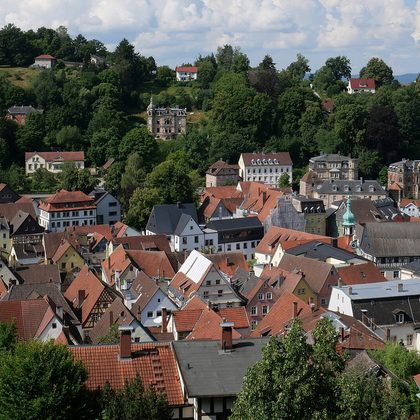
Almost entirely tied to built-up land: city parks with tall free-standing trees, wide avenues, gardens, playing fields, botanical gardens and the green edges of housing. The nest sits high in a palm, cedar, plane or eucalyptus, and just as readily in the steelwork of a floodlight mast or an electricity pylon. Feeds a great deal on the ground, short-legged and waddling, on mown lawns and short grass, and otherwise in flowering and fruiting trees; in the surrounding arable land, orchards and allotments it goes for seed, grain and ripening fruit. Stays near the colony all year.
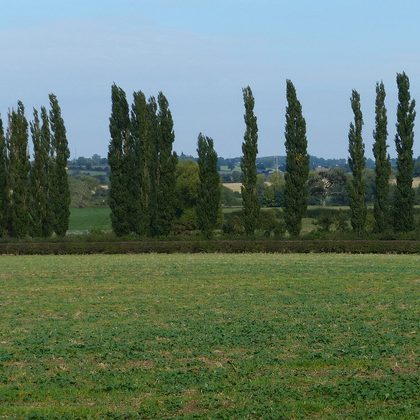
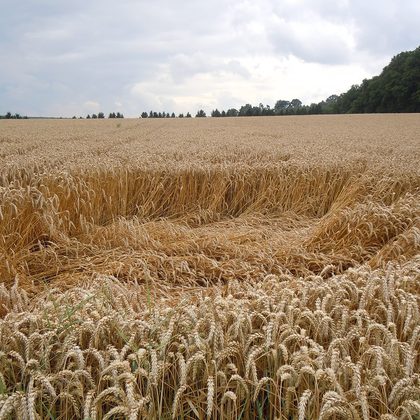
Where the bird is most at home, classified with EUNIS — the European standard for habitats.

Range and movements
The natural range lies in South America: Bolivia, Paraguay, Uruguay, Argentina and southern Brazil, in open country with scattered trees. The European population goes back to cage birds that escaped or were released from the 1970s onward. Spain holds by far the most: a national count put the total at around 20,000 birds in 2015, spread over more than a hundred and forty municipalities, with well over four fifths of them in Barcelona, Madrid and Málaga. There are further colonies in Italy (Rome, Genoa, Milan, Cagliari), Portugal, Brussels, Athens and several French and English cities. The Netherlands has only two, at Apeldoorn and on Goeree, together holding 39–55 birds.
- Resident
- Winter
- Passage
- dark = core range, pale = thinly spread
Where and when to look
Look for the nest, not the bird. A Monk Parakeet colony gives itself away from a hundred metres as one or more dark balls of twigs high in a crown or against a mast, and there are almost always birds attending. In Madrid try the Parque del Oeste and the Casa de Campo, in Zaragoza the Parque del Tío Jorge, in Barcelona the Parc de la Ciutadella and in Málaga the Parque de Málaga. In the Netherlands the address is the Mheenpark in Apeldoorn. Stand quietly under the nest and look up: the birds keep adding fresh twigs and clamber about on the outside, which is where you get the scalloped breast at close range.
Conservation status
Not globally threatened (IUCN: Least Concern); across South America it is locally numerous enough to count as an agricultural pest. In Europe it is an introduction founded on cage birds that escaped or were released. It is not on the EU list of invasive alien species of Union concern, but it is on the Spanish Catálogo español de especies exóticas invasoras (Royal Decree 630/2013): keeping, transporting and trading the bird are prohibited there, and the authorities are obliged to reduce its numbers. The documented damage is of two kinds: feeding on fruit and crops, and nests built on electricity infrastructure, which cause faults and a fire risk; noise at the colonies and competition for food with native birds are added to that. How the species should be handled is contested in Spain: Madrid has reported more than seventeen thousand birds trapped, where the city census of 2019 arrived at thirteen thousand, and SEO/BirdLife and Ecologistas en Acción question both those figures and the value of the method, since parakeets quickly learn to avoid the traps. In the Netherlands the population is small and confined to two places; trapping still works at those numbers, which is why action is being urged before the species spreads further.