All species › Passerines › Leaf warblers › Arctic warbler
Arctic warbler | Phylloscopus borealis
Noordse boszanger | Mosquitero boreal
The Arctic Warbler is the only member of the Siberian leaf warbler group that also breeds inside Europe: in the birch woods of Lapland it rattles out its dry, insect-like song. Less than two months later it is on its way to the Philippines right across Asia, one of the longest migrations of any European songbird. On the North Sea coast and in Shetland it is a bird of late August and September.

Voice
The song is a fast, dry rattle on one pitch, two to three seconds long and hard and mechanical in timbre — tsrrrrrrrr — more like an insect than a songbird, and it carries over the rustle of the birches. A few loose, hard clicking notes usually come first. The call is at least as useful: a short, hard, faintly metallic tzik or dzek, as though two pebbles were being tapped together, very like the call of a Dipper. It lacks completely the upward swing that most leaf warblers have, and that is exactly why a silent vagrant in a coastal copse gives itself away the moment it calls once. In Lapland males sing from mid-June to late July, most intensively in the first ten days after arrival.
No freely licensed recording is available for this species yet.
Identification
A large, heavy leaf warbler with a big head, a long wing and a fairly short tail; it looks bulky and moves through the foliage more slowly than a Willow Warbler. Upperparts are dull greyish-olive with no fresh green, underparts off-white with a grey wash across the breast sides and often faint dark streaking on the flanks. The supercilium is long and yellowish-white, runs well behind the eye, kinks slightly upwards there, and stops short in front of the eye without reaching the bill base; below it lies a crisp dark eye-stripe and a mottled, dirty ear-covert patch. A single narrow white wing bar crosses the tips of the greater coverts, and on worn autumn birds it can almost disappear. The bill is long, heavy and dagger-like, with an orange lower mandible that is distinctly dark at the tip — the single best mark on the species. Legs greyish-brown to flesh, and the primary projection is very long, about equal to the length of the tertials.
Confusion species
Greenish Warbler is the species it turns on, and four things settle it. The bill: smaller and finer in Greenish, with an entirely pale lower mandible, heavy and dark-tipped in Arctic. The supercilium: in Greenish it reaches the bill base and bends towards the forehead, in Arctic it stops in front of the eye and flares upwards at the rear instead. The primary projection: very long in Arctic, short in Greenish. And the call: a cheerful disyllabic rising chis-weet in Greenish, a hard dry tzik in Arctic. Two-barred Warbler shows two wing bars and dark legs. Willow Warbler and Wood Warbler have no wing bar at all; Wood Warbler also has a bright yellow throat against a snow-white belly and even longer wings. Yellow-browed Warbler is barely half the size, far more contrasting, and shows a pale crown stripe.
Habitat
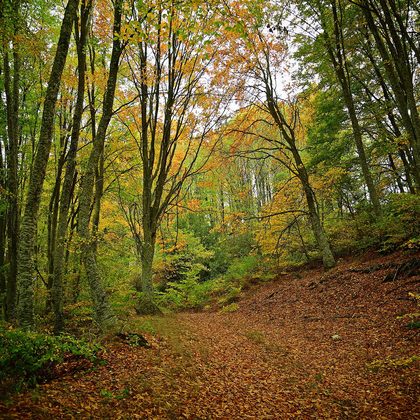
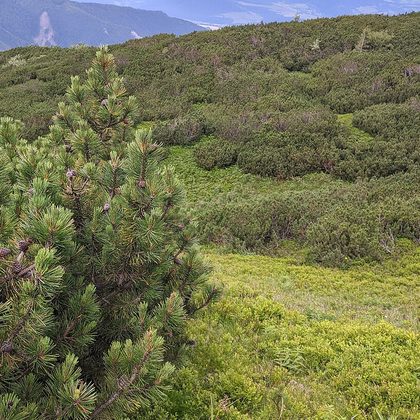
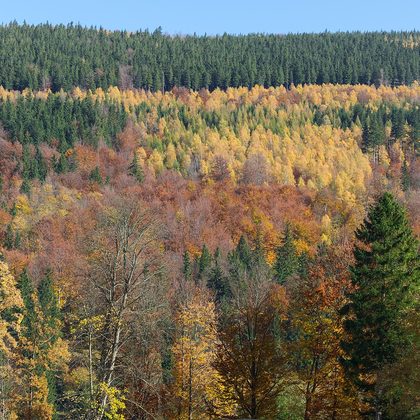
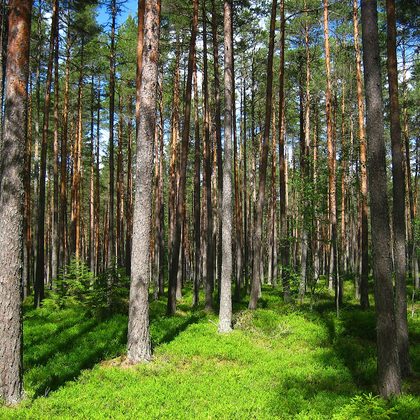
Breeds in the subarctic birch woodland of the Fennoscandian mountain fringe and in the northern taiga: tall birch with a dense, rank field layer, willow scrub along streams and lake shores, and the broad transition zone where conifer forest and birch belt interlock. It favours damp, mosquito-rich places and feeds high in the crowns of birch and willow. Further east it occupies the same combination of birch, larch and riverside willow scrub along the taiga rivers and at the tree line.
Where the bird is most at home, classified with EUNIS — the European standard for habitats.

Range and movements
From northern Norway, northern Sweden and northern Finland right across Siberia into Alaska; the entire world population, Fennoscandian birds included, winters in south-east Asia. Within Europe it is therefore a breeding bird, but only in the far north, and it arrives late: males are not on territory until mid-June. In the Netherlands it is a vagrant with thirty-six accepted records up to and including 2022, twenty-six of them since 2000, nearly all between late August and early November and concentrated in September, mostly on Vlieland, Terschelling, Ameland and Schiermonnikoog. In Shetland and on Fair Isle it is a near-annual visitor in the last week of August and the first half of September. In Spain it is extremely rare, with only a handful of records.
- Breeding (summer)
- Passage
- dark = core range, pale = thinly spread
Where and when to look
For the breeding bird: the second half of June in Finnish or Swedish Lapland, along a stream in tall birch wood, between four and eight in the morning. Walk the stream valleys and listen for the dry rattle; once you see the bird, look at the lower mandible first, because the dark tip rules out Greenish Warbler at a stroke. For the vagrant: late August and the first half of September on a Wadden island or in Shetland, after a few days of easterly to north-easterly wind. It usually sits higher than the other eastern vagrants, in the crown of elder, sycamore or sea buckthorn, and it is heavy and slow enough to stand out among the tits.
Conservation status
Not globally threatened, with an enormous population spread across half of Asia. The Fennoscandian breeders are only a small western outpost of that, and their numbers swing sharply from year to year with insect abundance and with the state of the birch woodland. Defoliation by autumnal moth caterpillars, which follows mild winters on a large scale, can leave whole valleys unsuitable for years, and the advance of conifer forest into the mountain birch belt works the same way. The number of vagrants reaching western Europe has risen clearly since 2000, most probably because there are now more observers on the islands who recognise that hard call.