All species › Waders, gulls and terns › Sandpipers and snipes › Bar-tailed godwit
Bar-tailed godwit
Limosa lapponica | Rosse grutto | Aguja colipinta
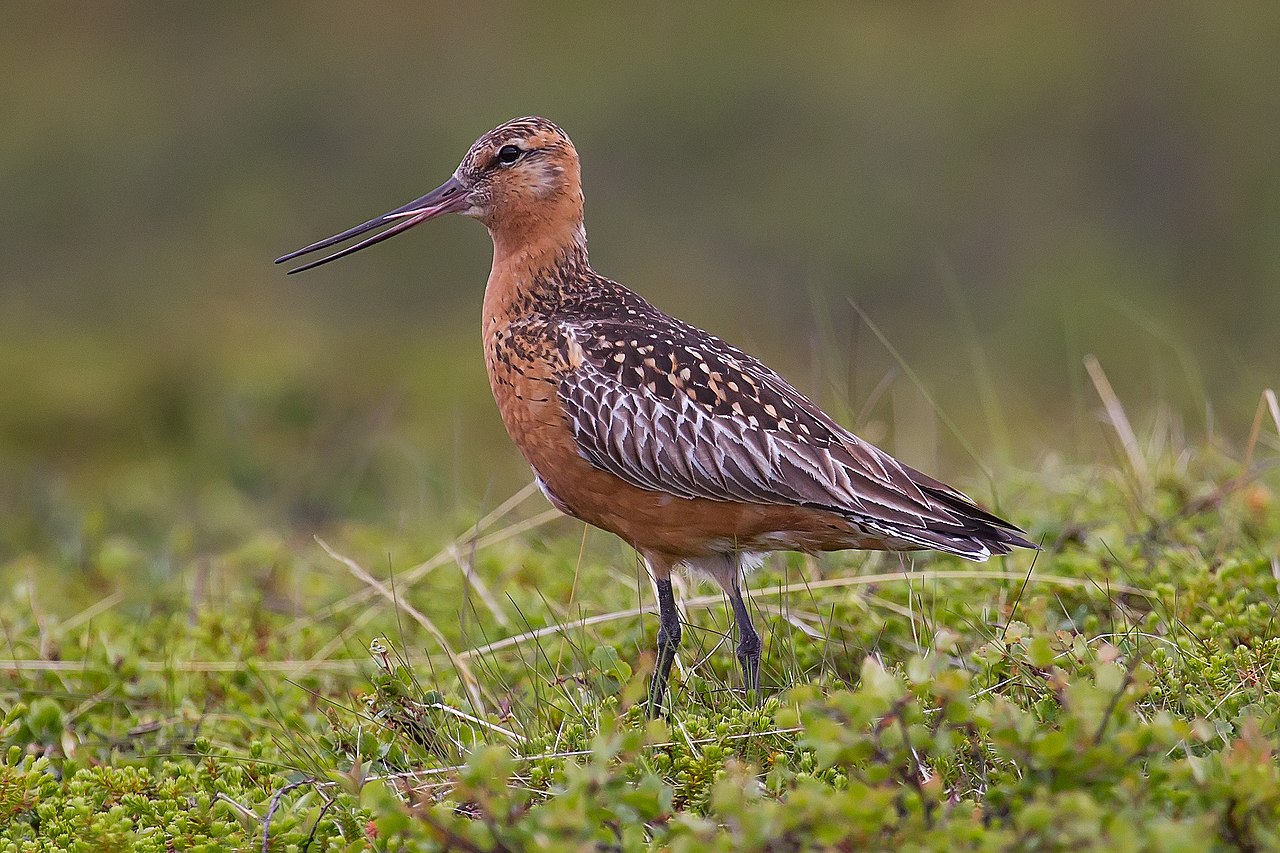
The Bar-tailed Godwit is the tidal-flat wader par excellence: outside the breeding season almost never inland, but present in tens of thousands on the Wadden Sea in May, when the males glow brick-red. From here they fly non-stop to the Siberian tundra.
Voice
Far less vocal than Black-tailed Godwit. The flight call is a low, nasal kirrik or kek-kek, heard as a flock lifts off the flats; at high-tide roosts a soft, muttered wik-wik rises from the mass. On the breeding grounds males sing in a display flight with a yodelling, rising a-wik-a-wik. In the Netherlands and Spain the flight calls are essentially all you get, and mostly on a rising tide.
Recording: Lauri Hallikainen — CC BY-SA 4.0 · Wikimedia Commons
Identification
A substantial wader with short, dark legs and a long, slightly upturned bill, pink at the base and black towards the tip. Summer males are brick-red right through to under the tail, with unbarred flanks; females are clearly larger, longer-billed and much paler, cream to light orange. In winter grey-brown with fine streaking and dark feather centres above. In flight the clinchers are the plain wing with no white wingbar, the white wedge running up in a point onto the back, and the finely barred tail; the feet barely project beyond it.
Confusion species
Black-tailed Godwit is the only real confusion species and differs on every one of those points: straight bill, broad white wingbar, black tail band on a white tail base, longer legs projecting well beyond the tail, and in summer an orange fore-body with sharply barred flanks and a white belly. Curlew and Whimbrel are larger with decurved bills. Knot is shorter-billed and more compact, with a pale grey rump.
Habitat
Extensive sandy to lightly muddy tidal flats, with a preference for the sandier parts that hold lugworms and bivalves. It probes deeply, the whole bill disappearing into the sand, taking lugworms, Baltic tellins, ragworms and small crabs. High-tide roosts on sandbanks, saltmarsh edges and beach spits. It breeds on flat wet tundra and peat mires above the treeline.
Range and movements
Breeds from Lapland and the Kola peninsula far into Siberia; west European birds belong to the subspecies lapponica and taymyrensis. The Wadden Sea is a staging site of global importance: in late spring hundreds of thousands of birds refuel here for the jump to Siberia, and in winter a large share of the north-west European population stays on the Dutch and German flats. In Spain thousands winter in the Bay of Cádiz, in Doñana and along the Galician rías, with a strong spring passage down the Atlantic coast.
- Resident
- Breeding (summer)
- Winter
- Passage
- Migration direction
- dark = core range, pale = thinly spread
Where and when to look
The last week of April and the first half of May are unbeatable: go to a high-tide roost on the Wadden, on Texel, Terschelling or the Balgzand, and wait out the rising tide. The flocks come in low and settle tightly packed, red males and much larger pale females side by side, making the size difference between the sexes obvious at a glance. In November a scope on a broad sandflat at falling tide gives the best feeding views. Arrive early: the birds gather before the flat is fully covered.
Conservation status
Near Threatened as of the latest assessment, with a globally declining trend. The decline is driven above all by the loss of intertidal habitat along the flyways: in East Asia through reclamation around the Yellow Sea, in Europe through disturbance, shellfish fishery and the shrinking of quiet high-tide roosts. On top of that, a warming tundra is shifting the insect peak relative to the birds' arrival. For the European population, protecting the Wadden Sea as a refuelling station is the most direct measure.
Other species in this family
Common sandpiper · Ruddy turnstone · Sanderling · Dunlin · Red Knot · Curlew sandpiper · Purple sandpiper · Little stint · Ruff · Temminck's stint · Common snipe · Black-tailed Godwit · Jack snipe · Eurasian Curlew · Whimbrel · Red phalarope · Red-necked phalarope · Eurasian woodcock · Spotted redshank · Wood sandpiper · Common greenshank · Green sandpiper · Common redshank