All species › Pigeons and doves › Pigeons and doves › Bolle's pigeon
Bolle's pigeon | Columba bollii
Bolles laurierduif | Paloma turqué
Bolle's pigeon is the pigeon of the closed cloud forest: slate-blue, washed vinous below, and rarely seen outside the canopy. It shares four islands with the laurel pigeon, and anyone hoping to separate the two should start at the tail.

Voice
A rough, guttural four-syllable coo repeated two or three times, troo-troo-troo-troo, drier and deeper than a wood pigeon's. There is also a mournful poo-poo-pooo. Heard all year, most persistently from winter into spring. Because the bird sits high in the canopy and the forest is otherwise silent, the call is notoriously hard to pin down.
No freely licensed recording is available for this species yet.
Identification
Large and uniformly dark. The upperparts, wings included, are slate blue-grey with blackish-brown flight feathers; the underparts are dark grey with a purplish, vinous breast. The hindneck carries a finely scaled gloss, green or violet-pink depending on the light. The bill is red with a pale tip, the eye pale yellow within a red orbital ring, the legs red. The tail is black with a broad pale grey band across it and a dark tip. Juveniles are sepia-brown and without gloss.
Confusion species
The laurel pigeon shares the same four islands and the same forest. On Bolle's the tail ends dark with the pale band across the middle; on laurel pigeon the tail ends pale, in an off-white tip. Bolle's is slate blue-grey on back and wings where laurel pigeon is red-brown. Bolle's nests in trees and keeps inside the wood; laurel pigeon nests on the ground in ravine walls and crosses open slopes far more often. The voices separate them as well: a rough guttural rattle of four syllables here, three deep hollow notes there. Wood pigeon, which also lives on these islands, always gives itself away with a white neck patch and a white wing band.
Habitat
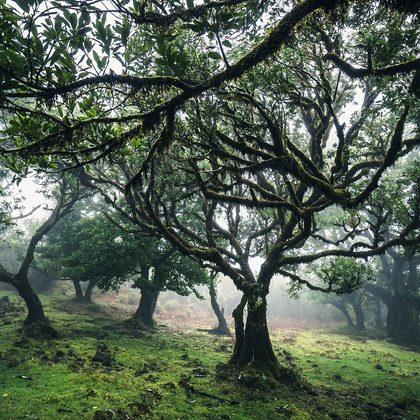
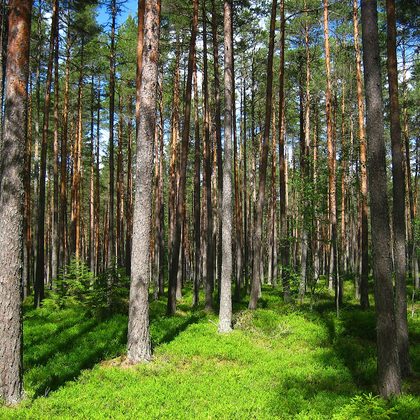
Closed, well-developed laurisilva and monteverde on the humid northern slopes, up to about 1500 m; more strictly tied to the forest than the laurel pigeon. Outside the breeding season it also uses pine woods and rank forest edges, and feeds in fields and orchards along the wood. The nest is always in a tree, often in a dense fork of til or viñátigo.
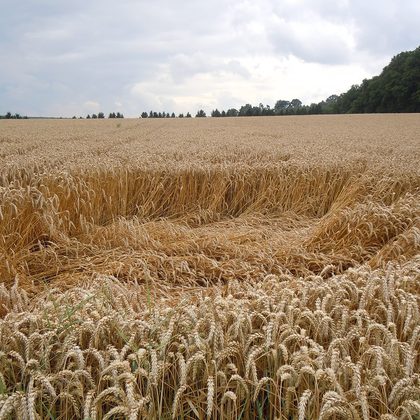
Where the bird is most at home, classified with EUNIS — the European standard for habitats.
Range and movements
The Canary Islands only: Tenerife, La Gomera, La Palma and El Hierro. It was lost from Gran Canaria at the end of the last century. The population is put at a few thousand birds, has grown over recent decades and is clearly larger than that of the laurel pigeon. It lives nowhere else on earth.
- Resident
Where and when to look
The Anaga hills on Tenerife or the Garajonay national park on La Gomera, early in the morning, from a mirador looking out over the canopy. Wait for the call before you look for the bird; it usually sits motionless in the crown of a til. If one flies across, go straight to the tail tip: dark is this species, pale is the laurel pigeon.
Conservation status
Not threatened on the global assessment, though the Canary list treats it as vulnerable. The cloud forest is protected and regrowing, and numbers are rising with it. What remains are feral cats and rats in the wood, collisions on forest roads and illegal shooting where the birds come down to crops. The species is on Annex I of the Birds Directive.