All species › Waders, gulls and terns › Sandpipers and snipes › Broad-billed sandpiper
Broad-billed sandpiper
Calidris falcinellus | Breedbekstrandloper | Correlimos falcinelo
The one genuine European breeder among the scarce calidrids, and one of the few whose nesting ground can actually be visited. Broad-billed Sandpiper breeds on floating peat mats in the aapa mires of northern Fennoscandia and passes down the North Sea coast in May and August, low-slung on short legs, with a bill that kinks downward at the tip.

Voice
The flight call is a dry buzzing trill, roughly dzhrreet, higher and thinner than the rolling call of Dunlin and best learned by picking it out of a mixed flock. A clicking tik tik is also given in flight. Over the breeding mire the male performs a low song flight with a sustained buzzing whirr, zree-zree-zree, that carries a long way across the pools on a still Lapland night.
No freely licensed recording is available for this species yet.
Identification
A small, squat sandpiper with a short rear end and notably short legs, so that it sits low and crouched on the mud. The bill is long for the size, broad at the base, straight for most of its length and then bent sharply down over the last centimetre. The head is snipe-patterned: a dark crown with a pale stripe above and below it, giving the double supercilium that meets in a V over the bill. The upperparts are dark with white mantle braces; summer birds are heavily streaked on the breast with arrowheads along the flanks, while juveniles carry warm buff feather fringes. In flight there is a narrow white wingbar and a dark leading edge to the wing.
Confusion species
The problem species is Dunlin, among which Broad-billed Sandpiper stands on every estuary. Three features settle it. First the head: Dunlin has one plain supercilium, Broad-billed has two pale stripes with a narrow dark line between them cutting off the side of the crown. Second the bill: Dunlin's tapers and curves evenly along its whole length, while Broad-billed's is straight with a short, abrupt kink at the very tip. Third the legs, which on Broad-billed are clearly shorter, so the bird works the mud with quick shuffling steps rather than Dunlin's steady walk. At distance the proportions help too: smaller, shorter behind the legs, yet with a bill that looks almost as long.
Habitat
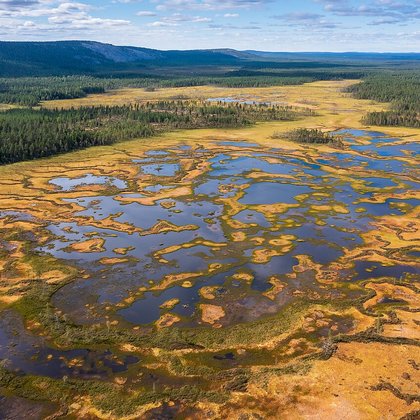
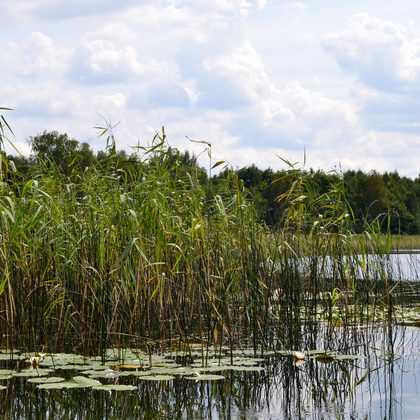
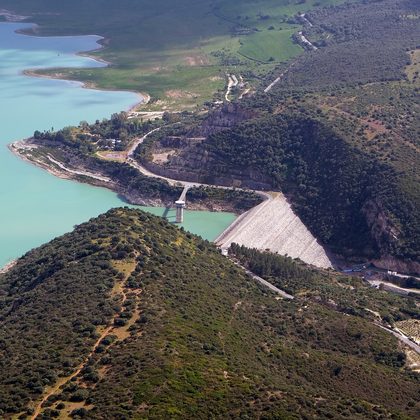
Breeds in aapa mires: extensive base-rich fens with pools, sedge ridges and floating carpets of sphagnum, the nest set on a low tussock within the wettest ground. Away from the breeding grounds it uses tidal flats and estuary edges, saltworks, brackish lagoons, clay pits and flooded wetland reserves, almost always at the water's edge on the softest mud.
Where the bird is most at home, classified with EUNIS — the European standard for habitats.

Range and movements
The European breeding range covers northern Norway, northern Sweden, northern Finland and north-west Russia, and these birds winter from the Persian Gulf coasts to East Africa and India. In Britain it is a scarce annual migrant, mostly single birds on east-coast marshes in late spring and again in autumn, with a strong bias towards adults in May. Across the North Sea the Dutch pattern is the same: annual in small numbers, sharply peaked around the middle of May and with a second wave in August, mainly on the Frisian and Groningen coasts and in the Delta.
- Breeding (summer)
- Passage
- dark = core range, pale = thinly spread
Where and when to look
Between roughly 12 and 20 May, take a high-tide roost on the Wadden coast or a flooded reserve, and work a Dunlin flock line by line. Do not look for colour, look at the head: the moment a bird shows two pale stripes above the eye, the rest follows. In August the method is identical, but juveniles are in the mix and their warm buff fringes make them stand out from the greyer moulting adults around them.
Conservation status
The species was listed as Vulnerable in 2024, jumping straight from Least Concern without passing through Near Threatened. Fennoscandian monitoring showed an annual decline of some 5.6 per cent between 2006 and 2018, and above 7 per cent in Finland, which halves a population in a dozen years. Most of the causes sit on the breeding mires: drainage for forestry and agriculture, acid run-off from forestry operations, sphagnum spreading over the open sedge pools, and nests lost to summer flooding. On the East Asian flyway the eastern subspecies faces the separate problem of intertidal reclamation, with counts in the Irrawaddy delta halving between 2019 and 2023.