All species › Waders, gulls and terns › Sandpipers and snipes › Buff-breasted sandpiper
Buff-breasted sandpiper
Calidris subruficollis | Blonde ruiter | Correlimos canelo
A calidrid that has given up on mud. Buff-breasted Sandpiper walks short grass on golf courses, airfields and dune pasture, evenly buff from crown to undertail, with a large dark eye set in a blank little face. In Britain and Ireland it is the most expected of the Nearctic grassland waders, and for many observers the September bird that finally makes the pattern click.

Voice
Silent for practical purposes. A flushed bird may give a short low tuk or a subdued rattling pr-r-reet that barely carries across a field. On the tundra lek males deliver a soft clucking murmur while raising one wing to show the white underside, but nothing of that behaviour is on offer in Europe. Do not expect to hear this species; find it with your eyes.
No freely licensed recording is available for this species yet.
Identification
A small, neatly built wader with a rounded head, a short straight black bill and ochre-yellow legs. The upperparts are scaled, black feather centres inside broad warm fringes. Head, neck, breast and belly are uniformly buff, with only fine dark spotting along the breast sides and no white belly cutting in below the breast. The large dark eye, ringed with fine pale feathering, stands out in that plain face. In flight there is no wingbar and the primaries are dark, but the bird opens a gleaming white underwing marked with a dark crescent along the tips of the primary coverts, which is the single most reliable feature at any range.
Confusion species
Almost every Buff-breasted Sandpiper is first written off as a juvenile Ruff, and understandably so: both are gold-scaled above and buff below. Ruff is considerably larger, longer in neck and leg, with a full head, a steep forehead and a small eye lost in the head streaking, and a longer bill that droops slightly at the tip. On Buff-breasted the large dark eye with its crisp pale ring sits in an unmarked buff face, giving the head an almost dove-like look. Leg colour helps: ochre-yellow on Buff-breasted, usually grey-green to olive on juvenile Ruff. In flight the question is settled in a second. Ruff shows a narrow white wingbar and the two white ovals flanking the dark rump; Buff-breasted shows a plain upperwing with no bar at all and flashes a silver-white underwing with that dark crescent across the primary coverts. Upland Sandpiper shares the big dark eye in a plain face, but is far larger, longer necked, boldly chevroned below and long-tailed.
Habitat
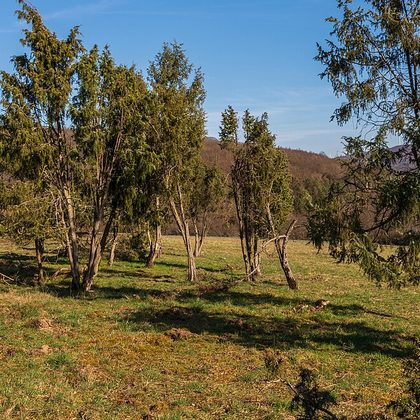
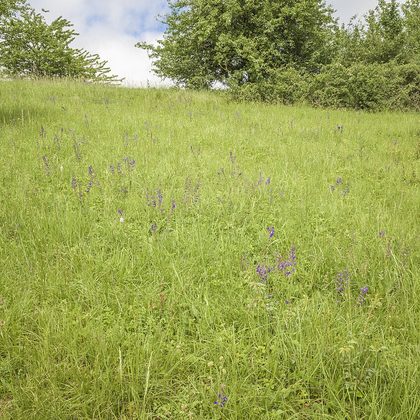
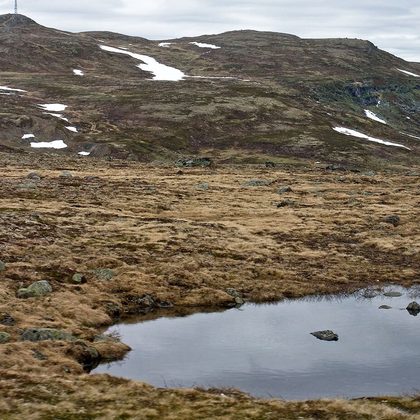
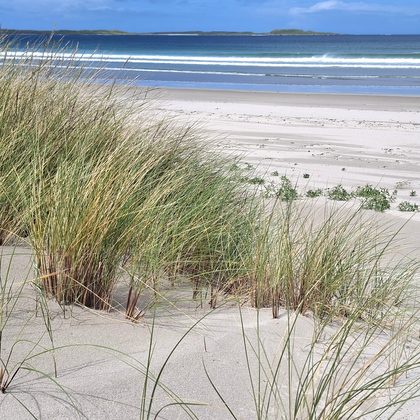
Close-grazed or closely mown grassland: golf courses, airfields, mown verges, machair, dune grassland, dry saltmarsh edges and occasionally stubble. It does not seek water and is an accident on a tidal flat. On the breeding grounds it takes dry raised ridges within otherwise damp grassy tundra, and it favours the same kind of very short sward on migration in the Americas, including turf farms.
Where the bird is most at home, classified with EUNIS — the European standard for habitats.
Range and movements
Breeds on the arctic tundra of northern Alaska and northern Canada, with a foothold on Wrangel Island, and winters on the pampas of Argentina, Uruguay and Paraguay. A well-worn Atlantic drift brings birds to western Europe every autumn, so that Britain and Ireland record it annually and it is no longer treated as a national rarity there; the Isles of Scilly, the Irish south-west coast and the Northern Isles take the largest share. Numbers rise sharply after a fast-moving depression crosses from Newfoundland in the first half of September. The Netherlands has close to eighty accepted records, most of them since 2000, and the Dutch committee stopped assessing the species in 2015.
Where and when to look
Work short grass in the first three weeks of September, within a few days of a westerly airflow, and cover the edges rather than the middle: airfield margins, the seaward strip of a golf course, close-grazed machair. Watch flocks of Golden Plover and Ruff for a smaller bird walking a little apart and standing slightly more upright, and let the plain buff underparts with no white belly do the work. If the bird flies, get on the underwing.
Conservation status
In 2024 the IUCN moved the species from Near Threatened to Vulnerable. The world population is a few tens of thousands of birds and falling. Nineteenth-century market hunting all but finished it off, and the pressure now comes from the conversion of the South American pampas to soy and arable, from the loss of short-grass stopovers along the Great Plains, and from oil and gas development on the arctic breeding grounds. Because the birds concentrate on a handful of staging sites, a single bad season on the Texas coast or in the Paraguayan grasslands carries a long way.