All species › Tubenoses › Petrels and shearwaters › Bulwer's petrel
Bulwer's petrel
Bulweria bulwerii | Bulwers stormvogel | Petrel de Bulwer
Bulwer's Petrel is a small, wholly dark seabird with a long tapering tail that flies low over the water in a weaving, moth-like way, quite unlike anything else in the eastern Atlantic. It breeds on the islands and stacks of Macaronesia and spends the rest of its life out of sight of land, which is why most observers meet it from a boat rather than from a headland.

Voice
Silent at sea. At the colonies, from an hour after dusk, birds call from inside the crevices with a monotonous muffled barking, woof … woof … woof, roughly one note a second and kept up for minutes at a time; a walker on a colony island hears it coming from under the boulders rather than from the air, since the species is far less vocal in flight than most petrels.
No freely licensed recording is available for this species yet.
Identification
About 27 cm long, entirely sooty chocolate-brown with no white anywhere. In decent light a paler, sandier bar crosses the upperwing coverts from the carpal joint back towards the body, and it is the one piece of pattern the bird has. The tail is long and wedge-shaped but is normally held closed, so it looks pointed and gives the bird an oddly long rear end. The head looks heavy for the size, with a short, thick, hooked black bill. The wings are long, narrow and held bowed and pushed forward. The flight is the clinching character: low, buoyant and continually twisting, shearing from side to side just above the surface with quick loose beats, and only rarely rising more than a few metres.
Confusion species
Swinhoe's Storm Petrel is much smaller and shorter-tailed, with a shallow fork in the tail and pale shafts in the outer primaries, and it flutters rather than shears. European and Madeiran Storm Petrels are smaller still and show white on the rump. Sooty Shearwater is far larger, with a long straight-winged glide and a silvery panel on the underwing. Dark Balearic and Yelkouan Shearwaters are bigger and heavier-bodied, with a shorter tail and steadier flight, and they show at least some pale on the belly and underwing. A dark juvenile skua at distance has a heavier chest, a white flash in the primaries in the case of Arctic Skua, and a straighter, more purposeful line. Within the map area the real pitfall is Jouanin's Petrel of the Arabian Sea and the Gulf of Aden: same all-dark plumage and same long tail, but clearly larger and heavier, with a thicker bill, broader wings, a much more powerful arcing flight and only a faint wing-bar. The two do not overlap — Bulwer's belongs to the Atlantic side of the area, Jouanin's to the north-western Indian Ocean — so on any given trip the geography settles what the shape has left open.
Habitat
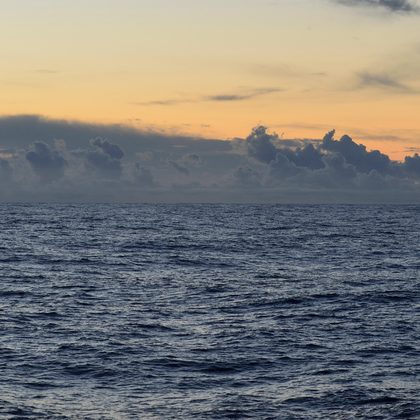
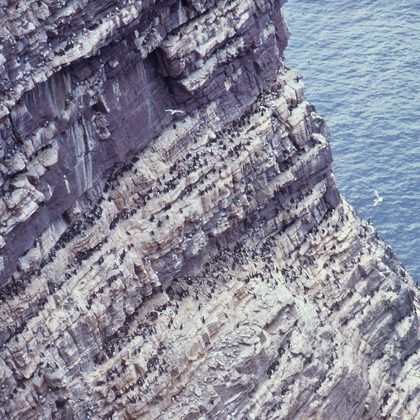
Open ocean over deep water, often around seamounts and along thermal fronts, where it feeds by picking small fish — lanternfish above all — and squid from the surface without settling, largely at night when the prey rises. It breeds in crevices between boulders, in lava tubes, under overhangs and in cliff cavities on small islands and stacks, coming and going only in darkness.
Where the bird is most at home, classified with EUNIS — the European standard for habitats.
Range and movements
In this area it breeds on the Desertas and Porto Santo off Madeira, on the Selvagens, on several of the Canary islets such as Montaña Clara, Alegranza and Roque del Este, and in small numbers in the Azores; the Desertas hold one of the largest colonies known. Beyond the map it breeds on Cape Verde and, on the other side of the world, from the seas of eastern Asia to Hawaii and the Marquesas. At sea it is regular off Madeira and the Canaries, scarce off the coasts of Portugal and Galicia, and a genuine rarity anywhere further north.
- Breeding (summer)
- Passage
- dark = core range, pale = thinly spread
Where and when to look
Take an evening pelagic out of Funchal or Machico on Madeira between mid-June and mid-September, or the day boat towards the Desertas: the birds come past the boat in the last hour of light, and that low twisting flight at close range is the point of the trip. In the Canaries the equivalent is a pelagic from Los Cristianos or Puerto Rico, or the crossing from Lanzarote towards Alegranza and Montaña Clara in July and August. From land the species is a poor bet, though a long seawatch from a southern Iberian cape in September will occasionally produce one.
Conservation status
Not globally threatened (IUCN: Least Concern), with a large world population spread across two oceans, and the north-east Atlantic total was revised upwards after improved counts on the Desertas in 2015. The pressures are the familiar island ones: introduced rats and cats at colonies, disturbance and trampling of crevice nests, and light pollution around harbours and resorts that grounds fledglings on their first flight. Removing predators from small islets and shielding coastal lighting are the measures that matter.