All species › Gamebirds › New World quail › California quail
California quail
Callipepla californica | Californische kuifkwartel | Colín de California
A North American quail that exists in Europe only because people put it there. It holds on in the maquis of Corsica and on a couple of islands off Sicily; anything seen elsewhere in Europe goes back to birds that escaped from aviaries.

Voice
The familiar sound is a loud three-syllable assembly call, chi-ca-go, the second syllable stressed and highest. Both sexes use it when a bird has lost the covey or when the covey is on the move. Add a soft tup-tup from feeding birds and a sharp pit-pit-pit of alarm, after which the whole party dives into the bushes. In spring males call repeatedly from a low lookout: a rock, a wall, a dead branch.
Recording: Jonathon Jongsma — CC BY-SA 3.0 · Wikimedia Commons
Identification
A round, short-tailed gamebird between a starling and a thrush in size, with a black topknot that hangs forward like a comma. The male has a black face and throat, cleanly outlined by a white supercilium and a second white stripe across the cheek; the crown is dark brown, the neck and breast slate grey, the hindneck finely flecked white. The belly carries a striking scaled pattern of cream and black with a chestnut patch in the middle, and the flanks are olive-brown with white shaft streaks. The female lacks the black-and-white head pattern, is duller brown-grey and has a shorter plume, but the scaled belly is the same. Flushed birds go off with a loud clatter of wings and drop back into cover after a few dozen metres.
Confusion species
Nothing in Europe really resembles it. Common Quail (Coturnix coturnix) is smaller, streaked buff, has no plume and no scaled belly, and flies away low and elongated rather than in a short whirring arc. Escaped aviary birds of other American quails, such as Elegant Quail Callipepla douglasii, differ in the pale, backward-pointing crest and the absence of a black throat; juvenile California Quail are duller but already show the belly scaling.
Habitat
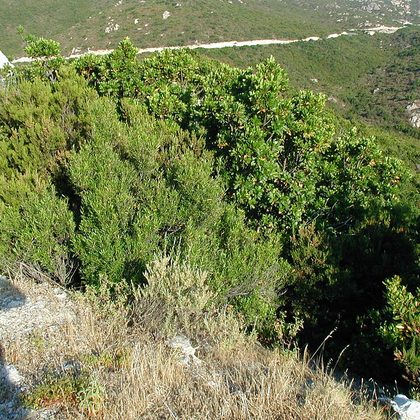
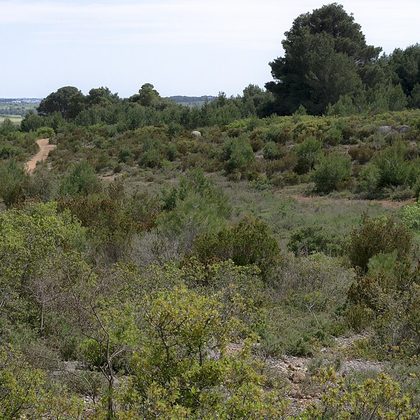
Low, dense scrub with bare ground between: maquis and garrigue, abandoned terraces gone to brush, roadsides, holm-oak woodland edges and the margins of villages and orchards. The birds feed in the open patches and run into the scrub, so the decisive factor is a mosaic of cover and bare soil. Summer water matters. They avoid closed forest and high mountains.
Where the bird is most at home, classified with EUNIS — the European standard for habitats.


Range and movements
Native to California, Oregon and Baja California. In Europe the birds are introduced: Corsica has held the species since game releases in the nineteenth and twentieth centuries, and a second small population sits on the Egadi Islands off Sicily. Records elsewhere in Italy, France, Spain, Germany and the Low Countries involve single escaped cage birds or releases that failed; there are no established breeding populations.
Where and when to look
On Corsica work the low maquis of the coastal hills and the abandoned terraces, ideally early morning from March to June. Drive slowly and stop at every chi-ca-go: the birds would rather run than fly and cross a track only at the last moment. In summer a wait at a drinking point pays off. Away from Corsica and the Egadi, treat any European sighting as an escape until shown otherwise.
Conservation status
Least Concern globally and abundant in its native range. In Europe it is an introduced species with a narrow foothold; the Corsican and Sicilian populations are small and depend on open, grazed scrub that is slowly closing over as farmland is abandoned. It is not regarded as harmful to native birds, but neither is it protected anywhere in Europe.