All species › Birds of prey › Hawks, eagles and kites › Cinereous vulture
Cinereous vulture | Aegypius monachus
Monniksgier | Buitre negro
The Cinereous Vulture is Europe's largest bird of prey and one of the heaviest flying birds in the world. It soars over the dehesa on broad, dead-straight wings held almost level, and against the light it reads as a dark plank cut out of the sky. By far the greater part of the world population breeds in Spain.

Voice
Virtually silent. Away from the colony and the carcass you will hardly hear it: vultures have a poorly developed voice and are limited to hoarse, unarticulated sounds. At the nest and in squabbles over food they hiss and grunt, with a rasping chaaa and sharp hissing sshh; young beg with a harsh, repeated squealing just audible from the valley floor.
No freely licensed recording is available for this species yet.
Identification
Huge and almost uniformly dark brown, without the Griffon's contrast between pale coverts and black flight feathers. The wings are very broad, with a straight, parallel trailing edge and six or seven long, widely spread fingers; the tail is short and distinctly wedge-shaped, its angled tip projecting just beyond the wings. Heavy head covered in brown or grey down, blue-grey bare skin around the eye and a ruff of dark feathers; the bill is enormous and blackish with a blue-grey cere. Soars on flat or very slightly drooped wings, never in a V. Adults have a paler head and ruff; juveniles are darker still, almost black, with a blackish head.
Confusion species
Griffon Vulture: the same size, but with a sandy body and pale coverts contrasting strongly with black flight feathers, a bare pale neck, a white downy ruff and a short square tail that barely projects behind the wings; it also soars with the wings in a pronounced V, while the Cinereous holds them flat and straight, with a broader, more rectangular wing and that longer wedge-shaped tail. Against the light, when colour is lost, the head decides it: heavy and dark on Cinereous, slender and pale on Griffon. Bearded Vulture: much longer, narrower wings and a long wedge-shaped tail; the dark juvenile Bearded is the plumage closest to Cinereous, and again the tail settles it. A juvenile Egyptian Vulture is also uniformly dark, but far smaller and much narrower-winged, with a long wedge tail.
Habitat
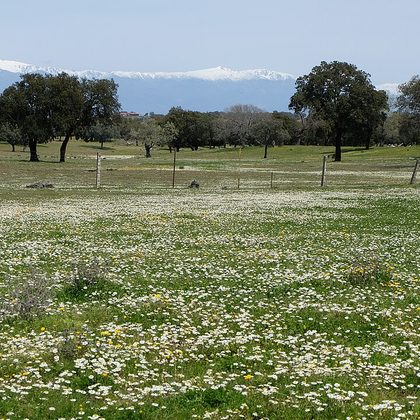
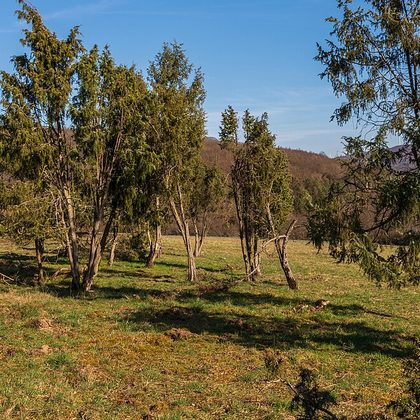
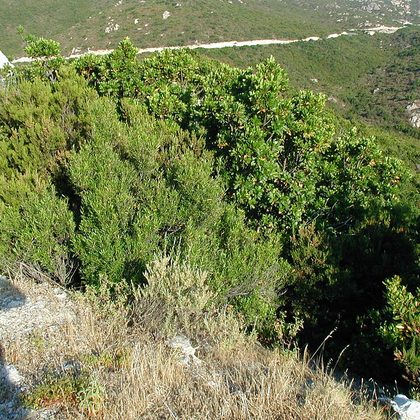
Nests in trees, not on rocks: an enormous platform of sticks in the crown of a holm oak, cork oak or stone pine, on little-frequented slopes of old Mediterranean woodland. Around it the bird needs large tracts of dehesa, scrub and cereal steppe with extensive livestock and big game, where dead stock, deer and rabbits are to be found. It rarely ranges far from tall mature woodland offering nest sites.
Where the bird is most at home, classified with EUNIS — the European standard for habitats.


Range and movements
Spain holds the great majority of the world population: some 2,500 pairs at the 2018 census, in Extremadura, the Sierra Morena, the Montes de Toledo, the Central System and Mallorca, and since 2022 about twenty pairs again in the Sierra de la Demanda. Portugal was reoccupied unaided and holds thirty to forty pairs. In France more than fifty pairs breed after releases in the Grands Causses and the Baronnies; in Greece only the Dadia colony remains, with some thirty pairs, and in Bulgaria birds have been released again since 2018. Further east it breeds in Turkey, the Caucasus and Central Asia.
- Resident
- Breeding (summer)
- Winter
- Passage
- dark = core range, pale = thinly spread
Where and when to look
Extremadura, February to June: the Salto del Gitano viewpoint in Monfragüe and the EX-208 road produce Cinereous Vultures daily. Go shortly after sunrise, while the birds still slide low along the slopes, and return between eleven and two, when the thermals are working and they circle high. A supplementary feeding station or a mountain pass where birds gather greatly improves the odds; the Sierra de Andújar and Cabañeros National Park work the same way.
Conservation status
IUCN: Near Threatened. The Spanish population has grown strongly from the barely two hundred pairs of 1973 and is still increasing, but the species remains threatened. Illegal poison baits set for wolves and foxes are the main unnatural cause of death; added to that are veterinary anti-inflammatories such as diclofenac, licensed for livestock in Spain since 2013 and lethal to vultures in tiny doses, collisions with wind turbines, electrocution on power lines, lead poisoning from hunting ammunition and the loss of extensive stock farming.