All species › Passerines › Reed warblers › Clamorous reed warbler
Clamorous reed warbler | Acrocephalus stentoreus
Indische karekiet | Carricero estentóreo
Along the Jordan and in the Egyptian delta a loud, grating reed warbler sings all year round. In January that cannot be a great reed warbler, which is in Africa. This is the resident that takes its place — and with a little patience it can be told by bill and wing as well as by the calendar.

Voice
A loud, hard, grating song built from short, quickly repeated motifs that clatters rather than stutters: kre-kre-kre-chak-chak-chirr, at a flat continuous tempo without the deep and shrill extremes of great reed warbler. It sings from February into June, from a reed plume or half hidden among the stems, and after dark as well; outside the breeding season you mostly hear calls. Calls: a deep throaty tcherr and a hard tchak running into a rattle in alarm.
No freely licensed recording is available for this species yet.
Identification
A big reed warbler, as long as great reed warbler but slighter in build and with a longer, clearly graduated tail. The bill is strikingly long and thin and tapers evenly, set below a flat, low-sloping forehead, so head and bill make one long pointed line. Upperparts dull olive to grey-brown, colder and drabber than great reed warbler. Underparts off-white with buff flanks and undertail coverts. The supercilium is narrow, short and weak and barely contrasts. The wing is rounded with a short primary projection — this bird goes nowhere. Legs sturdy, grey-brown. Sexes alike.
Confusion species
Great reed warbler is the only real pitfall, and in Israel the two share the same reedbed. Four things help. Bill: clamorous long, thin and evenly tapered; great reed shorter with a noticeably broader, deeper base. Wing: clamorous is resident and shows a short primary projection, roughly half the exposed secondaries, with crowded primary tips and a blunt wing point; great reed is a long-distance migrant with a long projection and a pointed tip. Supercilium: clamorous narrow, short and low-contrast; great reed broader and obvious in front of and above the eye, with a darker eye-stripe below it. Song: clamorous is faster, more even and more chattering, without the deep croaks and shrill squeals. And simplest of all, the date: from October to March only clamorous is here.
Habitat
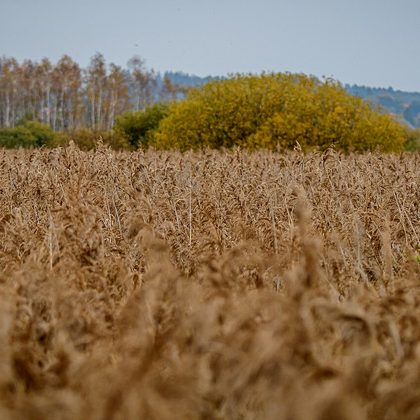
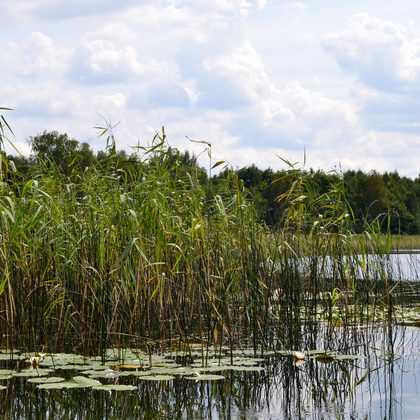
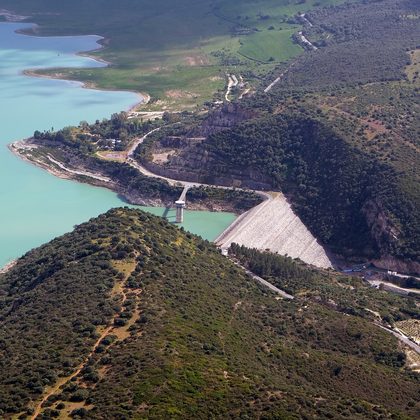
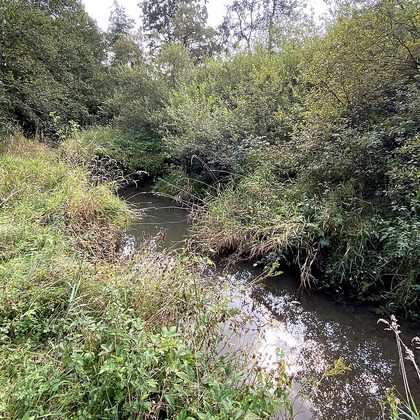
Reed and reedmace standing in water: the banks of the Jordan and the Sea of Galilee, the reedbeds of the Hula, the fishponds of the Bet She'an valley, irrigation reservoirs, coastal streams, and in Egypt the canals and rice fields of the delta and the shores of Birket Qarun in the Fayum. It wants tall, dense, second-year reed with its feet in water, and in winter also uses tamarisk and waterside scrub. The nest is a deep basket slung between vertical stems, low above the water.
Where the bird is most at home, classified with EUNIS — the European standard for habitats.
Range and movements
From the Nile delta and the Levant east through Iran and Central Asia to India, South-East Asia and Australia — one of the most widespread reed warblers in the world. Within this guide's map it occurs only in Egypt, Sinai, Israel, the Palestinian territories and western Jordan; those birds belong to the sedentary form levantinus and do not migrate. It has never been recorded in Europe.
- Resident
- Breeding (summer)
- Passage
- dark = core range, pale = thinly spread
Where and when to look
February and March, along the Jordan below the Sea of Galilee or at the Kfar Ruppin fishponds: it is then the only large reed warbler singing, because great reed warbler does not return until mid-April. Stand on a bank where the reed is tall and old and wait for the singer to climb a plume; one view gives you the long thin bill and the low forehead together. In Egypt a morning along any delta canal will do.
Conservation status
Not threatened (LC) and numerous across its range. In the Levant and Egypt it gains from fishponds, irrigation reservoirs and the reed that grows up around them, so breeding sites have if anything increased. What costs it locally is the annual clearing and dredging of irrigation canals, reed burning, and the water abstraction that dries the Jordan and its tributaries in summer.