All species › Tubenoses › Petrels and shearwaters › Cory's shearwater
Cory's shearwater
Calonectris borealis | Kuhls pijlstormvogel | Pardela cenicienta atlántica
Cory's Shearwater is the heaviest shearwater of the Atlantic part of this guide's area: a broad-winged seabird that sails from trough to trough on stiff, slightly bowed wings. It breeds in hundreds of thousands of pairs on the Azores, Madeira and the Canaries, and away from the colonies it is almost only seen over open water.

Voice
Practically silent at sea. At the colony it is noisy after dark, giving a nasal, wailing, three-part aa-oo-ah that often ends in a sob and carries like a crying child. Males sound higher and more nasal, females hoarser and lower, so an occupied burrow often produces two birds answering each other. Calling is loudest from May to August, from soon after sunset until deep into the night.
Recording: Blue Label — CC BY-SA 3.0 · Wikimedia Commons
Identification
Large and heavily built, the broad wings held slightly bowed forward in a glide with a shallow kink at the wrist. Head and upperparts are greyish brown and merge into the white underparts without a sharp border, so there is no black cap and no white collar. The bill is stout and yellow with a dark band just before the tip, the most useful feature at close range. The underwing is white with a broad dark trailing edge, a dark leading edge and a wholly dark hand; no pale wedge runs into the outer primaries. At most a narrow, indistinct pale fringe shows above the tail base. The flight is unhurried and sailing, with long arcs on a single deep beat.
Confusion species
Scopoli's Shearwater is barely smaller but finer built, with a slimmer bill, and shows a pale wedge running into the bases of the outer primaries on the underwing; that wedge is the only reliable feature and needs a view from below in decent light. Great Shearwater has a sharply defined dark cap, a white collar, a slim black bill, a dark belly patch and a white band above the tail. Sooty Shearwater is wholly dark brown with a silvery stripe down the centre of the underwing. Northern Gannet is larger, pointed at both ends and shows black wingtips in an otherwise white plumage.
Habitat
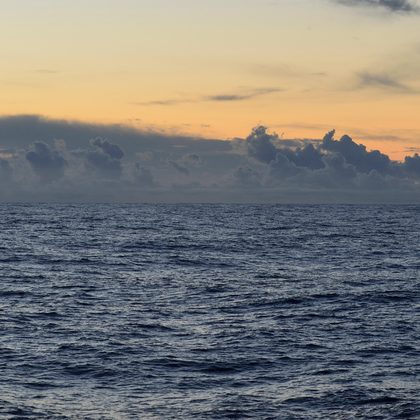
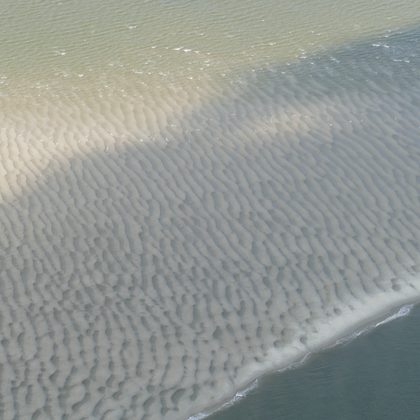
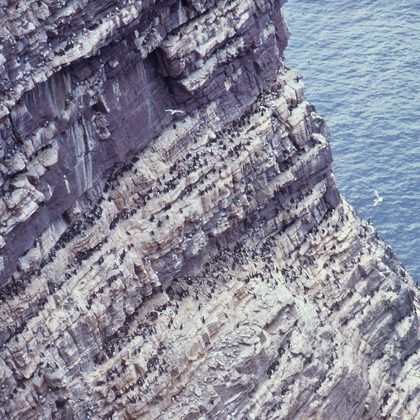
Outside the breeding season entirely a bird of the open ocean, favouring the shelf edge and places where currents bring food to the surface. It picks squid and small fish from the water, makes shallow plunges from a low shearing flight, and readily joins hunting tuna and dolphins or fishing boats discarding bycatch. It breeds in burrows, rock crevices and under boulders on islands and steep rocky coasts, where it is active only at night.
Where the bird is most at home, classified with EUNIS — the European standard for habitats.
Range and movements
A breeding bird of the Azores, Madeira, the Selvagens, the Canaries and the Berlengas, with smaller colonies off Atlantic Morocco. After breeding almost the whole population moves to the South Atlantic, staying off Brazil and southern Africa until February. Off Britain and Ireland it is a scarce but annual seabird from July to October, most numerous off the south-western approaches, and it can be numerous in the Bay of Biscay; in the North Sea and off the Netherlands it drops to a few birds each autumn. The pattern follows depth: where deep water comes close to the coast the species is regular, elsewhere it is a storm-driven visitor.
- Breeding (summer)
- Passage
- Migration direction
- dark = core range, pale = thinly spread
Where and when to look
For a North Sea record, seawatch from mid-August to early October at a headland such as Westkapelle, Camperduin or Scheveningen and choose a day with force 6 or more from the west or north-west; the first three hours after sunrise are the most productive. To see the bird well and without doubt, take a July or August boat trip off La Gomera, Tenerife or the Azores, where birds follow the boat within a few metres and the yellow, dark-banded bill is easy to check.
Conservation status
Not globally threatened (IUCN: Least Concern), with a few hundred thousand pairs concentrated on a handful of island groups. Many colonies are nevertheless under pressure: introduced cats and rats take eggs and chicks, birds drown on longline hooks, and fledglings are disoriented by street and harbour lighting on their first flight and end up on roads and in villages. On the Canaries several thousand grounded young are collected and released at sea each autumn.