All species › Passerines › Leaf warblers › Dusky warbler
Dusky warbler | Phylloscopus fuscatus
Bruine boszanger | Mosquitero sombrío
Dusky Warbler is the darkest and most mouse-like of all leaf warblers: a small, uniformly grey-brown bird with not a trace of green or yellow, hiding in a ditch or a bramble patch and betraying itself with a hard tacking note. Since 2020 it has appeared on the North Sea coast almost every autumn, and a few now stay the winter.

Voice
The call makes the species and is nearly always the first thing you notice here: a hard, dry, smacking tchek or tack, as though two pebbles were being clicked together, with an emphatic attack and no ring to it at all. It is repeated monotonously, sometimes dozens of times from deep cover, and it is markedly harder and sharper than a Lesser Whitethroat's tack and far drier than the soft tyuck of Radde's Warbler. Wintering birds call in December and January too, often from reed or a bramble bank along a ditch. The song, exceedingly rare here but delivered in the Siberian willow scrub from June into July, is a simple, rather wistful series of drawn-out, falling whistles, chwee-chwee-chwee, all on the same pitch with short gaps between — slow and monotonous, and of a wholly different character from the rich fluting of Radde's.
No freely licensed recording is available for this species yet.
Identification
Small, compact and short-winged, with a rounded head and a short primary projection of at most half the tertial length. Upperparts uniform dark grey-brown, cold in tone, without the least hint of olive or green; underparts off-white with a warm buff wash on the flanks and undertail coverts. The supercilium is long, narrow and sharply defined, and it is at its broadest and warmest just in front of the eye — an orange-buff tone there, whiter and gradually more diffuse behind. Below it runs a clear dark brown eye-stripe, often with a broken pale eye-ring. The bill is fine, thin and pointed, dark with a pale base to the lower mandible. The legs are slender and brownish-pink. No wing bar, no crown stripe, no yellow: plainness itself, and that uniform brown impression is the mark.
Confusion species
Radde's Warbler is the problem, and each species has its own page here; concentrate on bill, legs and supercilium. Dusky has a fine, thin, pointed bill and fairly slender brownish-pink legs; Radde's a short, thick, stubby bill and strikingly heavy, pale orange-pink legs. The supercilium runs the opposite way in each: on Dusky it is broadest and warmest in front of the eye and narrows behind, on Radde's it is broadest behind the eye and flares out diffusely there. Colour helps too: Dusky is cold grey-brown with buff flanks, Radde's warmer olive-brown with ochre-yellow undertail coverts and yellow-buff flanks. And the call: Dusky gives a hard, dry, smacking tchek like two pebbles struck together, Radde's a softer, lower, more liquid tyuck. Chiffchaff is greener and more olive, has dark legs and a much shorter, vaguer supercilium. Cetti's Warbler is far bigger, rufous, and has a broad rounded tail.
Habitat
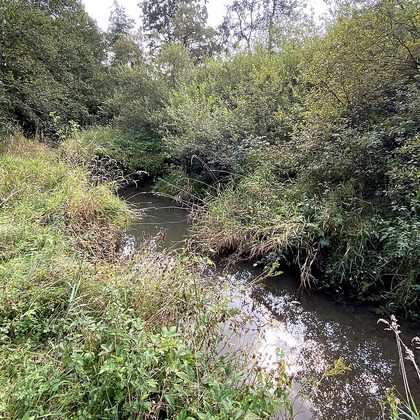
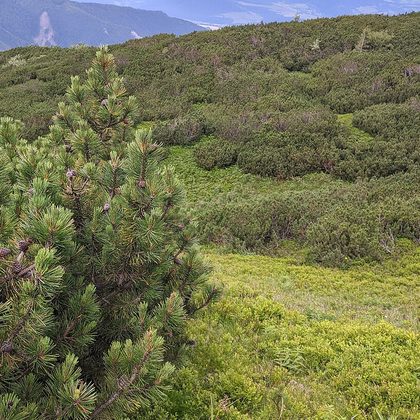
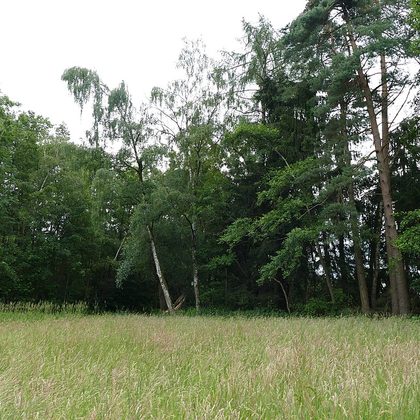
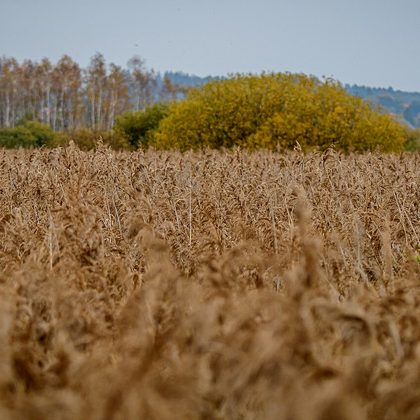
Breeds in low, dense, damp scrub: willow and birch thickets along the rivers and streams of the Siberian taiga, dwarf birch at the tree line, rank herbage around pools and small mires, and sedge marsh with scattered bushes. It is a bird of the lowest metre and feeds largely on or just above the ground, working between the stems with much hopping. In winter, in India and south-east Asia, it uses the same structure: reed, rank vegetation, marshy edges and neglected field margins.
Where the bird is most at home, classified with EUNIS — the European standard for habitats.
Range and movements
Breeds from central Siberia east to the Sea of Okhotsk, Mongolia and north-east China, with a separate form in the Himalaya, and winters in north-east India, Bangladesh, Myanmar, Thailand and southern China. In north-west Europe it is an annual autumn vagrant whose numbers have risen clearly since 2020; it appears from late September into December, peaking in the second half of October and in November, later than Radde's Warbler. In the Netherlands that means mainly the coast and the Wadden islands, and birds now regularly stay to winter. In Spain it is a major rarity with a small number of records, mostly on the north coast.
Where and when to look
From mid-October to early November, after a few days of easterly wind, along a ditch, a reed fringe or a bramble thicket in a dune slack or behind the foredune. Walk slowly and listen for the hard tchek; you will often hear it twenty times before you glimpse the bird at all. Then wait patiently at the edge of the cover, because it comes briefly into view before diving back in. In those few seconds look deliberately at three things: the bill (fine and pointed), the legs (slender and brownish-pink) and the supercilium in front of the eye (broad and warm buff). That sequence is exactly what rules out Radde's Warbler.
Conservation status
Not globally threatened, with a very large and stable Siberian breeding population in a habitat — riverside and tree-line scrub — that is if anything expanding. The number reaching Europe has climbed steeply since the 1990s and that climb has accelerated since 2020; besides more and better-listening observers, a genuine shift in migratory direction is probably involved. That birds now winter in north-west Europe at all is a new and striking development, barely known twenty-five years ago.