All species › Passerines › Leaf warblers › Radde's warbler
Radde's warbler | Phylloscopus schwarzi
Raddes boszanger | Mosquitero de Schwarz
Radde's Warbler is the big, heavy cousin of Dusky Warbler: a sturdy, thick-headed bird with a stubby bill, thick pale legs and ochre-yellow trousers. It reaches our coast from the southern Siberian taiga, usually a couple of weeks earlier in autumn than Dusky, and it is almost as skulking.

Voice
The call is soft and easy to miss, and that is at once the chief difference from Dusky Warbler: a low, faintly nasal, slightly liquid tyuck or chep, with a gentler attack, as though someone were clicking their tongue some way off. A short churring trrt often follows when the bird is startled. Where a Dusky's tchek cracks across a dune slack, for Radde's you have to stand still and listen; in wind you simply will not hear it. The song, virtually never heard here but delivered from late May into July along Siberian woodland edges, is surprisingly rich and musical: short, loud, fluting phrases with a thrush-like ring, interspersed with fast rolling notes and sometimes a nasal closing note. Anyone who knows both songs hears the difference at once between a monotonous counting-out and a real melody.
No freely licensed recording is available for this species yet.
Identification
A bulky, compact leaf warbler with a big head, a thick neck and strikingly long undertail coverts; it looks heavier and more angular than Dusky Warbler and often moves on the ground with long strides. Upperparts warm olive-brown, a shade greener in tone than Dusky; underparts creamy white with a distinct yellow-buff wash across the flanks and bright ochre, almost apricot undertail coverts. The supercilium is long and broad and most obvious behind the eye, where it flares diffusely; in front of the eye it is narrower and buff. Below it lies a dark eye-stripe, and faint dark lateral crown stripes often give the head a capped look. The bill is short, thick and blunt, deep at the base, with a pale pink lower mandible — a wholly different shape from Dusky's fine spike. The legs are heavy and pale: flesh to orange-pink, with large feet. No wing bar.
Confusion species
Dusky Warbler is the only real alternative, and the same comparison is set out on its own page. Four benchmarks: the bill (short, thick and blunt in Radde's, fine and pointed in Dusky), the legs (heavy and pale orange-pink in Radde's, slimmer and brownish-pink in Dusky), the supercilium (broadest and most diffuse behind the eye in Radde's, sharpest and warmest in front of the eye in Dusky) and the colour under the tail (bright ochre-yellow in Radde's, dull buff-brown in Dusky). Structure helps too: Radde's is larger, bigger-headed and longer in the undertail coverts, and is more often on the ground or low in a tree, while Dusky flicks its tail deep in cover. The call decides: a soft, low, rather liquid tyuck in Radde's, a hard dry tchek in Dusky. Chiffchaff is smaller, greener, dark-legged and short-browed. Booted Warbler is paler and greyer, with a squarer tail and white outer tail feathers.
Habitat
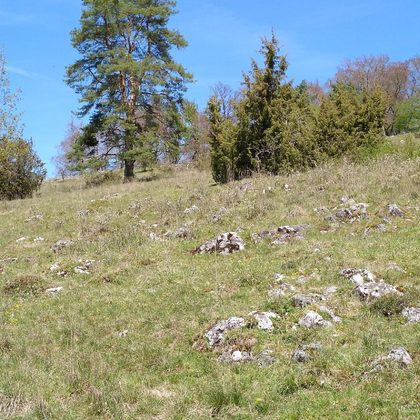
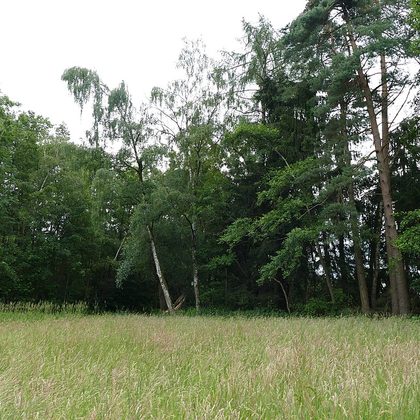
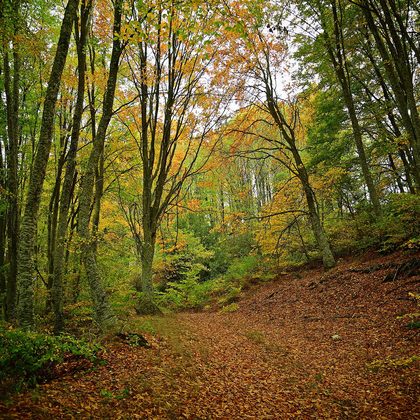
Breeds in the southern taiga and the forest belt below it, in scrub and young regrowth with a dense field layer: thickets on hillsides, rank woodland edges, young birch and willow regrowth on clear-fells and burns, and open broadleaved woodland with impenetrable undergrowth. Unlike Dusky Warbler it is not tied to water; it chooses drier, more structured scrub and taller herbage, with scattered trees to sing from. On migration and in winter it uses the same combination: dense bushes over a thick ground layer, along woodland and field edges.
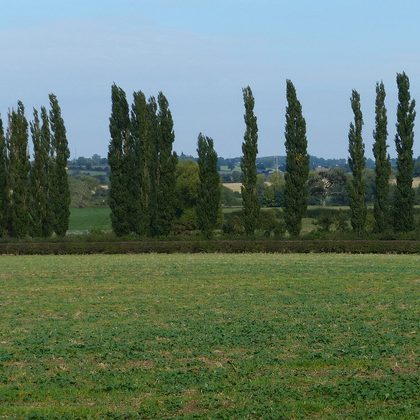
Where the bird is most at home, classified with EUNIS — the European standard for habitats.
Range and movements
Breeds from the Altai and the Baikal region east to the Amur basin, north-east China and Korea, and winters in Bangladesh, Myanmar, Thailand, Laos and Cambodia. Every autumn birds drift to north-west Europe over a distance of more than three thousand kilometres; the first European material came from Heligoland. In the Netherlands it has been an annual visitor since about 2000, with typically three to eight birds each autumn, recorded from September into November and peaking between late September and mid-October — earlier than Dusky Warbler. Almost all records are coastal or from the Wadden islands, and Fair Isle and Shetland show the same pattern. In Spain it is an exceptional rarity.
Where and when to look
The last week of September and the first two weeks of October, after a spell of easterly to south-easterly wind, in sea-buckthorn and elder scrub on a Wadden island or in a small coastal copse. Look at the boundary between dense scrub and open sand or short turf: Radde's regularly walks out there with the tail cocked and long strides, and that is the best chance of seeing the thick pale legs. Sit quietly at the edge of a block of scrub and wait; it is shy but inquisitive, and after ten minutes it will often hang briefly in an outer twig. At first sight, go for the bill: short and blunt means Radde's, fine and pointed means Dusky.
Conservation status
Not globally threatened, with a large breeding population in the southern Siberian forest belt that appears stable and that benefits from scrub on clear-fells and burns. In north-west Europe the species has gone from a major rarity in the 1970s to an annual autumn visitor. Whether that reflects population growth, a shift in migratory direction or simply far more observers who know the soft call is unresolved; the picture is the same as for Dusky Warbler, except that the numbers stay lower and the autumn peak falls distinctly earlier.