All species › Passerines › Leaf warblers › Eastern Bonelli's warbler
Eastern Bonelli's warbler | Phylloscopus orientalis
Balkanbergfluiter | Mosquitero oriental
Eastern Bonelli's Warbler is the eastern counterpart of Western Bonelli's, and has been treated as a separate species by most authorities since the 1990s. On looks the two are all but inseparable; on call it takes half a second. Walk through a Greek or Bulgarian oak wood in May and you hear it everywhere and see it almost never.

Voice
The song closely resembles Western Bonelli's and is therefore not a safe character: a short, dry rattle of one to two seconds on a single pitch, srrrrrrr, breaking up at close range into separate ticks. On average it is a shade slower, harder and more angular than Western's, with the individual notes more audible and a silvery ring to them, but the difference is too fine to rely on in the field. The call is not: a hard, short, flat, clipped chip, closer to a House Sparrow or a ticking Blackcap than to anything a leaf warbler ought to say, with nothing rising or disyllabic about it. One call is enough. Birds sing from arrival in late April into the first half of July, most persistently through the morning, high in the oaks and often from a bare twig above the canopy.
No freely licensed recording is available for this species yet.
Identification
A pale, cold-toned leaf warbler with grey-brown to grey upperparts and clean white underparts, without yellow on throat, breast or flanks. The rump is yellow-green and contrasts with the duller back; the closed wing shows a yellow-green panel, but less obviously than in Western. The face is blank and open, with a short, ill-defined pale supercilium, a narrow white eye-ring and a large dark eye. The bill is proportionately long and heavy with an orange lower mandible; legs brown to grey-brown. Sexes alike. Autumn birds look slightly browner and warmer, but always stay white below.
Confusion species
Everything turns on Western Bonelli's Warbler — see its own species page, where the same difference is set out from the other side. Eastern averages greyer and whiter, with less green in wing and rump, a slightly heavier bill and often a marginally longer wingtip, but each of those characters varies and none decides an individual bird. Where the ranges meet, in Croatia and along the Adriatic, a silent bird simply cannot be named. The voice can, at once: a hard, monosyllabic, flat chip against Western's soft, disyllabic hoo-eet. Otherwise, Wood Warbler is larger and far yellower on throat and breast, and Chiffchaff has dark legs, no yellow rump and a constantly dipping tail.
Habitat
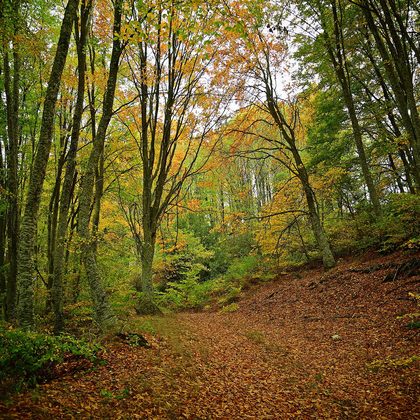
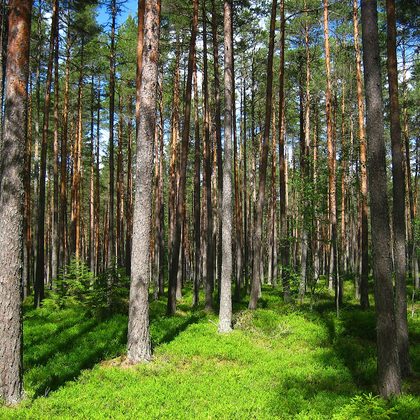
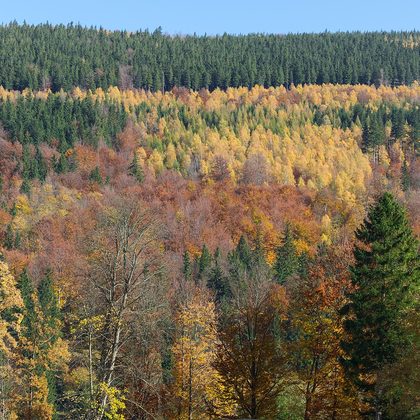
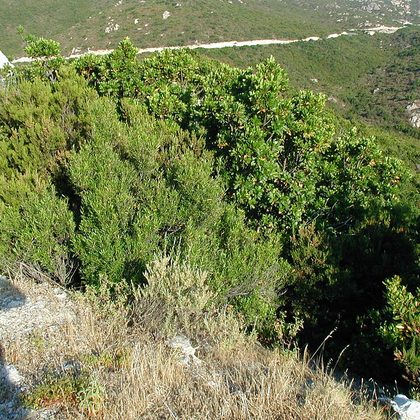
Dry, open broadleaved woodland on slopes, and above all oak coppice with sparse undergrowth, which holds the bulk of the population. Also mixed woodland, old pinewoods in the south of the range, wooded maquis with scattered oaks and junipers, and forested mountain flanks to around 1,800 metres. In the north of the range it takes lower, more open woodland with some shrub layer; in the south, wooded hillsides. The nest sits on the ground in the leaf litter, tucked against a bank.
Where the bird is most at home, classified with EUNIS — the European standard for habitats.
Range and movements
Breeds from the Dinaric Alps and Croatia through Serbia, North Macedonia, Albania, Greece and Bulgaria across the whole of Turkey to the Caucasus, Syria, Lebanon and Israel. The largest numbers are in Greece, Bulgaria and Turkey; the Bulgarian population is put at 5,000 to 7,000 pairs, concentrated in the Eastern Rhodopes, the Struma and Mesta valleys, Strandzha and Sakar. It winters in north-east Africa, from Sudan and South Sudan to Eritrea and Chad. Arrival is in late April and departure begins as early as July. It is a very rare, non-annual vagrant to north-west Europe: six accepted Dutch records between 1983 and 2021, in May and September, and a comparably tiny British tally.
- Breeding (summer)
- Passage
- dark = core range, pale = thinly spread
Where and when to look
Mid-May, in an oak wood on a south-facing slope in the Eastern Rhodopes, the Peloponnese or on Lesvos, shortly after sunrise. Go for the sound before the bird: the dry rattle comes from high in the canopy and repeats every ten seconds or so. Then wait for the call, because only the call makes the record solid, and record it if you can — outside the core range a sonogram of that chip is the only evidence a rarities committee will accept. Lesvos and north-east Greece hold the densest populations in the European part of the range.
Conservation status
Not threatened. The range is large and continuous and Balkan populations are regarded as stable. The concerns are the conversion of old oak coppice into dense even-aged stands, wildfire in Greece and Turkey, and — as for every trans-Saharan migrant — conditions in the wintering grounds, here the dry savannas of Sudan and the Sahel, where grazing and cutting are thinning the tree layer.