All species › Passerines › Leaf warblers › Yellow-browed warbler
Yellow-browed warbler
Phylloscopus inornatus | Bladkoning | Mosquitero bilistado
A Siberian mite of barely seven grams that lands in our coastal thickets by the dozen every autumn on an easterly wind. Fifty years ago it was a sensation; now it is a fixture of October — and still a thrill — and you will almost always find it by sound first.

Voice
The call makes the species: a loud, penetrating, rising tsoo-eest, two syllables that shoot upwards, startlingly strong for so small a bird and repeated every few seconds. That sound is exactly how you find it in a coastal thicket: you hear it three times before you see it once. Hume's Warbler calls flatter and less rising, more a disyllabic tsu-weet or a dry, tit-like wesoo, without the whipped-up ending. The song, rarely heard in Europe, is a high, thin series of a few repeated notes.
Recording: Luis Ramos — CC BY-SA 3.0 · Wikimedia Commons
Identification
The smallest green bird in the thicket, fresh olive-green above and white below, with a strikingly marked head: a long, broad, creamy-yellow supercilium running well behind the eye, a dark eye-stripe and usually a faint pale stripe along the centre of the crown. The wing shows two pale bars: a broad yellowish-white one across the greater coverts and a shorter, narrower one across the median coverts; the tertials have broad white fringes. The bill is dark with an orange-pink base and the legs are pale brown to flesh-coloured. Never still: it hangs, flicks and hovers at the tips of branches.
Confusion species
Hume's Warbler is the hard one: duller and greyer, with an off-white rather than yellowish supercilium, one clear wing bar and a second that is often nearly absent, an all-dark bill with at most a trace of pale at the base, and dark legs. Pallas's Leaf Warbler is smaller still and far more contrasting: a bright yellow crown stripe, a yellow rump patch that flashes as it hovers, and broader yellow wing bars. Chiffchaff and Willow Warbler are larger, with no wing bars and no crown stripe.
Habitat
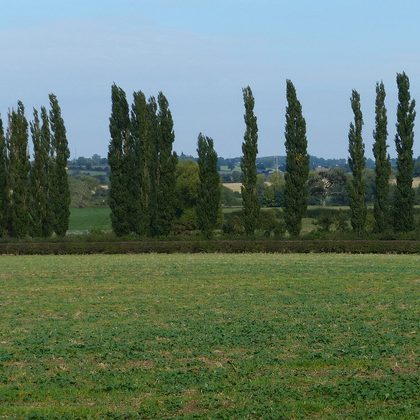
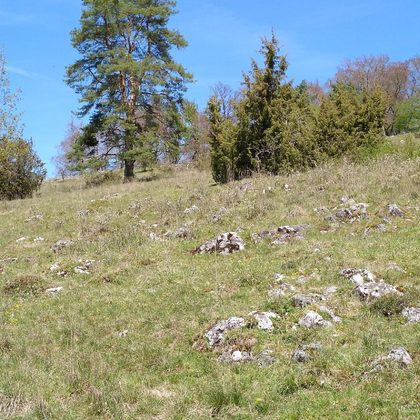
Breeds in the Siberian taiga of birch, larch and spruce. On passage in Europe it turns up in coastal copses, dune scrub, sea buckthorn and elder, willows around pools, poplar lines, cemeteries and village gardens — almost always in the outer branches of broadleaved trees, high in the crown or low in the shrub layer, and often in the company of tits and Goldcrests.
Where the bird is most at home, classified with EUNIS — the European standard for habitats.


Range and movements
Breeds from the Urals into eastern Siberia and normally winters in south-east Asia. Every autumn a proportion drifts west: with a settled easterly wind in October, tens to hundreds appear in the Netherlands, concentrated on Vlieland, Texel, the Maasvlakte and other coastal points. In Spain it is a vagrant recorded mainly on the north coast — Galicia, Asturias, the Basque Country — and on the Canaries, with more records year on year.
- Winter
- Passage
- dark = core range, pale = thinly spread
Where and when to look
The first two weeks of October, after a few days of easterly or north-easterly wind, in a coastal copse or dune scrub. Walk slowly, stop every fifty metres and listen; once you hear the tsoo-eest, wait for the tit flock to come through, because Yellow-browed almost always travels with one. Watch the outer twigs against the sky — that is where the double wing bar shows best.
Conservation status
Not globally threatened, with a very large and stable breeding population in Siberia. The number reaching Europe has risen sharply over recent decades; whether that reflects population growth, a shift in migratory direction or simply more observers who know the call is still unsettled.