All species › Passerines › Leaf warblers › Hume's warbler
Hume's warbler
Phylloscopus humei | Humes bladkoning | Mosquitero de Hume
The drab, late-autumn twin of the Yellow-browed Warbler, out of the mountains of Central Asia. It arrives on average a month later than its more famous cousin, sometimes lingers all winter in a sheltered park or along a stream, and is found almost entirely by call.

Voice
The call is flatter and less piercing than the Yellow-browed's: a disyllabic, slightly falling or level tsu-weet, or a dry, tit-like wesoo reminiscent of a Crested Tit or Willow Tit. Where Yellow-browed ends on a whipped-up, penetrating tsoo-eest, Hume's stays on the flat: less sharp, less loud and without the upward flick. It often calls only a few times a minute, which makes it hard to pin down. The song, exceptional in Europe, is a high, thin, persistently repeated series of two or three notes.
Recording: Shyamal L. — CC BY-SA 4.0 · Wikimedia Commons
Identification
As small as Yellow-browed but duller and colder throughout: grey-green to grey-brown above with no fresh olive tone, and off-white to dingy buff below. The long supercilium is off-white or pale buff, not creamy yellow. The wing shows one clear pale bar across the greater coverts; the second, on the median coverts, is faint or absent altogether. Bill base and legs give the best support: the bill is almost wholly dark with at most a trace of pale below, and the legs are dark brown to black. A pale crown stripe is absent or barely traceable. In fresh autumn plumage it can look surprisingly contrasting, so never let colour decide on its own.
Confusion species
Yellow-browed Warbler is the only real confusion species: brighter green, a yellowish-white supercilium, two clear wing bars of which the upper stays visible, an orange-pink bill base and pale brown to flesh-coloured legs. In case of doubt the voice always beats the view. Pallas's Leaf Warbler has a bright yellow crown stripe and a yellow rump. Chiffchaff is larger, browner and has no wing bar at all.
Habitat
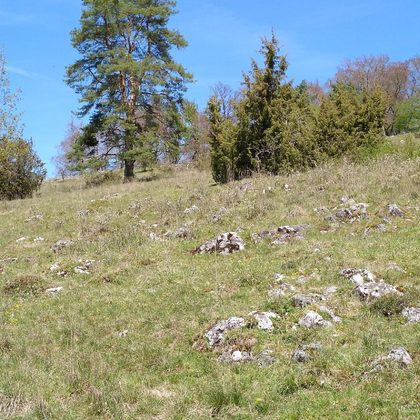
Breeds high in the mountains of Central Asia — Tien Shan, Altai, Pamir and the western Himalaya — in open conifer forest and dwarf juniper and willow scrub up beyond the treeline. In Europe in late autumn and winter it uses sheltered scrub: coastal copses, sea buckthorn and elder, willows and alders along streams and ditches, sewage works, parks and old cemeteries, often keeping to the same circuit for days.
Where the bird is most at home, classified with EUNIS — the European standard for habitats.



Range and movements
An Asian species that normally winters in northern India and Pakistan. In north-west Europe a rare but annual visitor: the Netherlands records a handful to a dozen or so birds each autumn, weighted towards the second half of November and December, on the coast but also inland. In Spain it is a very rare vagrant, with a handful of records, mostly in winter on the north coast.
- Winter
- Passage
- dark = core range, pale = thinly spread
Where and when to look
The second half of November and December, after a spell of easterly wind, in sheltered scrub behind the dunes or along a stream lined with alder and willow. Follow up every late 'Yellow-browed': after mid-November the chance of Hume's is real. Give it time, because this species calls sparingly; look for it in the mixed tit flock and, once you see it, concentrate on the dark bill and legs and the weak second wing bar.
Conservation status
Not globally threatened, with a large and inaccessible breeding range in the Central Asian mountains where no decline is apparent. European records are increasing, but mainly because the call is now widely known and many observers review their recordings.