All species › Owls › Typical owls › Eurasian Eagle-Owl
Eurasian Eagle-Owl
Bubo bubo | Oehoe | Búho real
The largest owl in the world and a formidable hunter, taking prey up to herons, crows and fox cubs. After a century of persecution it has returned to quarries and even industrial sites in the Low Countries.
Voice
A deep, muffled, far-carrying oo-hu with the stress on the first syllable, audible over kilometres on still evenings; the female sounds higher and hoarser. Mainly from January to March, in the first hour after sunset. Begging young give a hoarse, grating tcheeh in May and June.
Recording: Robert Petersen — CC BY-SA 4.0 · Wikimedia Commons
Identification
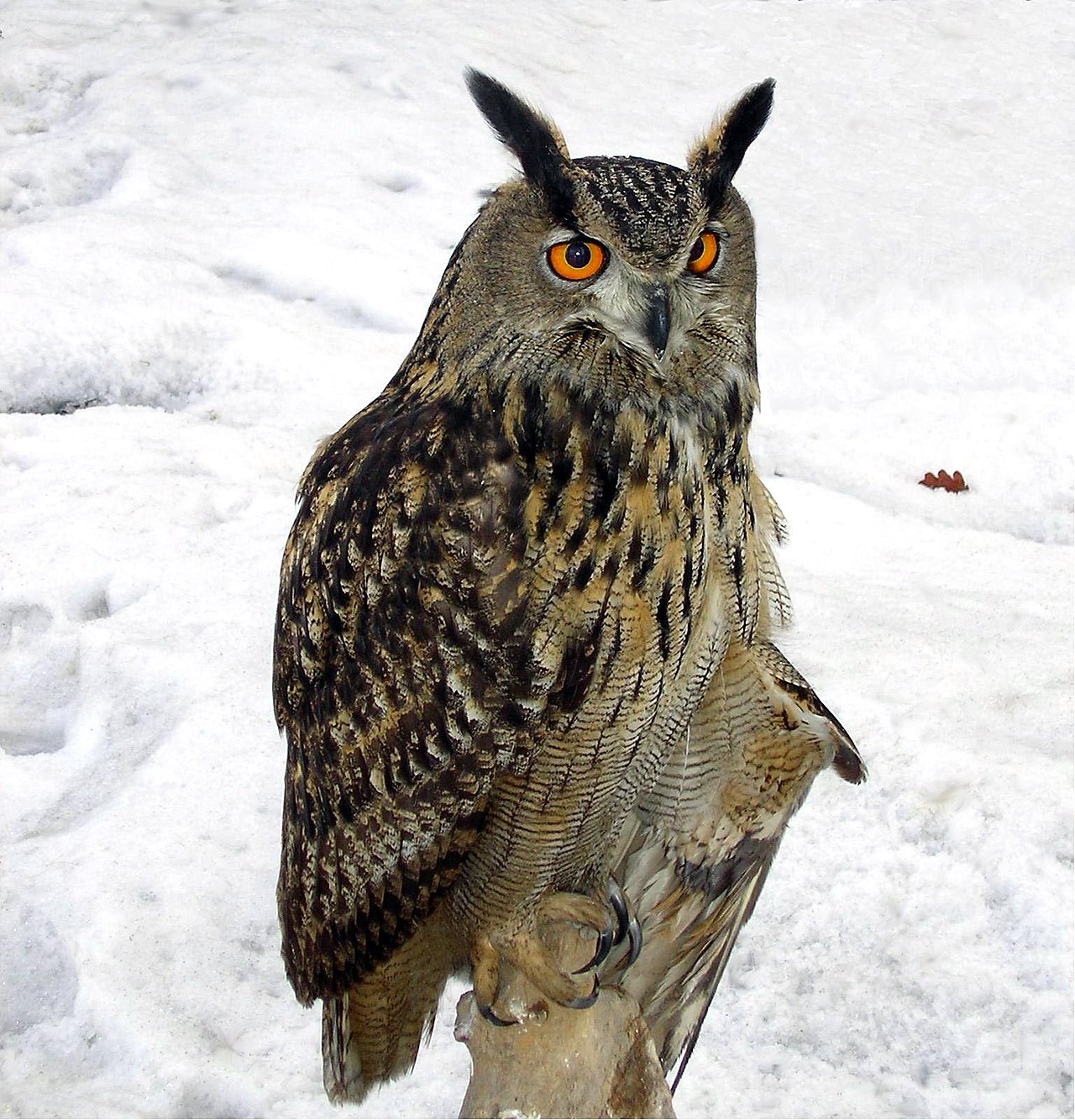
Colossal, barrel-bodied and broad-shouldered, with long ear tufts angled outwards and blazing orange eyes. Warm ochre-brown, heavily black-streaked on the breast and finely barred on the belly. In flight huge, with broad rounded wings, a short tail and slow buzzard-like beats interspersed with glides; juveniles have shorter tufts.
Confusion species
Long-eared Owl is the classic confusion, but is no bigger than a crow, with yellow eyes, upright close-set ear tufts and a far slimmer shape. Tawny Owl is smaller, tuftless and black-eyed. A perched Eagle-Owl is regularly reported as a tree stump or a Buzzard; only the Eagle-Owl gives a deep, far-carrying hoot.
Habitat
Cliffs, gorges, quarries and steep slopes overlooking open hunting ground. Breeds without a nest on a ledge or in a crevice, sometimes in an old raptor nest or on the ground, and hunts along woodland edges, fields, rubbish tips and lit town margins.
Range and movements
Almost all of continental Europe, but scarce and patchy everywhere; absent from Britain and Ireland. In the Netherlands a recent colonist of southern Limburg and the eastern border country, still with few pairs. In Spain widespread and numerous in barrancos, sierras and river canyons. Resident and strongly site-faithful.
- Resident
- Breeding (summer)
- Winter
- Passage
- Migration direction
- dark = core range, pale = thinly spread
Where and when to look
In February or March, on a still evening, sit well back with a view of a cliff or quarry an hour before sunset and listen; calling birds often give themselves away before full dark. Keep your distance from the face, as disturbance at the nest is fatal.
Conservation status
After heavy persecution and poisoning in the twentieth century it has recovered in many countries and is spreading north-westwards again. The main threats are electrocution and collision at medium-voltage pylons, road and railway casualties, and disturbance of nesting ledges by climbers and photographers.