All species › Waterfowl › Ducks, geese and swans › Eurasian teal
Eurasian teal
Anas crecca | Wintertaling | Cerceta común
Europe's smallest duck, barely bigger than a pigeon and startlingly fast and agile in the air. Flocks tower off a muddy edge in a tight turn, sounding like a handful of small bells.
Voice
The male gives a clear, short, bell-like whistle, krik or prrit, which in flocks sounds like ringing chimes and carries a long way. The female quacks high, thin and nasal. Heard most from October to March, often from unseen birds inside reed edges.
Recording: British Library — CC BY-SA 4.0 · Wikimedia Commons
Identification
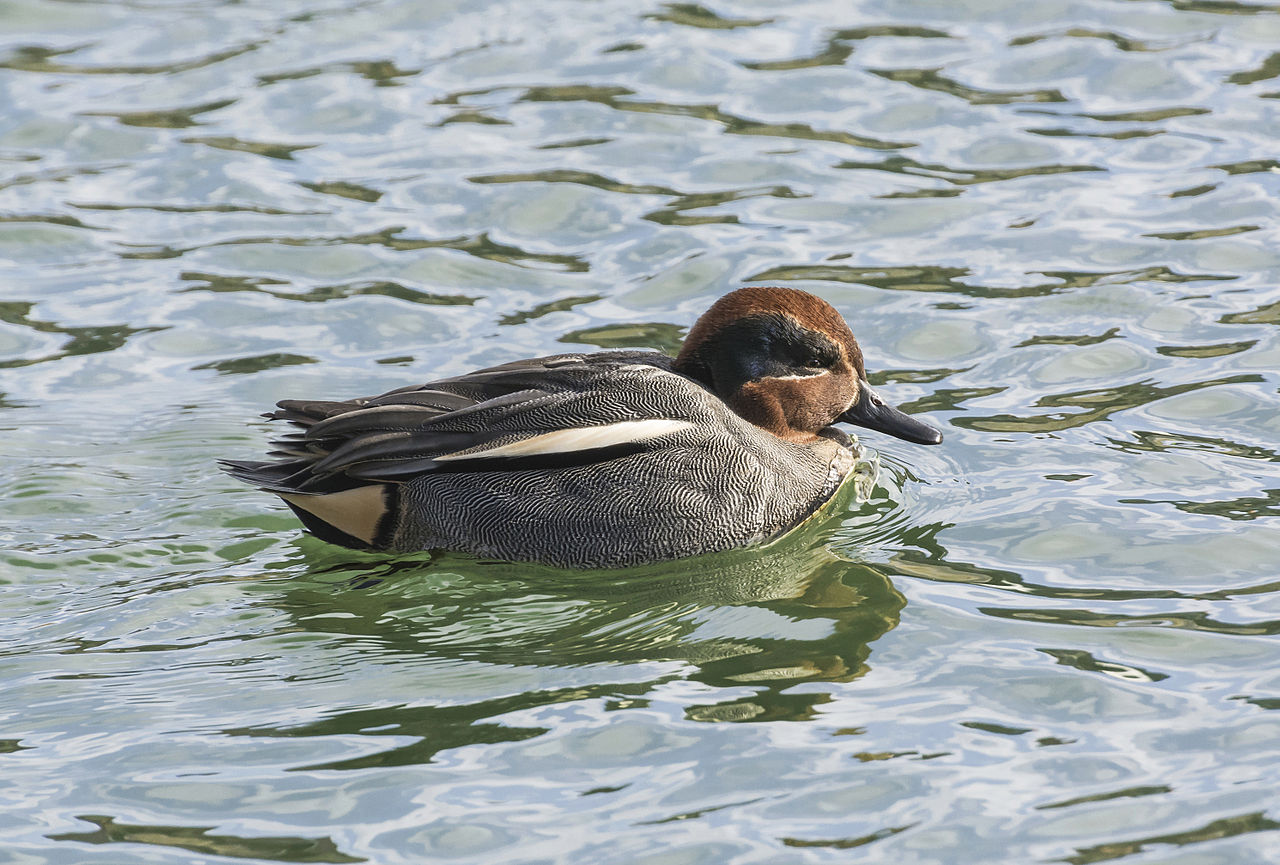
Very small, short-necked duck with a slim dark bill. The male has a chestnut head with a green, yellow-bordered eye patch, finely vermiculated grey flanks crossed by a white horizontal stripe above the wing, and a yellow triangle under the black stern. The female is brown-spotted with a pale mark at the bill base; both sexes show a green speculum with a white leading edge.
Confusion species
Garganey has a longer, paler bill, a more sharply defined pale spot at the female's bill base, and blue-grey forewings. Green-winged Teal males show a vertical white bar on the flank and lack the horizontal stripe. Size and the fast twisting flight rule out any larger duck.
Habitat
Shallow muddy waters with cover: bog pools, saltmarsh creeks, reed-fringed ditches, wet grassland and silting-up ponds. Breeds concealed in marsh, raised bog and dune slacks. Feeds by sieving along the waterline for seeds and small invertebrates, usually close against the vegetation.
Range and movements
Breeds from Iceland and Scandinavia to central Europe, thinly and locally in the Netherlands. Dutch wetlands, especially the Delta and Wadden area, hold large winter numbers from northern Europe and Russia. In Spain it is an abundant winter visitor to Doñana, the Ebro delta and inland lagoons.
- Resident
- Breeding (summer)
- Winter
- Passage
- Migration direction
- dark = core range, pale = thinly spread
Where and when to look
Work muddy pool edges in October and November, soon after sunrise when birds emerge from the reed fringe. Stay low and quiet, because disturbed flocks leave at speed. Check every male for a vertical flank bar, as Green-winged Teal turns up almost annually.
Conservation status
Numerous and widespread across the Palearctic, so not globally threatened. The Dutch breeding population is small and sensitive to drying out and the loss of small-scale wet marsh. As a winter visitor the species benefits from wetland restoration on floodplains and from reduced hunting pressure in parts of Europe.
Other species in this family
Mandarin duck · Egyptian goose · Northern pintail · Mallard · Greater white-fronted goose · Greylag Goose · Pink-footed goose · Snow goose · Lesser white-fronted goose · Taiga bean-goose · Bar-headed goose · Tundra bean-goose · Common pochard · Tufted duck · Greater scaup · Ferruginous duck · Brant · Canada goose · Barnacle Goose · Red-breasted goose · Common goldeneye · Long-tailed duck · Black swan · Bewick's swan · Whooper swan · Mute Swan · American wigeon · Eurasian wigeon · Gadwall · Velvet scoter · Common scoter · Smew · Common merganser · Red-breasted merganser · Red-crested pochard · Ruddy duck · Common eider · Northern shoveler · Garganey · Ruddy shelduck · Common shelduck