All species › Waterfowl › Ducks, geese and swans › Falcated duck
Falcated duck
Mareca falcata | Bronskopeend | Cerceta de alfanjes
An East Asian duck with a green-and-bronze head, a shaggy mane over the nape and long sickle-shaped tertials drooping over the stern. A drake on open water is unmistakable at range. Every British record nonetheless turns on the same question: genuine vagrant or escape from a collection?

Voice
Displaying drakes give a clear low whistle followed by a short trill, oo-trrr, with the mane raised and the rear end briefly cocked. The female quacks hoarsely in short series. Outside display the species is silent, and in Britain it is realistically heard only from a wintering drake displaying among Wigeon or Gadwall between January and March.
No freely licensed recording is available for this species yet.
Identification
Breeding drake: head dark glossy green with a coppery-bronze sheen, carrying a long mane that hangs over the nape, a small white forehead spot, a white throat and a narrow black collar. The body is finely grey-vermiculated, with long drooping sickle-shaped tertials over the tail and a cream-yellow triangle under the stern edged in black. The bill is wholly black. Female and eclipse drake are dark greyish-brown with heavily scalloped flanks, a greyish head with a short mane, an all-dark bill and a dark green speculum.
Confusion species
On females Wigeon is the usual error: it shows a pointed tail, a blue-grey bill with a black tip and warmer rufous flanks, whereas Falcated Duck has an entirely dark bill, coarser scalloping and an obvious bulge to the nape. Gadwall, which sits with both in the genus Mareca, gives away its female by the white speculum patch; Falcated shows dark green there. The breeding drake is unmistakable, but in eclipse it becomes a dark, heavily marked duck with a black bill, so check the sickle tertials and the maned nape.
Habitat
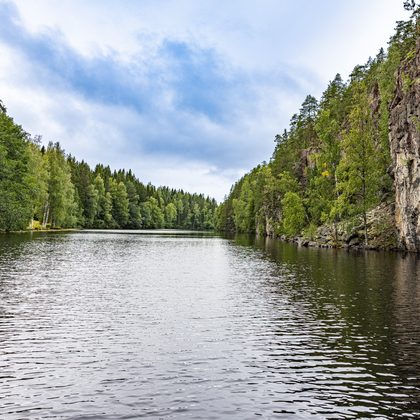
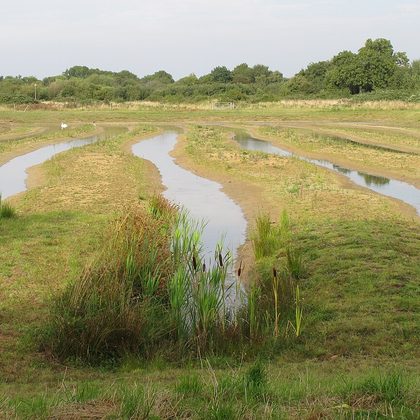
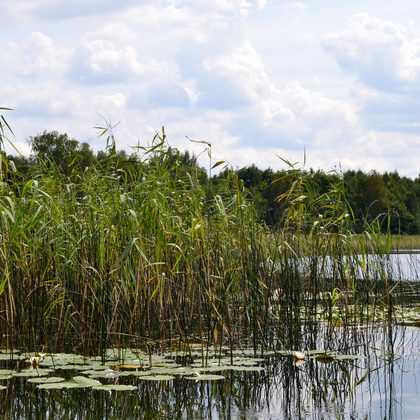
Shallow fresh water with plenty of marginal cover: broads, old river channels, flooded grazing marsh and reed-fringed pools. In Britain birds usually turn up on duck-rich gravel pits, reservoirs and washes, drifting among Wigeon and Gadwall. It feeds by dabbling and by grazing along the water's edge, and rarely dives.
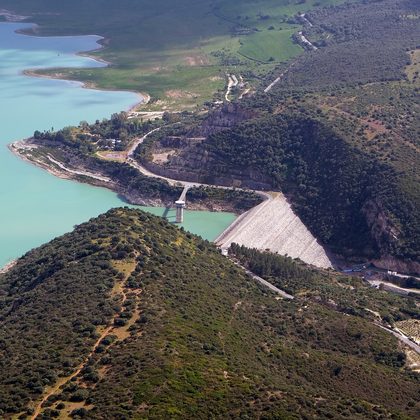
Where the bird is most at home, classified with EUNIS — the European standard for habitats.
Range and movements
Breeds in eastern Siberia, north-east China and Japan and winters across East Asia. In Europe it is very rare and almost always contentious, because the species is widely kept in wildfowl collections and escapes regularly. Britain admits it to Category A on the strength of a drake at Welney, Norfolk, from 9 to 27 December 1986, which then moved between Norfolk and Northamptonshire into early 1988. Treat every bird as a question of origin first: check for rings, clipped primaries and tameness before anything else.
- Resident
- Winter
- Passage
- dark = core range, pale = thinly spread
Where and when to look
The realistic chance is a winter drake among Wigeon and Gadwall on a large shallow water: the Ouse Washes, the Norfolk Broads or a big reservoir. Scan duck flocks for a dark head with a drooping mane, which reads at long range as a Wigeon that is the wrong shape and colour. Get the legs and wingtips on camera straight away, because that decides whether the record goes anywhere.
Conservation status
Near Threatened, with a world population of the order of ninety thousand birds and declines in parts of the range. Hunting and trapping in the wintering areas and the draining and development of wetlands across East Asia are the main pressures. European records stand apart from all of that and say nothing about the trend.