All species › Passerines › Sylvia warblers › Garden warbler
Garden warbler | Sylvia borin
Tuinfluiter | Curruca mosquitera
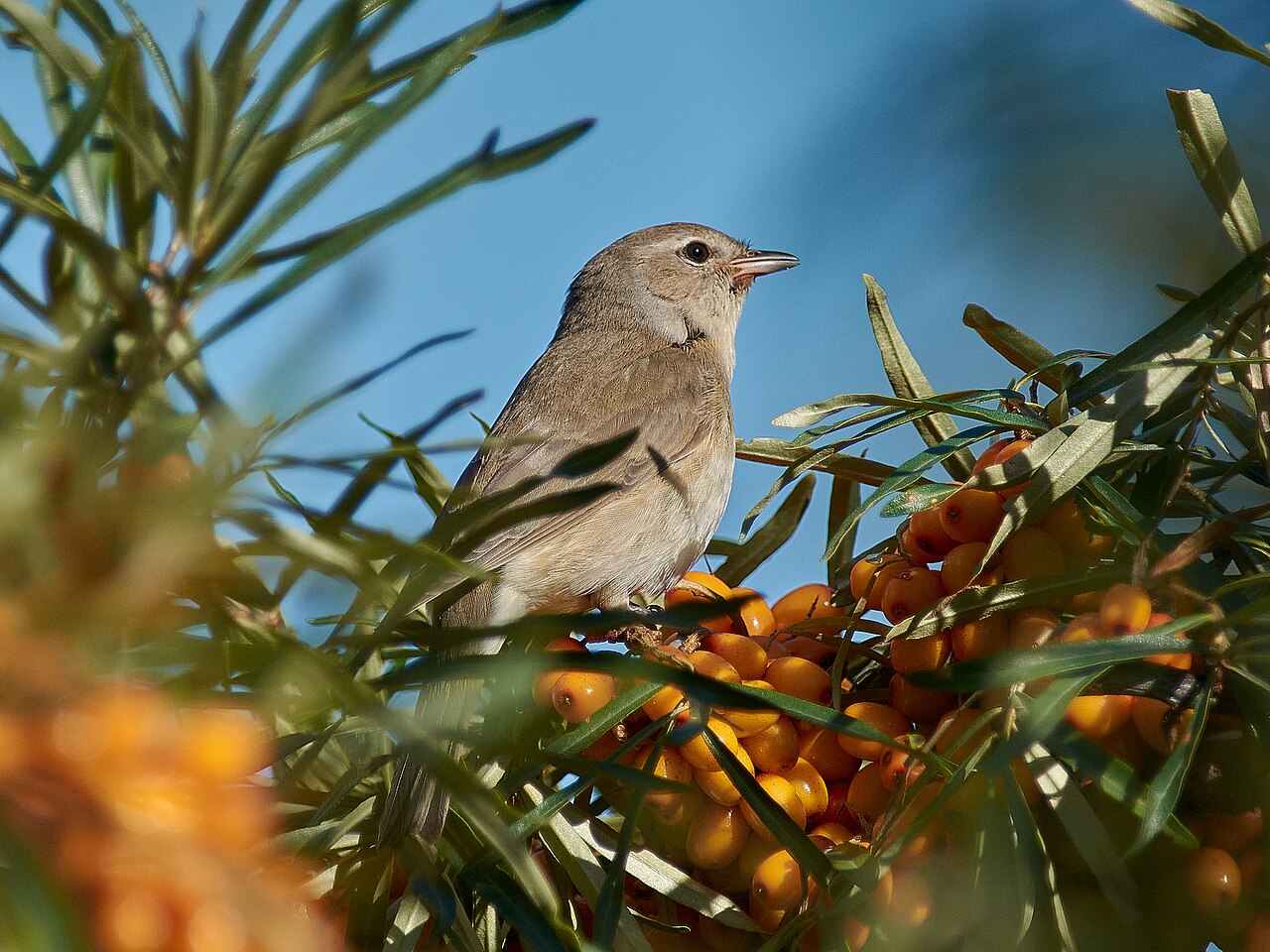
The garden warbler proves that a bird can be recognisable without a single field mark. No cap, no stripe, no wing panel, no colour: a plain olive-brown bird with a round, mild and completely expressionless face. That blankness is the mark. And despite the name it is hardly ever in a garden — it wants dense scrub with rank growth beneath it, and would rather sing for half an hour than show itself.
Voice
A long, even, babbling stream of clear and slightly rolling notes, usually three to eight seconds but regularly twenty seconds or more at a stretch, low in pitch, soft in tone and without any climax at all: a brook running over pebbles. That is exactly where it parts company with Blackcap, which also opens with a warble but bursts after a second or two into a run of loud, clear, bugle-like whistles. A rule that always works: on every singing Blackcap, count slowly to ten; if the phrase babbles evenly on all that time with no fluting finish, it is a garden warbler. The call is a full, rather dull chek, heavier and blunter than the pebble-hard tak of Blackcap, and an agitated bird gives a rasping churrr. Song runs from early May to mid-July, almost always from inside a bush, fiercest in the first two hours after sunrise and, on cool days, continuing through the middle of the day.
Recording: Philippe_Grange — CC0 · xeno-canto
Identification
A compact, rather thickset warbler with a round head, a full neck and a short, stout bill with a pale grey-pink base. Upperparts plain olive-brown without any pattern, underparts off-white with a buff wash on the flanks. A faint grey patch on the side of the neck is the only marking the bird possesses. The eye is dark, set in a narrow, ill-defined pale eye-ring that gives the face an open, faintly surprised look; there is no real supercilium. The legs are blue-grey and the tail is square-ended, with no white in the outer feathers. No wing bar and no pale wing panel. The primary projection is long, almost the length of the exposed tertials: the outline of a bird that flies to southern Africa. Sexes alike; juveniles slightly greyer above and warmer buff below.
Confusion species
Female and juvenile Blackcap are the main confusion — see their own species page, where the same difference is set out from the other side. Blackcap always has a crisply bordered cap, rufous-brown in the female, standing out clearly against the greyer side of the head; garden warbler has a completely uniform head with no border anywhere. Blackcap's bill is finer and longer, garden warbler's short and blunt with a pale base, and garden warbler looks fuller in the neck and rounder in the head. Icterine warbler shares the size and the scrub, but is sulphur-yellow on throat and belly, with blue-grey legs, a long bill with an orange lower mandible, a flat sloping forehead and a pale wing panel — four things garden warbler lacks. Marsh warbler is warmer brown, with a longer, flatter head, a fine pointed bill, a clearer supercilium and a rounded tail. In autumn on the coast a juvenile barred warbler is the classic trap: it is bulkier and heavier-billed, with two faint pale wing bars, pale tips to the tertials and scaly markings on the undertail coverts. In Iberia, western Orphean warbler can also come into play, being larger and longer-tailed, with a pale iris and white outer tail feathers.
Habitat
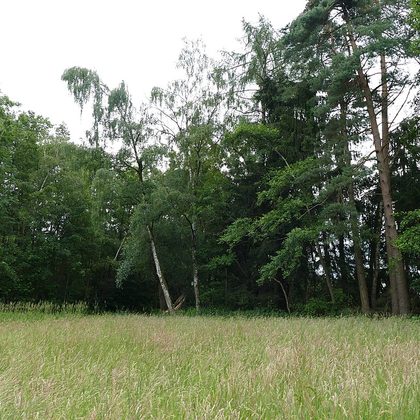
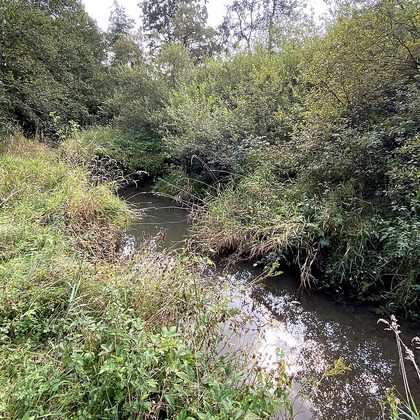
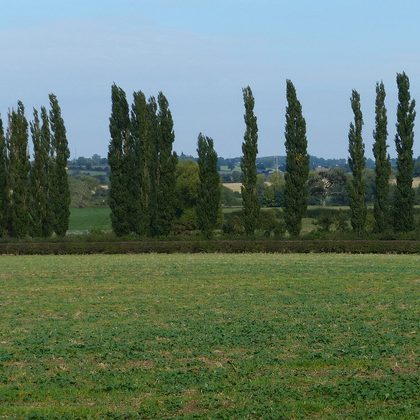
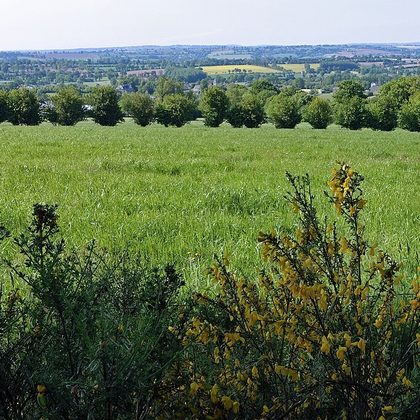
Dense, tall scrub with rank growth beneath it and scattered trees above: rank woodland edges and rides, young plantation and clear-fell with regrowth, bramble- and elder-rich hedgebanks, willow and alder thickets along ditches, streams and reed beds, dune scrub and neglected park margins. It avoids closed mature woodland without a shrub layer and, despite the name, the ordinary garden landscape: a tidy garden has nothing to offer it. The nest is placed low in bramble, nettle or young regrowth, rarely more than a metre above the ground.
Where the bird is most at home, classified with EUNIS — the European standard for habitats.
Range and movements
Breeds from northern Portugal, Ireland and Britain east to the Yenisei in Siberia, and from Lapland south to the Alps and the Balkans. In Britain there were some 145,000 territories in 2016, occupying around two-thirds of the 10-km squares, but the population has fallen by about thirty per cent since 1967. In the Netherlands it is a common breeder with 80,000 to 140,000 pairs. It arrives late, usually not before the end of April, and is gone again in September. Every population winters in Africa south of the Sahara, from the Sahel to southern Africa; western birds cross at Gibraltar and fly the desert by night, resting in the shade of a bush by day. In Spain it breeds sparsely in the mountain woods of the north, while large numbers pass through the whole country in August and September.
- Breeding (summer)
- Passage
- Migration direction
- dark = core range, pale = thinly spread
Where and when to look
Mid-May, the first hour after sunrise, along a rank woodland edge or a bramble-rich hedgebank. Do not go looking: the garden warbler sings from inside the bush and will come into view for a few seconds of its own accord. Use those seconds for three things — no cap, short blunt bill, blue-grey legs — and the bird is yours. If the voice is not yet secure, find a place where Blackcap and garden warbler sing side by side and listen to nothing but the end of the phrase; one morning fixes it for good. In August and September, elder and bramble heavy with ripe fruit are the best bet: the birds are entirely silent then, but show themselves far better than in spring.
Conservation status
Not threatened, with a very large European population, but the long British decline is real and is shared across much of north-west Europe. Scrub is its whole existence, so the flailing of woodland edges and ditch banks in the breeding season, the tidying away of young regrowth and the loss of untidy corners take nesting cover directly. As a complete trans-Saharan migrant it is exposed on top of that to drought in the Sahel and to the loss of scrub along the flyway, and cool wet Junes cut breeding success in the north of the range.