All species › Passerines › Kinglets › Goldcrest
Goldcrest | Regulus regulus
Goudhaantje | Reyezuelo sencillo
With Firecrest, the Goldcrest is the smallest bird in Europe: nine centimetres and five to seven grams, the weight of a twenty-pence piece. That such a scrap sits out a Scandinavian winter, and crosses the North Sea by night in October, is among the odder facts in European ornithology. You seldom find one by looking; you find it by listening — provided you can still hear the notes.

Voice
This is where the species becomes a practical problem. The call is a run of three or four thin, high notes on one pitch, see-see-see, with no body under them at all. They sit around eight kilohertz, higher than almost any other European bird sound, and that is precisely the band human hearing loses first. Many birdwatchers over fifty hear a Goldcrest only within a few metres, and over sixty often not at all. This is not a curiosity but a fact to plan your fieldwork around: whoever cannot hear the species will consistently under-record it. The song is one of the pleasanter sounds of the conifer wood — a high, rhythmic swinging back and forth, see-see-tiddely-eet, see-see-tiddely-eet, repeated three or four times and closed with a quick, slightly untidy flourish. Heard from March into July, and briefly again on mild winter days. If the notes are gone, a recorder with headphones goes a long way, as does a younger pair of ears alongside you.
No freely licensed recording is available for this species yet.
Identification
A round, short-tailed mite with a big head, a needle-fine bill and a large dark eye set in a blank, off-white face. That blank face is the surest mark of the species: no supercilium, no eye-stripe, only a pale ring of fine feathering around the eye that gives the bird a permanently startled look. Upperparts olive-green, underparts off-white with a yellowish wash on the flanks. A lemon-yellow stripe runs along the crown, sharply bordered with black on both sides; in the male the yellow encloses an orange core, visible only when the crown feathers are raised, which in practice means a displaying or squabbling bird. Two pale bars cross the wing, the lower one bounded beneath by a small black mark at the base of the secondaries: tiny, but present on every bird. Legs dark with dull yellow feet. First-autumn birds lack the crown stripe altogether and are then plain greenish, with the same empty face.
Confusion species
Firecrest is the only real confusion — see its own species page, where the same difference is set out from the other side. It is all in the head: Firecrest has a long, clean white supercilium with a black stripe running straight through the eye beneath it, and a pale cheek patch below that again, while Goldcrest has none of it and keeps a uniform dull face. Then look at the shoulder: Firecrest carries a bronze to golden patch there which Goldcrest lacks. The Goldcrest's crown is yellow, with a hidden orange core in the male only; the Firecrest's is orange to fiery red in both sexes. At distance and against the light it is the contrast that tells: Firecrest looks brighter, whiter and greener, Goldcrest duller and greyer. If all you have is a silhouette, record nothing. In autumn a Yellow-browed Warbler can also get in the way: it is larger and more elongated, with a long yellow supercilium and a bold wing bar, and calls a loud rising tsoo-weest. The thin calls of Long-tailed and Blue Tit resemble the Goldcrest's, but neither bird is anything like as small or as round.
Habitat
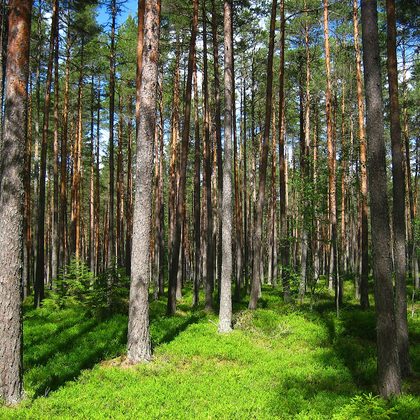
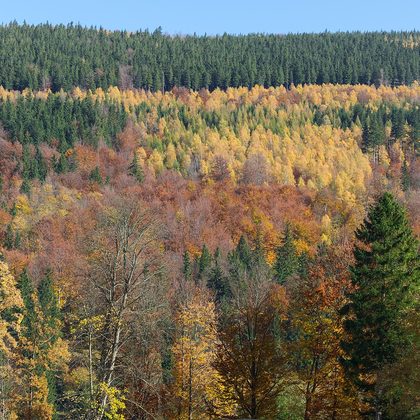
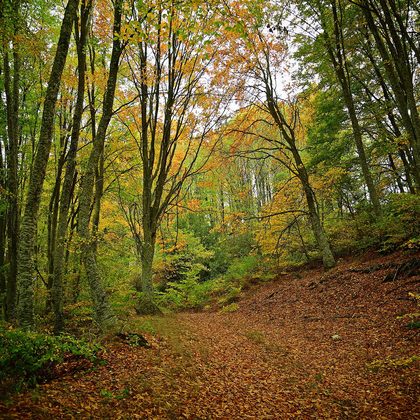
Conifer wood is the core, and within it Norway spruce above all: mature stands, young plantation, shelter belts along pasture, a single spruce in a garden. Silver fir, Douglas fir and larch will serve, and in mixed woodland the bird holds on wherever clumps of conifer remain. It also breeds in gardens, parks and churchyards with yew, holly, cypress and conifer hedging — in built-up areas that is often the only place it sits. Outside the breeding season it widens its choice considerably and drifts with tit flocks through broadleaved wood, hedgebanks, dune scrub and even reed fringes. The nest is a small, deep hanging cup of moss, lichen and spider silk, slung beneath the end of a spruce branch and thickly lined with feathers; it holds eight to eleven minute eggs, which the female incubates in two layers, one above the other.
Where the bird is most at home, classified with EUNIS — the European standard for habitats.

Range and movements
From Ireland and the Azores to Japan, in a broad band through the conifer belt of Europe and Asia and further south in the mountain conifer forests. In the Netherlands a common breeder of virtually every conifer wood and conifer garden, present all year, with an enormous influx of Scandinavian and Baltic birds laid over it in October; these cross the North Sea by night, and on a good autumn day dozens at a time sit in the dune scrub and on the Wadden islands, working through sea buckthorn and elder where there is not a needle in sight. In Spain it breeds in the humid conifer forests of the Pyrenees, the Cantabrian mountains and the Iberian System, and in winter spreads much more widely, down into the lowland pine woods of the interior.
- Resident
- Breeding (summer)
- Winter
- Passage
- Migration direction
- dark = core range, pale = thinly spread
Where and when to look
The surest route is a winter tit flock. Goldcrests almost always travel at the back of one; from November to February walk a wood edge, stand still as soon as you hear the chatter, look up and wait — the birds come to you and feed within a few metres. In the conifer wood itself it pays to walk a spruce edge in March or April and wait for song; train your binoculars on the outer twigs rather than the trunk, because the bird feeds under the branch tips and regularly hangs upside down to do it. And the most honest tip of all: test first whether you can still hear the species. Play a recording at home and turn the volume down until it just disappears; then you know how close you have to get in the field.
Conservation status
Not globally threatened, and one of Europe's most numerous breeding birds, with a population running into tens of millions of pairs. Numbers do swing hard. A winter of prolonged frost and snow can cost more than half the local birds, but with two clutches of eight to eleven eggs a year the gap is usually closed within two or three seasons. Over the longer run two things pull against each other: the conversion of conifer plantation to broadleaved woodland removes nest sites, while drought and bark beetle outbreaks are taking out whole spruce stands. Where spruce and Douglas fir are left standing, the Goldcrest stays.