All species › Passerines › Kinglets › Common firecrest
Common firecrest | Regulus ignicapilla
Vuurgoudhaantje | Reyezuelo listado
As small as the Goldcrest but far more boldly marked: a white supercilium, a black stripe straight through the eye and a crown running from orange to fiery red. The Firecrest is a southern bird that has settled firmly across the Low Countries over the past half century, and it is the default crest of Iberia. See the head well and you never doubt it; see only a silhouette high in a pine and you are right to.

Voice
The call resembles the Goldcrest's but is fuller, slightly lower and more emphatic: zit or zi-zi-zi, more sharply attacked and less thinly drawn out. The same practical objection applies, though: this sound too sits so high that older observers lose it first. Over fifty, many people hear a Firecrest only at close range; over sixty, sometimes not at all — and a large part of the species then vanishes from the count without the counter noticing. Be honest about that when surveying, and work with a recorder or a younger companion where it matters. The song is the easiest separation from Goldcrest: a run of eight to twelve identical thin notes, zi-zi-zi-zi-zi-zi, gradually accelerating and rising in volume and then stopping abruptly. There is no rhythmic swing in it and no closing flourish, whereas the Goldcrest swings and finishes with an untidy curl. Heard from February into July, and in the south again in late summer.
No freely licensed recording is available for this species yet.
Identification
Round and short-tailed like the Goldcrest, but with a patterned head and brighter colours. An orange to fiery red stripe runs along the crown, black-bordered on both sides; unlike the Goldcrest that colour is present in female as well as male, though the female is more yellow-orange and the male deeper red. Below it runs a long, clean white supercilium reaching well behind the eye, and below that a narrow black stripe straight through the eye, with a pale cheek patch beneath again. Upperparts bright olive-green, underparts cleaner white than the Goldcrest's, with a silvery sheen. A bronze to golden patch sits on the side of the neck and shoulder — the best mark when the head turns away. Two pale wing bars, with the same black mark beneath at the base of the secondaries. First-autumn birds have no colour on the crown yet, but the white supercilium and black eye-stripe are already fully formed and settle the identification.
Confusion species
Goldcrest is the only real confusion — see its own species page, where the same difference is set out from the other side. It has a completely blank, off-white face: no white supercilium, no black eye-stripe, only a pale ring around a large dark eye. It lacks the bronze shoulder patch, is duller and greyer green above and dirtier white below, and its crown stripe is yellow, with a hidden orange core in the male that you will hardly ever see. On a young Firecrest without crown colour the head is therefore still decisive: a stripe above and a stripe through the eye means Firecrest, a blank face means Goldcrest. In autumn Yellow-browed Warbler comes into it: clearly larger and more elongated, with a long yellowish-white supercilium, two yellow wing bars and a pale crown stripe, and an altogether different loud rising call. A Chiffchaff or Willow Warbler high in a tree may cause a moment's doubt, but both are a third larger, longer-tailed, and lack the black wing mark.
Habitat
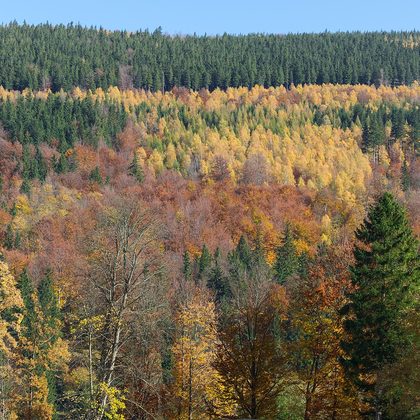
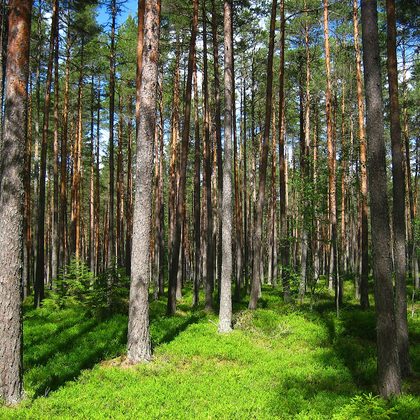
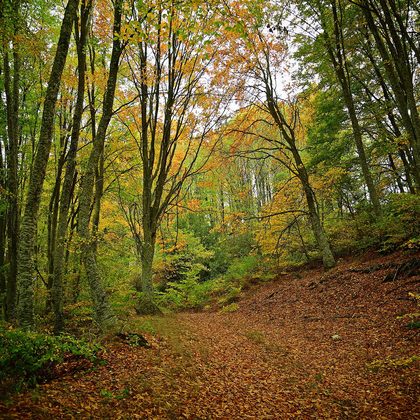
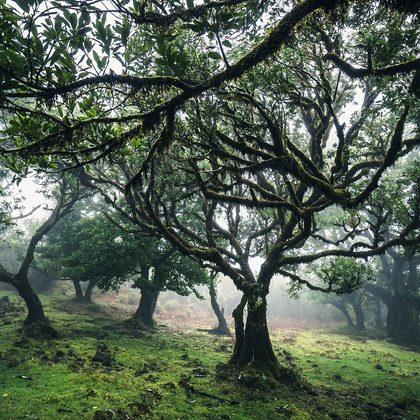
More catholic than the Goldcrest. The core is mixed woodland with a dense evergreen underlayer — mature Douglas fir and spruce with holly, yew or ivy beneath, and mixed broadleaved woods with the odd conifer in them. Pure conifer wood serves as well, as does broadleaved wood with heavy ivy on the trunks, and in gardens, parks and churchyards with conifers it often sits alongside the Goldcrest. Around the Mediterranean the picture shifts: there it breeds in holm oak and cork oak forest, in pine wood, in the Spanish fir stands of the southern sierras and up into the spruce belt of the Pyrenees. The nest is the same hanging cup of moss, lichen and spider silk as the Goldcrest's, but more often slung in ivy, yew or a broadleaved tree; seven to eleven eggs, two broods a year.
Where the bird is most at home, classified with EUNIS — the European standard for habitats.

Range and movements
A bird of Europe, north-west Africa and the Caucasus and of nowhere else on earth: from Portugal and Morocco east to Belarus, Turkey and the Caucasus, with settled populations on the Balearics, Corsica, Sardinia, Sicily and Crete. In the Netherlands it was a rarity until well into the twentieth century; since the 1970s it has increased sharply and now breeds in many thousands of pairs on the sandy soils, in the dunes and in old park woodland. Part of the population moves off to France and Iberia in autumn, but in mild winters many stay. In Spain it is the common one of the two: widespread and numerous in virtually every wooded area of the peninsula, from the Cantabrian slopes to the Sierra de Grazalema, and on the Balearics.
- Resident
- Breeding (summer)
- Winter
- Passage
- Migration direction
- dark = core range, pale = thinly spread
Where and when to look
March and April are the best months, when males are singing and the leaves are still thin. Walk a wood edge where conifer meets holly or ivy, and listen to the shape of the song: if the run accelerates and then stops dead, it is a Firecrest; if it swings and curls at the end, it is a Goldcrest. Only then work for a view, training your binoculars on the outer twigs rather than the trunk. In winter it pays to search ivy-covered trunks and clumps of yew, because the Firecrest feeds lower than the Goldcrest and will sometimes let you watch it at two metres. In Spain, a holm oak wood with dense understorey in the early morning is the surest place of all.
Conservation status
Not globally threatened, and in north-west Europe one of the clearest winners of recent decades: the species has pushed north and gained ground in the Netherlands, Belgium, Denmark and southern Sweden, helped by milder winters and by the maturing of last century's conifer plantations. Hard, prolonged frost remains the brake, because a six-gram bird burns through most of its reserves in one long freezing night; after such a winter numbers drop sharply, then bounce back within a few years. Around the Mediterranean, forest fire and the loss of the damp evergreen understorey are the main pressures.