All species › Tubenoses › Petrels and shearwaters › Great shearwater
Great shearwater
Ardenna gravis | Grote pijlstormvogel | Pardela capirotada
The Great Shearwater is the best-marked of the large shearwaters: a dark cap, a white collar, a black bill and a dark smudge in the middle of the white belly. It breeds on a handful of islands in the South Atlantic and passes through the North Atlantic in millions each year, including along the coasts of western Europe.

Voice
Usually silent. Squabbling over food at sea, especially in flocks behind fishing vessels, it gives a hoarse, nasal, quarrelsome eh-eh-eh or a growling gra-gra. At the Tristan da Cunha colonies birds call at night, but that is far outside the area of this guide. Anyone seeing one from a European headland will almost never hear it.
No freely licensed recording is available for this species yet.
Identification
Slightly smaller and more compact than Cory's Shearwater, with narrower wings held stiffer. The dark brown cap reaches below the eye and is sharply cut off by a white collar, the best feature at range. The bill is slim and black, not yellow. The upperparts are brown with pale feather edges, giving a scaled look, and a narrow white horseshoe crosses the base of the tail. A dark patch sits in the middle of the white belly, and the white underwing carries irregular dark lines and a dark axillary mark. Flight is faster and stiffer than in Cory's, with short bursts of strong beats between the glides.
Confusion species
Cory's Shearwater lacks the cap and collar, has a yellow bill and an evenly greyish-brown head grading into the white. Scopoli's Shearwater likewise, and both are broader winged and slower. Sooty Shearwater is wholly dark. Manx Shearwater is much smaller, black and white, and shows no cap, belly patch or white tail band. A juvenile Kittiwake can confuse in poor light on a seawatch, but has a black neck bar, a black tail band and a quite different fluttering flight.
Habitat
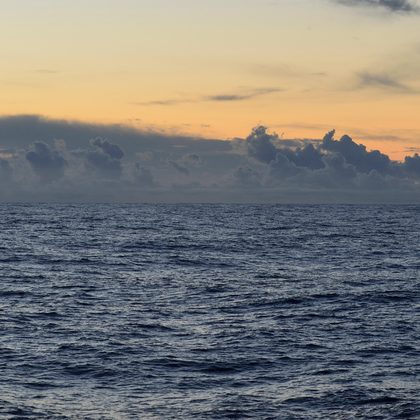
Entirely a bird of the open ocean, favouring cooler water and the shelf edge, where it joins mixed seabird flocks. It takes fish and squid from the surface but also dives properly, several metres down, swimming with its wings. Hundreds may gather around a trawler, pitching onto discards and fighting noisily. In this guide's area it never comes ashore.
Where the bird is most at home, classified with EUNIS — the European standard for habitats.
Range and movements
Its breeding grounds lie far outside the area of this guide, on Tristan da Cunha, Gough and Nightingale in the South Atlantic. From April the birds work clockwise round the North Atlantic: north along the American seaboard to Newfoundland and Greenland, east across the ocean in August, then south past Ireland, the Bay of Biscay and Iberia from September to November. That makes it a genuine passage migrant here rather than a vagrant. Off south-west Ireland and Cornwall it can be numerous in late summer, while in the southern North Sea and off the Netherlands it drops to a handful of birds each autumn, nearly always in a sustained north-westerly.
- Winter
- Passage
- dark = core range, pale = thinly spread
Where and when to look
For a North Sea record, pick a seawatch point such as Westkapelle or Camperduin on the second or third day of a westerly gale between late August and mid-October, and watch for the contrast between dark cap and white neck. To see the species reliably, go to the south-west of Ireland or into the Bay of Biscay: the September ferry to Santander often produces tens to hundreds of birds, usually around midday over deep water.
Conservation status
Not globally threatened (IUCN: Least Concern), with many millions of pairs but almost all of them on three island groups. That concentration is the weak point: a single introduced rodent population, or an oil spill at Tristan da Cunha, would affect a large share of the world total. Fisheries bycatch, plastic ingestion and the traditional, now regulated, harvest of chicks on the islands all play a part as well.