All species › Passerines › Leaf warblers › Green warbler
Green warbler | Phylloscopus nitidus
Groene fitis | Mosquitero verde
Green Warbler is the southern counterpart of Greenish Warbler: a leaf warbler of the mountain forests of the Caucasus, north-east Turkey and northern Iran, so a breeding bird of our map area, yet known to most birders only as an extreme vagrant. It is exactly what the name promises — the greenest and yellowest bird of the whole complex — and since 1983 it has turned up now and then on the coasts of north-west Europe.

Voice
The call is trisyllabic — chi-su-wee — short, clear and with a close that rises unmistakably; on a sonagram it draws a lazy w. That rising ending is the only genuinely reliable field character against Greenish Warbler, whose call is disyllabic and falls at the end. The song is delivered in fairly short phrases that start without an introductory note and are built from complex, twisting elements with almost no repetition, so that each phrase sounds unlike the last. Greenish, by contrast, sings in clear repeated blocks — the difference between a handwritten and a printed line. Song runs from late April into July, usually from high in the crown of a beech or hornbeam.
No freely licensed recording is available for this species yet.
Identification
Build and size as Greenish Warbler, but the colour is different: fresh grass-green above, with an obvious yellow wash over the supercilium, ear-coverts and throat that carries onto the upper breast. The rest of the underparts are white with a yellow-green cast on the flanks. The supercilium is long and broad, usually distinctly yellower than in Greenish and running onto the base of the bill, with a dark eye-stripe beneath it. The greater-covert wing bar is broader and yellower than in Greenish, and on a fresh bird there is often a second, faint bar on the median coverts. The bill looks substantial with a strongly orange lower mandible and no dark tip; the legs are pale grey-brown. On a worn summer bird almost everything fades — except the yellow on the face, which is the very feature that lasts longest.
Confusion species
Everything turns on Greenish Warbler, and the difference is one of colour and of call. Greenish is grey-green rather than grass-green and silky white rather than yellow-washed; its supercilium is white, not yellow, and its single wing bar is narrow and off-white. See its own species page, where the same difference is set out from the other side. The call decides it: Greenish is disyllabic and falls away at the end, Green Warbler is trisyllabic with a clearly rising close. Be wary of a single photograph — hard sunlight on a fresh autumn bird turns any Greenish into a Green. Two-barred Warbler has two crisply marked white wing bars and no yellow on the face at all. Yellow-browed Warbler is smaller, with a pale crown stripe and white tertial fringes. Arctic Warbler is larger and duller, with a dark tip to the lower mandible and a supercilium that fails to reach the bill base.
Habitat
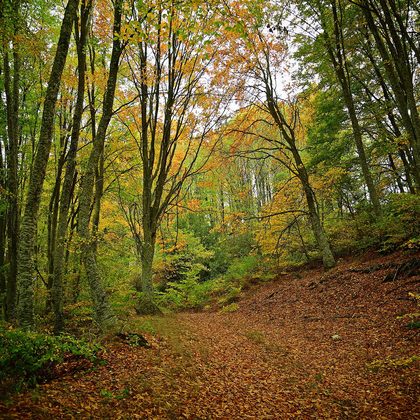
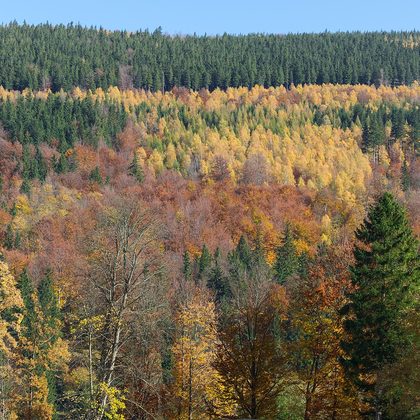
Breeds in humid montane forest of the Caucasus, the Pontic mountains and the Caspian lowlands: beech, oak and hornbeam woodland with a dense understorey of holly, rhododendron and bramble, mixed forest with spruce and pine, and wooded stream valleys up to about 2,500 metres. Also in old parkland and village woodlots and in overgrown coppice on the mountain slopes. It feeds high in the crown and on the outer branches. In winter it is in the broadleaved woods and gardens of southern India and Sri Lanka.
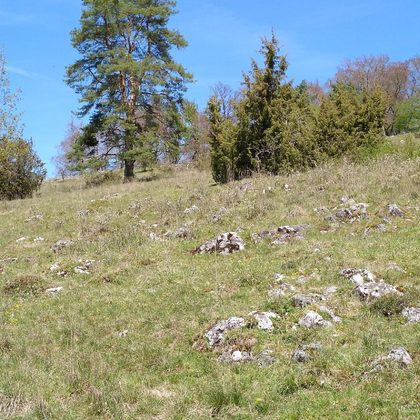
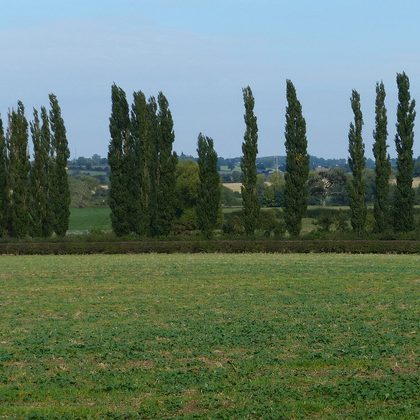
Where the bird is most at home, classified with EUNIS — the European standard for habitats.
Range and movements
Breeds in north-east Turkey, throughout the Caucasus — Georgia, Armenia, Azerbaijan and southern Russia — and along the Caspian into the Elburz of northern Iran, with an outpost in north-west Afghanistan; it winters in south-west India and Sri Lanka. The breeding range therefore lies largely inside our map area, in its eastern corner. As a vagrant to north-west Europe it is exceptionally rare: the first British record was a bird on the Isles of Scilly in autumn 1983, and the Netherlands has four accepted records, at Vlaardingen in June 2019, Texel in June 2020, Borsele in July 2023 and Bronckhorst in August 2025. Records have increased since 2008, largely because birders now routinely record calls. In Spain it is an extreme rarity.
- Breeding (summer)
- Passage
- dark = core range, pale = thinly spread
Where and when to look
Anyone who genuinely wants to see one should go to the breeding grounds: the second half of May in the beech and hornbeam forest of Georgia or the Turkish Pontic coast, early in the morning, looking high in the canopy for a vivid green bird with a yellow head. Closer to home there is only one workable method, and it involves a recorder: any late-spring or summer vagrant from this complex is a Green Warbler only once the call has been captured and the rising, trisyllabic close made visible. Every accepted north-west European record has come about that way. Beyond that, look for the yellow on supercilium and throat, which stays visible even on a worn bird.
Conservation status
Not threatened. The breeding population in the Caucasus and northern Iran is large and there is no sign of a decline, though locally the felling of old beech forest and grazing of the shrub layer are pressures. Since 1991 the bird has been treated as a full species rather than as a form of Greenish Warbler, which is why the European record series is so short: many older birds were never assigned a name.