All species › Birds of prey › Hawks, eagles and kites › Hen harrier
Hen harrier
Circus cyaneus | Blauwe kiekendief | Aguilucho pálido
The Hen Harrier is the heaviest and broadest-winged of the three grey harriers, and in the Netherlands above all a bird of winter: gliding low over saltmarsh, dune slacks and stubble with that unmistakable searching, rocking flight.

Voice
Away from the breeding territory it is almost always silent; the winter birds on the saltmarsh are never heard. At the nest and in display a rapid chattering kek-kek-kek-kek, higher and more hurried in the male than in the female. The female begs at food passes with a plaintive, insistent peee-yew, often the first sign that there is a nest nearby.
Recording: Benoît Van Hecke — CC BY-SA 4.0 · Wikimedia Commons
Identification
Start with the flight silhouette: the wings are held in a clear shallow V, the bird rocks slightly on its long axis and quarters the vegetation low and slow. For a harrier the wing is broad and rather blunt-tipped, with five fingered primaries; the tail is long and fairly broad. Male: pale blue-grey on head, breast and upperparts, white on belly and undertail coverts, with a sharply cut black wingtip covering roughly the outer five primaries — like a black hand on a grey arm. The trailing edge of the wing is grey, not dark-edged, and the rump is white. Female: brown, with a barred tail, a conspicuous white rump patch and streaked underparts; the underwing is coarsely barred across both hand and arm. Immature: like the female but warmer rusty below, the streaking thinning out towards the belly, and with a less contrasting face than in the other two species.
Confusion species
The three grey harriers are the classic pitfall, and the answer lies in build and primary pattern. The male Hen Harrier is the bulky, broad-winged one with a blunt tip and a black wingtip that starts abruptly and covers the outer five primaries. The male Montagu's is clearly slimmer, with a pointed wing, only four fingered primaries, a black bar across the upperwing secondaries, two dark bars on the underwing and rusty streaks on the flanks; its rump is grey or barely white. The male Pallid is paler still, almost white, with only a narrow black wedge on the outer four primaries running into the wingtip like a thin pen stroke. On females and juveniles the head pattern decides it: Pallid shows a dark mask with a narrow pale collar closing round the neck like a boa, plus a small white spot above the eye; Montagu's has a less complete collar and a finer-barred inner underwing; Hen Harrier is the bulkiest, has the largest white rump and the least sharply drawn face. Check the inner underwing too: coarsely barred across its whole width in Hen Harrier, strikingly pale with a dark trailing edge in Pallid, and marked with two narrow dark bars in Montagu's.
Habitat
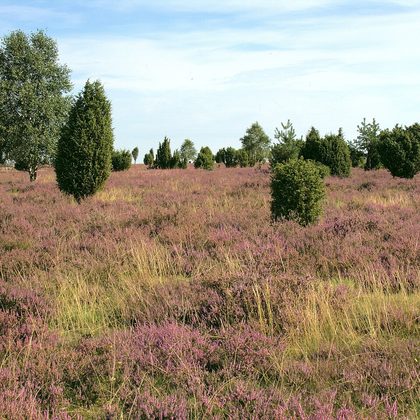
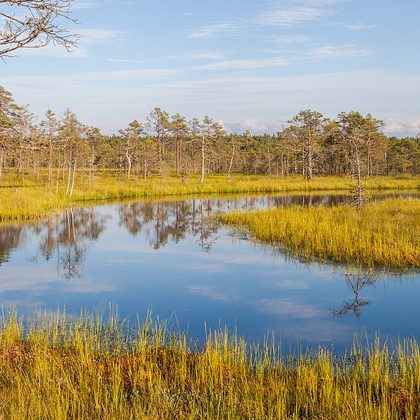
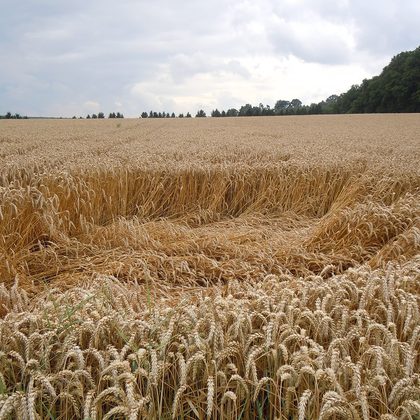
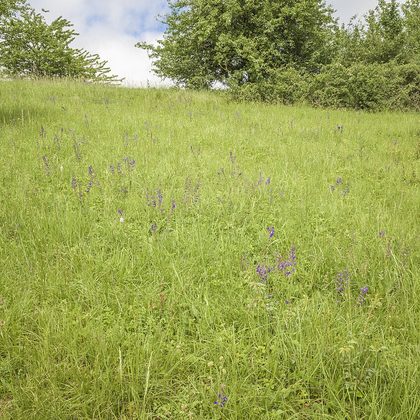
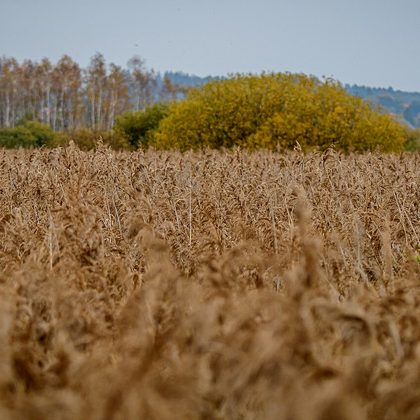
Breeds in open, treeless country with dense low vegetation: dune slacks and dune heath on the Wadden islands, raised bog, young plantations and clear-fell, extensive heather moor and, further north, tundra and birch scrub. Outside the breeding season it hunts over saltmarsh, rank reed edges, grassland, stubble and winter cereals. In winter it roosts communally on the ground in reeds or rough grass, often with dozens of birds together.
Where the bird is most at home, classified with EUNIS — the European standard for habitats.

Range and movements
A breeding bird of northern and eastern Europe with a western arm through Britain, Ireland, France and Spain. In the Netherlands it has all but disappeared as a breeder — a handful of pairs on the Wadden islands — but is easy to see in winter on the saltmarshes of Friesland and Groningen, in the Delta, on the islands and over the Flevoland polders. In Spain it breeds scattered through the northern half, in mountain heath and fallow cereal country, and winters in the lowlands of Extremadura and Castile.
- Resident
- Breeding (summer)
- Winter
- Passage
- dark = core range, pale = thinly spread
Where and when to look
Between November and February, take a saltmarsh dyke or a viewpoint beside a large reedbed in the last hour before sunset. That is when birds drift in low to roost, and a single evening regularly produces both a grey male and several brown females. Over arable land look for the rocking, low hunting flight; a harrier sailing slowly over stubble on raised wings is recognisable at several hundred metres.
Conservation status
Not globally threatened (IUCN: Least Concern), but the European population has fallen sharply in the west. In the Netherlands it has nearly gone as a breeder through scrub encroachment in the dunes, predation and the collapse of rabbits as a prey base. In Britain, illegal persecution on grouse moors holds numbers far below what the habitat could support. Northern and eastern populations are more stable, and Dutch winter numbers track those of Scandinavia and the Baltic.