All species › Passerines › Shrikes › Iberian grey shrike
Iberian grey shrike | Lanius meridionalis
Iberische klapekster | Alcaudón real
The Iberian Grey Shrike is the grey shrike of the dry south-west. In the dehesa, on the steppes and along the almond groves of Spain and Portugal it sits bolt upright on a fence post, a wire or the top of a thistle, watching for grasshoppers, lizards and mice. Whatever it does not eat at once it impales on a thorn or on barbed wire.

Voice
Usually silent, but when agitated it gives a hard rattling chek-chek-chek and a nasal, slightly plaintive eeoo. The song is soft and sustained and comes from a high perch, chiefly on still winter and spring mornings: a hesitant, faintly grating warble carrying fragments of other birds — a pipit, a finch, the call of a Kestrel. Such imitations help draw small songbirds within striking distance.
No freely licensed recording is available for this species yet.
Identification
A slim, long-tailed shrike the size of a Blackbird. The upperparts are dark slate grey, a shade darker still on crown and nape than in Great Grey Shrike. The throat is white, but breast and flanks carry a clear pinkish-buff wash that shows well in side light. A broad black mask runs from the base of the bill to behind the eye, bordered above by a conspicuous white brow that continues over the ear coverts. The wing is black with a single white patch at the base of the primaries; that white stays small and does not extend into the secondaries or the tertial tips. The tail is long and black with white outer feathers. The bill is heavy and strongly hooked. Juveniles are browner grey, with a dull mask, cream fringes to the wing coverts and fine vermiculation below. The silhouette is that of the whole group: ramrod straight on the highest free perch, the tail swinging or slowly rotating, and a low, undulating flight with a swift climb to the next lookout.
Confusion species
Great Grey Shrike is the yardstick. It is a paler ash grey, clean white below without any pink, has a narrower white line above the mask and more white in the wing, often reaching into the secondaries; in Spain it is a scarce winter visitor to the north-east, so the two are rarely seen side by side. Northern Shrike is larger again and paler, with a longer bill and a stronger hook, and young birds show fine vermiculation across the whole underside; in this region it is no more than an extreme rarity. Lesser Grey Shrike is more compact, shorter-tailed and longer-winged, with black running right across the forehead and a shorter bill, and it perches strikingly upright; it is also a summer bird, whereas the Iberian is here all year. Woodchat Shrike is less of a problem, with its chestnut crown and black back. When in doubt, judge the shade of grey first, then the pink, and only then the wing patch.
Habitat
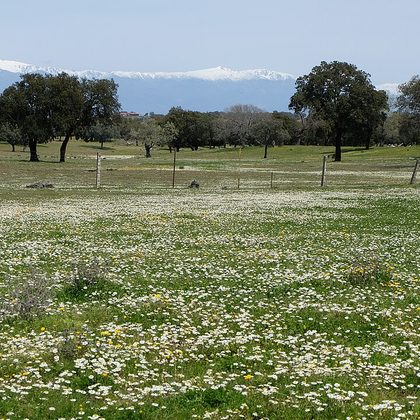
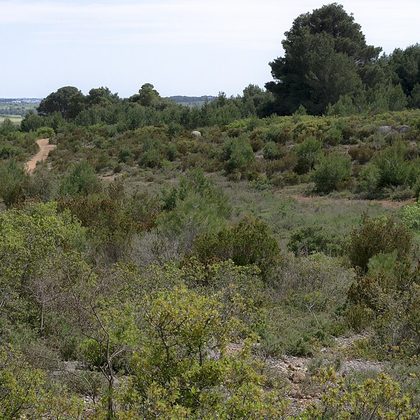
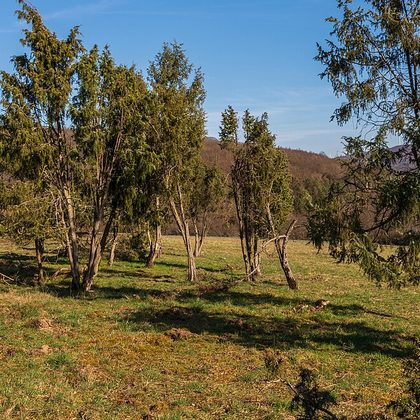
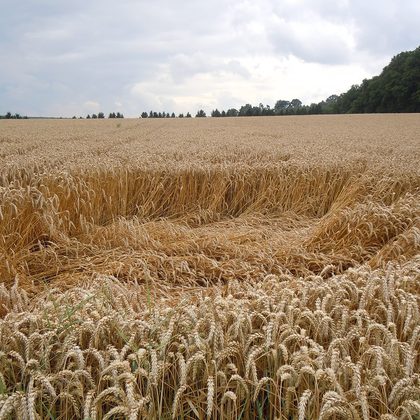
Wide, dry, half-open country with plenty of scattered lookouts: dehesa with well-spaced holm oaks, garrigue and low matorral, thin steppe grassland, almond and olive groves with bare ground beneath, and the rough margins of dry arable land. The requirement is the same everywhere — high perches to hunt from, short or bare ground on which prey can be seen moving, and thorn bushes to store it in. A pair holds the same large territory all year.
Where the bird is most at home, classified with EUNIS — the European standard for habitats.
Range and movements
The entire world range lies in south-western Europe: almost the whole Iberian Peninsula, from Andalusia and the Alentejo to the Ebro valley and the Spanish tablelands, plus a strip of Mediterranean southern France in Languedoc and Provence. Exactly where the French boundary with Great Grey Shrike runs is disputed: in the Rhône valley and on the southern Causses the two are recorded differently by different observers and the same birds are read in different ways. Beyond that area the species does not occur; it does not migrate, and birds usually stay within a few kilometres of their territory.
- Resident
- Winter
- Passage
- dark = core range, pale = thinly spread
Where and when to look
Good all year, but easiest in winter and early spring when the grass is short. Drive slowly along a track through dehesa or steppe and scan the top wire of every fence and the tops of isolated bushes; a white dot on a fence post here is more often this shrike than anything else. Check any thorn bush that holds a larder: the remains of beetles, lizards and young mice betray an occupied territory even when the owner is briefly away.
Conservation status
The species is Vulnerable on the global Red List (IUCN). That is a surprise for a bird that still seems common in Iberia, but Spanish and Portuguese counts have shown a steady decline for decades: the fragmentation and rank growth of the dehesa, the loss of small field margins and of fences with thorn scrub, the tidying away of isolated trees, and above all the decline of large insects. A note on names: Lanius meridionalis has been treated as a species separate from Great Grey Shrike since 1997, and the present definition, restricted to Iberia and southern France, is younger still; the grey shrikes of North Africa and Asia are no longer included in it.