All species › Passerines › Shrikes › Masked shrike
Masked shrike | Lanius nubicus
Maskerklauwier | Alcaudón núbico
The Masked Shrike is the smallest and slimmest shrike of the region, black and white with a white forehead and orange-buff flanks. It belongs to open woodland and old orchards in south-east Europe and behaves unlike its relatives: instead of sitting motionless on an exposed lookout it works restlessly through the canopy, hangs at the tips of branches and catches insects in flight. It too impales prey on thorns.

Voice
A series of hard, grating calls: a repeated tsr or shek, with a rattling krrrrr when alarmed. The song is soft and musical for a shrike: a hurried chattering phrase with clear, rolling whistles worked in, suggesting a warbler in a thicket rather than a small predator. Imitations of other birds are part of it.
No freely licensed recording is available for this species yet.
Identification
Slim and long-tailed, with a finer bill than the other shrikes. Adult male: crown, mantle and wings black, forehead white and continuing as a narrow white border above the black mask, throat and breast white, flanks warm orange-buff, with a large white scapular patch and white at the base of the wing. The tail is black with white outer edges. The female is brown-black rather than black, with paler orange on the flanks. Juveniles are grey with dense fine scaling and a pale face; they already show a pale scapular patch and the same restless movement through the branches.
Confusion species
Red-backed Shrike is sturdier and shorter-tailed, and the male has a blue-grey crown and chestnut back instead of black. Great Grey Shrike is bulky, ash-grey and much larger, with a heavy hooked bill. Woodchat Shrike has a chestnut crown and nape and a black forehead with no white, and is far more thickset; it also perches low and in the open, whereas Masked Shrike stays higher and more hidden in the crown. White in front of the mask rather than above or behind it, together with orange flanks and the slender build, is the safest combination.
Habitat
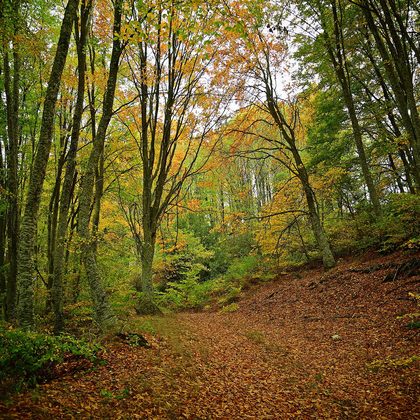
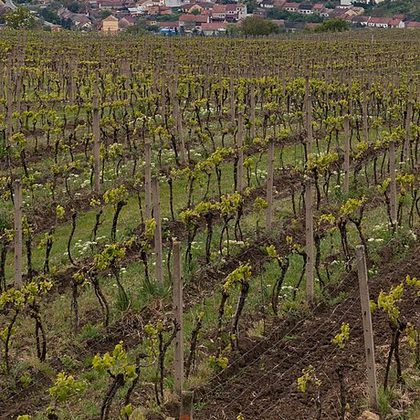
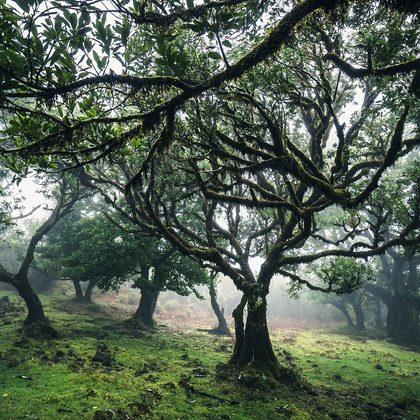
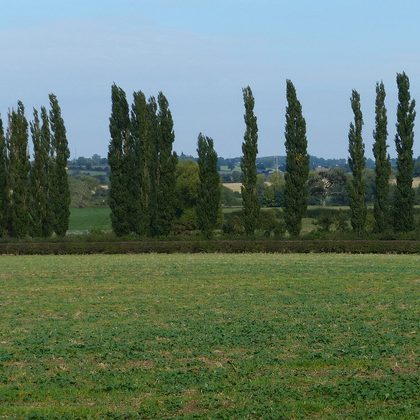
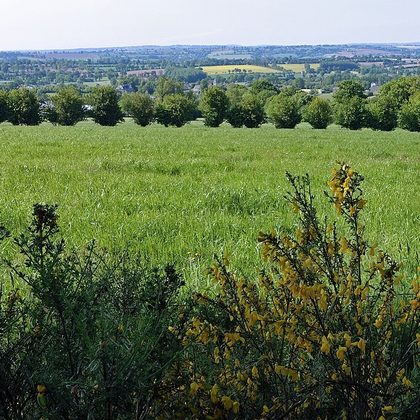
Open, light broadleaved woodland and its edges, above all old oak woods with an understorey, together with orchards and farmland holding old standard trees, olive groves, thin pine woodland, parkland with lines of trees, and wooded valleys with hedges. It is emphatically not a bird of open steppe: it needs standing trees with open ground between them, so that it can hunt from a perch at half height. It breeds in lowland and hill country up to about a thousand metres, occasionally higher in summer.
Where the bird is most at home, classified with EUNIS — the European standard for habitats.
Range and movements
Breeds in south-east Europe and the Near East: southern Bulgaria, eastern North Macedonia, north-east Greece and the eastern Aegean islands, Turkey, Cyprus and the Levant, with a separate population in eastern Iraq and western Iran. The whole population winters in north-east Africa, chiefly in Chad, Sudan and Ethiopia. Beyond that range it is a major rarity, with only a handful of records for north-west Europe as a whole.
- Breeding (summer)
- Winter
- Passage
- Migration direction
- dark = core range, pale = thinly spread
Where and when to look
Mid-April to June on Lesbos, Cyprus or in southern Turkey. Search open oak woodland and old olive groves, and watch for movement in the canopy rather than a silhouette on a wire. The bird often gives itself away first by its grating call or by a short flight in which the white in wing and tail flashes. Early morning, while the birds are still hunting low, gives the best views.
Conservation status
Not globally threatened (IUCN: Least Concern). The European population is small and confined to a narrow south-eastern margin, which makes it vulnerable: the loss of old standard orchards, the clearance of open oak woodland and insecticide use in olive groves all bite hard here. In Greece and Cyprus numbers are reasonably stable; at the northern edge in Bulgaria and North Macedonia the species holds only tens to hundreds of pairs and is exposed to any change in land use.