All species › Passerines › Shrikes › Lesser gray shrike
Lesser gray shrike | Lanius minor
Kleine klapekster | Alcaudón chico
The Lesser Grey Shrike is the summer bird among the grey shrikes: it breeds on the warm plains of south-eastern Europe and leaves in August for southern Africa. It sits strikingly upright on a wire or an isolated tree in farmland, hunts mainly large beetles and grasshoppers, and impales its catch on thorns and barbed wire. In Britain and the Low Countries it is a scarce vagrant, usually in late spring.

Voice
The song is a hurried, slightly scratchy warble of short high phrases laced with imitations of other birds, delivered from a wire or the top of a poplar and sometimes in a fluttering song flight. In alarm a hard, chacking tchek-tchek and a harsher kwek. In the African winter quarters it is all but silent.
No freely licensed recording is available for this species yet.
Identification
Smaller and more compact than Great Grey Shrike, with a shorter tail and much longer wing points that reach well down over the base of the tail. The upperparts are a clean blue-grey, the underparts white with a soft rose flush across breast and belly, strongest on the male in the breeding season. The decisive character is on the head: the black mask runs not only through the eye but right across the forehead, so that a black band above the bill joins the two eye masks and no white brow is left. The bill is short, thick and bluntly hooked. The wing is black with a white primary patch; the tail is black with white outer feathers. Females show less black on the forehead and are duller; juveniles lack the black forehead altogether, have a brownish mask and finely scaled upperparts. The bird often perches very upright, head high and tail still, and hunts with short, quick drops to the ground.
Confusion species
Great Grey Shrike is the yardstick: larger, longer-tailed, shorter-winged, and its black mask stops at the base of the bill with a thin white line above it — in Lesser Grey the black carries straight on across the forehead. Season separates them too: Great Grey is a winter bird in north-west Europe and Lesser Grey a summer one, so the window in which both can occur is narrow. Iberian Grey Shrike also has a broad mask, but with a broad white brow above it, a darker grey back and a stronger pink wash; it belongs to the south-west and does not migrate. Northern Shrike is larger and paler again, with a long bill and a strong hook. Young birds call for care: they lack the black forehead and can then look much like a young Great Grey — note instead the far longer wing point, the shorter tail and the shorter, blunter bill.
Habitat
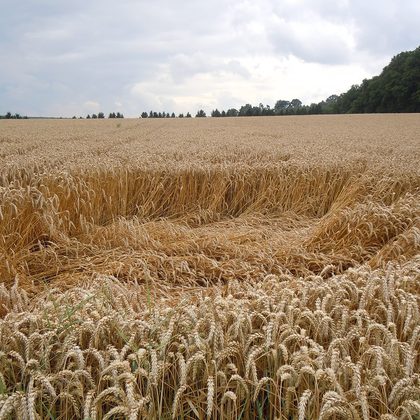
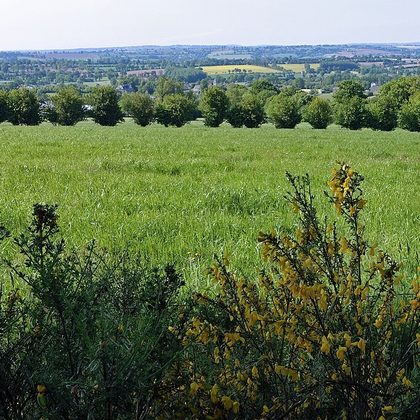
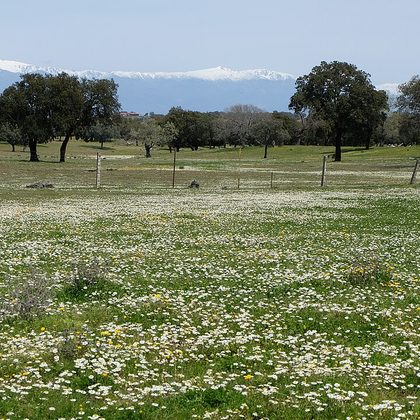
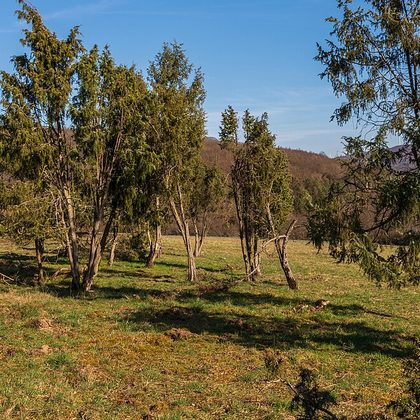
Warm, open farmed country with plenty of tall isolated trees: arable and lucerne fields with roadside rows of poplar, willow or mulberry, wood pasture and extensively grazed grassland with scattered trees, and hedges and shelter belts along field edges. It needs the combination of high, free lookouts, short or bare ground on which large insects are visible, and thorns or barbed wire on which to store the catch. Wet, cold or heavily wooded country it avoids.
Where the bird is most at home, classified with EUNIS — the European standard for habitats.
Range and movements
Breeds from north-eastern Spain and Italy east through the Balkans, Hungary, Romania and Ukraine to southern Russia, Turkey and Central Asia, with its centre of gravity in the steppe belt. The whole world population winters in southern Africa, migrating by way of the eastern Mediterranean. In the Netherlands there are over forty accepted records, more than half in May and June — spring birds that have overshot — with a clear bias towards the Wadden islands and the coastal strip. Since the turn of the century those records have become noticeably fewer, exactly as the European breeding range has drawn back.
- Breeding (summer)
- Passage
- Migration direction
- dark = core range, pale = thinly spread
Where and when to look
In north-west Europe it is a matter of waiting for news: a grey shrike in May or June on an offshore island is suspicious and deserves a good look at the forehead. To see the species with certainty, go to the Hungarian puszta, the Vojvodina or the Dobrudja between mid-May and early July. Drive the field tracks there and scan the wires and isolated trees along lucerne and sunflower fields; in the middle of a warm day, when the beetles are flying, the bird sits highest and straightest.
Conservation status
Not globally threatened (IUCN: Least Concern), thanks to large numbers in eastern Europe and Asia, but in Europe the species has largely fallen away along the western edge of its range: it has gone as a breeder from Germany, Switzerland, Austria and most of France, and little is left in Italy or Spain. The causes are those that press on Red-backed Shrike as well — the removal of tree lines and hedges, the shift to large-scale arable farming, pesticides and the decline of large insects — compounded by drought in the African winter quarters.