All species › Passerines › Shrikes › Woodchat shrike
Woodchat shrike | Lanius senator
Roodkopklauwier | Alcaudón común
The Woodchat Shrike is the shrike of the warm south: a compact, boldly marked bird with a chestnut crown and nape that watches the ground from a dead branch, a fence post or a wire and drops on large beetles, grasshoppers and lizards. Like its relatives it builds a larder, impaling prey on thorns and barbed wire. In Iberia it belongs to the dehesa; in north-west Europe it is a scarce but almost annual spring visitor.

Voice
The song is a long, sustained chattering warble with many imitations of other birds worked into it, soft and best heard at close range. The usual call is a hard, slightly nasal kshek; when agitated the bird adds a rattling gerr-gerr reminiscent of a magpie. A pair often gives this rattle away before you find them.
No freely licensed recording is available for this species yet.
Identification
As long as a Red-backed Shrike but stockier and shorter-tailed. The adult has a chestnut crown and nape, a black forehead running back into a broad black mask, a white throat and underparts, a black mantle with a large white scapular patch and a white patch at the base of the primaries. The white rump is a good mark, most obvious as the bird flies off. The female is duller, brown-black where the male is black, with a paler forehead and sometimes fine barring on the flanks. Juveniles lack any chestnut on the head and are grey-brown with dense scaling over head, back and underparts, though they already show a pale scapular patch and a pale rump. The bill is short, heavy and hooked.
Confusion species
Females and especially juveniles recall Red-backed Shrike. Look for the pale rump, the pale scapular patch and the shorter tail; a juvenile Red-backed is warmer brown, has an unbroken back without a pale shoulder, and a rufous tail. Great Grey Shrike is far larger, ash-grey above and longer-tailed, and in the north it appears in winter instead. Masked Shrike is smaller and slimmer, with a white forehead above the black mask rather than a chestnut crown, and orange-buff flanks. In southern Europe a shrike with a chestnut cap and a white shoulder is almost always this species.
Habitat
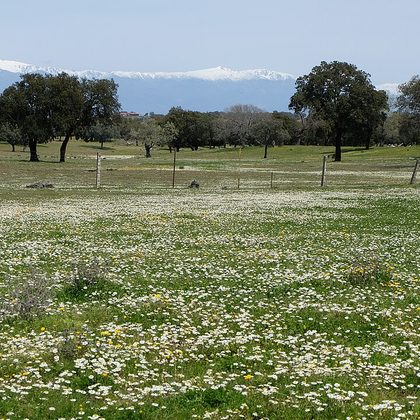
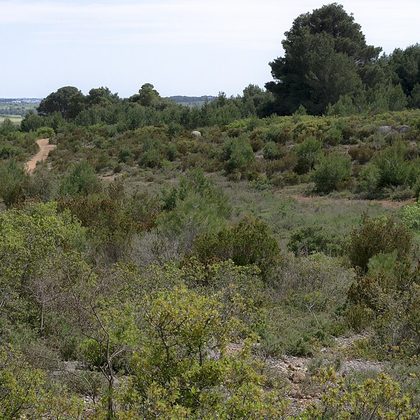
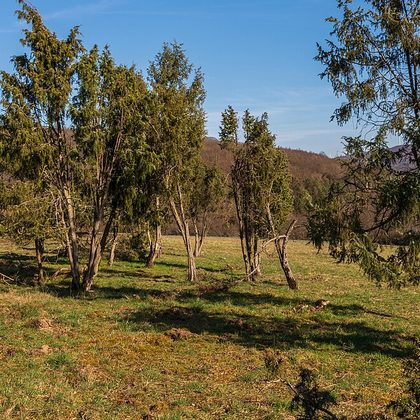
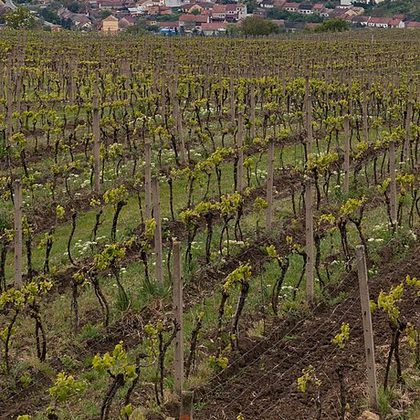
Warm, half-open country with scattered trees and bare or closely grazed ground: dehesa and other wood pasture with old oaks, olive groves and vineyards, garrigue and open scrub with emergent trees, and dry grassland with scattered bushes. The constant is the combination of free lookouts at eye level and open ground holding large insects. Towards the north of the range the species depends on traditional standard-tree orchards around villages.
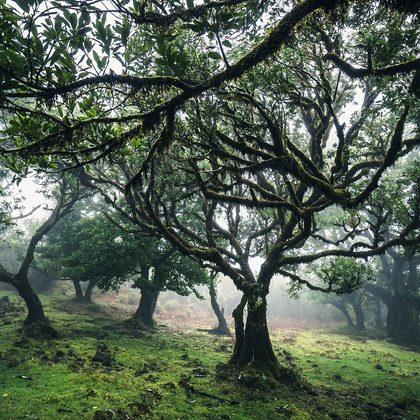
Where the bird is most at home, classified with EUNIS — the European standard for habitats.
Range and movements
Breeds around the Mediterranean from Portugal and Spain through southern France, Italy and the Balkans to Greece, Turkey and the Middle East, and in north-west Africa. By far the largest part of the European breeding population is on the Iberian Peninsula. All birds winter in the Sahel and the savannas of tropical Africa. In Britain and the Low Countries it is a scarce visitor, recorded in most years with a clear spring peak, and a smaller scatter of late-summer birds, many of them juveniles.
- Breeding (summer)
- Passage
- Migration direction
- dark = core range, pale = thinly spread
Where and when to look
In Iberia from mid-April into June. Work the edges of a dehesa and scan fence wires, dead branches and the crowns of isolated oaks; the bird perches low and exposed and moves from post to post in short, low flights. As it goes, the white rump shows well. Farther north, coastal scrub and island headlands in May are the places to look.
Conservation status
Assessed globally as Near Threatened. The species is in retreat across most of Europe: in France, Italy, Switzerland and Germany the range has shrunk sharply within a few decades, and even in Spain, its stronghold, numbers are falling moderately. Behind the decline lie the loss of large insects, the conversion of extensive wood pasture and standard orchards into intensive plantations, and the tidying away of small landscape features. Management that keeps old solitary trees, nutrient-poor margins and light grazing has a direct effect here.