All species › Passerines › Shrikes › Isabelline shrike
Isabelline shrike | Lanius isabellinus
Daurische klauwier | Alcaudón isabel
The Daurian Shrike breeds in the steppes and semi-deserts of Mongolia and north-west China and winters in north-east Africa and Arabia. That journey takes it in good numbers through the Gulf states and western Iran in March and April, and again from September to November — the only part of the area covered by these maps where it is a regular bird. In western Europe it is a rare autumn visitor. It is the palest of all Palearctic shrikes: sandy from crown to mantle, with a rusty red tail set sharply against it.

Voice
Silent here. On the breeding grounds the territorial call is a loud, sharp ksheh-ksheh, running into a rattling series when the bird is agitated. The song is a soft, fairly melodious murmuring chatter laced with imitations of other birds, usually audible only at close range.
No freely licensed recording is available for this species yet.
Identification
A small, slim shrike the size of a Red-backed Shrike. The whole upperside is pale sandy to sandy grey, and crown and mantle differ hardly at all — that very lack of contrast is the point. The black mask is narrow and weakly defined at the front, and the supercilium above it is diffuse and off-white, nothing like as striking as in Red-tailed Shrike. Rump and tail are bright rusty red and flare against the pale back as the bird takes off. Adult males often show a small white patch at the base of the primaries. The underparts are dirty white with a buff wash across breast and flanks; females and young birds carry fine, faint vermiculation there, distinctly weaker than in related species. The bill is shorter and finer than a Brown Shrike's, and six or seven primary tips usually show on the closed wing.
Confusion species
The comparison starts with the tail. Red-backed Shrike has a black-and-white tail and is chestnut above, or cold brown in the female; this bird has a rusty red tail, a difference visible even on a bird flying away. Red-tailed Shrike is the harder problem: the two were treated as a single species until this century, and have been listed separately on the British List since 2018. Red-tailed is warmer and more contrasting — a rufous crown standing out against a greyer mantle, a broad black mask running across the base of the bill, and a crisp, clean white supercilium. Daurian Shrike, by contrast, is uniformly pale sandy, with a narrower mask, a weak supercilium and a crown that reads greyish rather than rufous. Brown Shrike is warm brown rather than sandy, has a dull brown instead of rusty tail, a much heavier bill and a strikingly short hand with only about four primary tips visible. Be honest about the limits of fieldwork here: females and especially first-year Daurian and Red-tailed Shrikes often cannot be separated with certainty, and many records are accepted simply as Daurian or Red-tailed Shrike. On top of that, birds of the greyer-backed karelini type occur in the west of the range and their status is unclear, and hybrids with Red-backed Shrike are known, betrayed by a tail in which rufous and dark markings are mixed. The rule of thumb: name a bird only when tail colour, crown colour, mask shape and flank pattern all agree.
Habitat
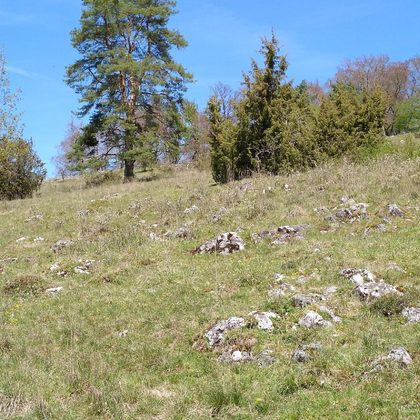
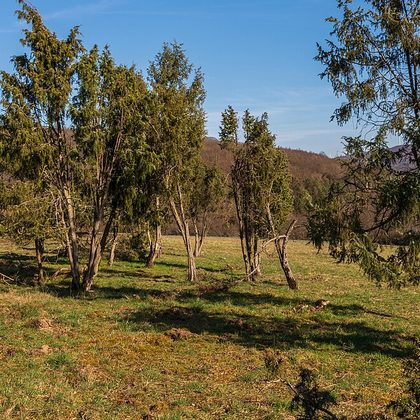
Dry steppe, semi-desert and mountain steppe, roughly between two hundred and two and a half thousand metres. The characteristic settings are tamarisk thickets in river valleys, saxaul and pistachio scrub, thorn bushes in closely grazed steppe and the edges of oases. Everywhere the combination is the same: a handful of bushes to hunt from and nest in, with open, bare ground around them where grasshoppers, beetles and lizards can be taken. Prey is impaled on thorns and stored, exactly as Red-backed Shrike does here.
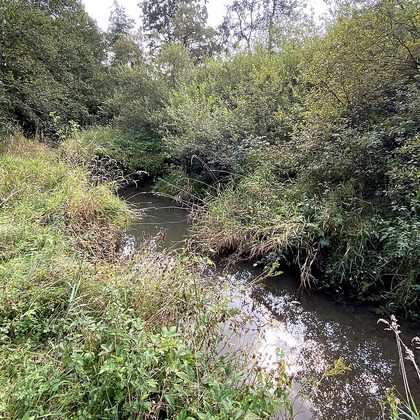
Where the bird is most at home, classified with EUNIS — the European standard for habitats.
Range and movements
Breeds from Tuva and Mongolia to north-west and central China, south-east to the Qaidam Basin. Western birds winter in Arabia, the Nile valley and East Africa, eastern birds in north-west India and Pakistan. Within the area of these maps it is above all a passage migrant: in Kuwait, Bahrain, Qatar, eastern Saudi Arabia, Israel and western Iran it is a familiar bird in March and April and from September to November, with smaller numbers through the winter. In north-west Europe, by contrast, it is a vagrant. The Netherlands has twenty-one accepted records since the first on Texel in May 1995; apart from one December bird in 1996 all the others fell in autumn, fourteen of them in October alone, with Texel, Bergen and Vlieland producing the most. Britain has a comparable tally, Shetland foremost. In Spain it is a major rarity: a handful of records, mostly coastal and in autumn or winter.
- Winter
- Passage
- dark = core range, pale = thinly spread
Where and when to look
In western Europe, mid-September to early November, on the coast, after days of easterly airflow. Scan bush tops, fences and wires at the edge of dune scrub or a rough field; the bird hunts from a low perch and keeps returning to it. Watch the tail as it flies: that is when the rusty red shows best. If you want to put a name to the bird, get images of the crown, the front of the mask and the flanks — those three points decide the question against Red-tailed Shrike.
Conservation status
Not globally threatened (IUCN: Least Concern), with a large, thinly populated range in Central Asia and no sign of rapid decline. For Europe this is not a species with a conservation status but a visitor, and the number of records says as much about observers as about birds: since this species and Red-tailed Shrike have been treated separately, it has become clear that Daurian is by far the commoner of the two in north-west Europe. A proportion of the older records, however, can no longer be assigned to either.