All species › Waders, gulls and terns › Plovers and lapwings › Killdeer
Killdeer
Charadrius vociferus | Killdeerplevier | Chorlitejo culirrojo
A large, long-tailed American plover that names itself: the ringing kill-deee carries across a whole field and has put more than one bird on the record before anyone raised a binocular. In Britain and Ireland it is a bird of late autumn and winter, arriving on the back of deep Atlantic storms.

Voice
A loud, insistent kill-deee, rising on the second syllable and repeated endlessly, from which the English name is taken. In alarm the bird runs the notes together into a rapid dee-dee-dee-dee, and in display it gives a long, hard trill. Vagrants are vocal, they call in flight and often at night, and in practice the voice is the first clue at least as often as the plumage.
Recording: Jonathon Jongsma — CC BY-SA 3.0 · Wikimedia Commons
Identification
Distinctly bigger and longer than Ringed Plover, with a long tail that projects well beyond the wingtips at rest and gives the bird an oddly rear-heavy shape. Warm brown above and clean white below, with two black breast bands, a black-and-white face pattern and a bright orange-red orbital ring around a large dark eye. The bill is thin and all black, the legs dull pinkish-grey. In flight the wings look long and rather pointed, with a broad white bar, and the rump and upper tail are a striking orange-rufous with a black subterminal band. Juveniles already show both breast bands, with browner, softer edges.
Confusion species
There is nothing to work through: the double breast band is decisive at the first clear view, and no other plover in the region shows it. Ringed Plover, Little Ringed Plover and Kentish Plover all have a single band, complete or broken, and all are much smaller and shorter-tailed. A bird seen only in flight is separated just as easily by the orange-rufous rump and tail, which no European plover approaches. The one genuine trap is a distant, hunched bird on stubble whose lower band is hidden by the breast feathering; wait for it to stretch or run, and the second band appears. Size and shape help even before that, because at rest the long tail beyond the wingtips is unlike any small plover.
Habitat
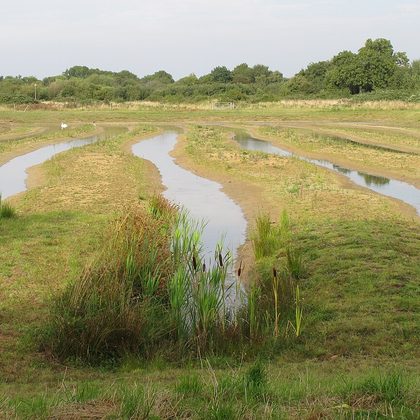
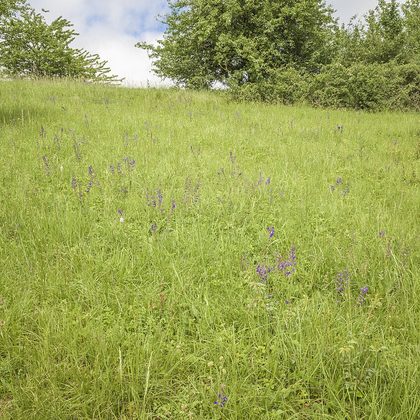
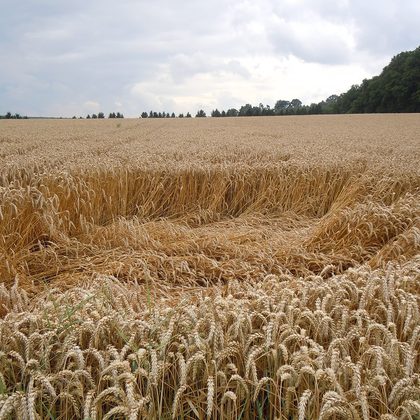
Open, short, damp ground with bare patches: coastal grazing marsh, flooded stubble, muddy field margins, playing fields, airfields, gravel and hard standing around farms. It feeds by the plover method of run, stop and pick, and it is far less tied to the tideline than most waders, so estuarine mud is used mainly as a roost or when the fields freeze.
Where the bird is most at home, classified with EUNIS — the European standard for habitats.

Range and movements
Breeds across almost the whole of North America and winters south to northern South America, one of the most numerous and adaptable waders on the continent. It reaches Europe as a rare vagrant, with Ireland, western Britain, Iceland and the Azores taking most records, and the pattern is markedly late: the great majority arrive between November and February, after a run of deep Atlantic depressions, rather than during the classic September wader-vagrant window.
Where and when to look
After a spell of severe westerly gales in late autumn or early winter, check flooded coastal fields and grazing marsh in western Ireland and south-west Britain, and listen before you look. Once found, a Killdeer usually settles: birds have held the same wet field or farmyard for weeks on end, which makes this one of the more obliging American waders to catch up with.
Conservation status
Not of conservation concern, and one of the few waders that has genuinely benefited from farmland, airfields and gravel pits. Numbers in North America are nonetheless slipping, with pesticide use, mowing of nests and collisions with traffic on the roadside margins the species favours all taking a share.