All species › Pigeons and doves › Pigeons and doves › Laughing dove
Laughing dove
Spilopelia senegalensis | Palmtortel | Tórtola senegalesa
A small, warm cinnamon dove of squares, palms and village streets around the eastern Mediterranean. Its soft rolling coo runs through the day in any Turkish town, filling the sound niche that Woodpigeon occupies further north.

Voice
A soft, rolling, tripping coo of four or five syllables, doo-doo-dooroo-doo, rising in the middle and falling away at the end; the chuckling rhythm is what gave the bird its English name. It calls from roof edges, wires and palm fronds, all year and at any hour. Displaying males add a steep clapping flight.
Recording: MRG90 — CC BY-SA 4.0 · Wikimedia Commons
Identification
Clearly smaller and slimmer than Collared Dove, with a long tail and short, rounded wings. Head and breast are pinkish wine-brown, the mantle rufous, and a blue-grey panel runs across the closed wing as a grey wedge. The feature that matters sits on the side of the neck: a copper patch spotted with black, worn like a speckled bib across the upper breast rather than as a stripe or a collar. The legs are dark red, the bill dark, and white tail corners show as the bird flies. There is no black hind-neck collar.
Confusion species
Collared Dove is larger, plainer sandy, and carries a narrow black half-collar on the hind neck rather than a speckled patch on the neck side; from below its tail is black with a broad white end. Turtle Dove shows a black-and-white barred neck patch and rufous, black-centred scaling on the upperparts. Laughing Dove sits between the two: smaller, longer-tailed and warmer in tone, and the speckled neck patch settles it at any range at which you can see it at all.
Habitat
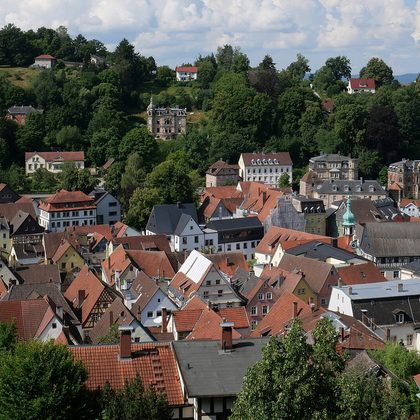
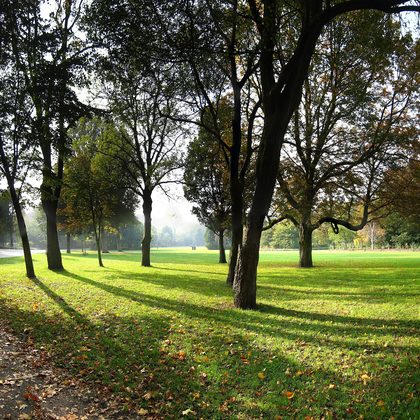
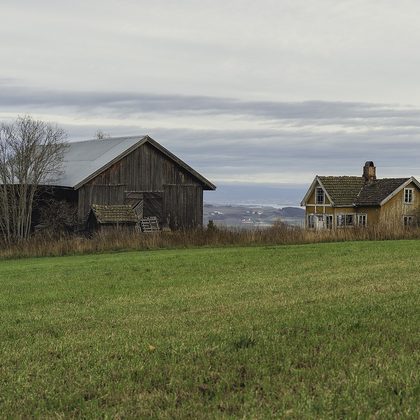
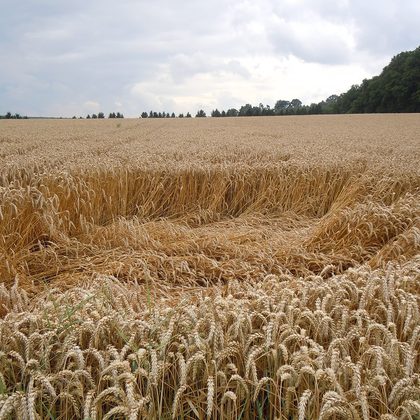
Towns and villages with open, dry ground: squares, parks, gardens, palm groves, farmyards, mosque courtyards and the edges of fields and orchards. The birds feed on foot on bare soil, between café tables and along dusty paths, and nest low in creepers, palms and on building ledges. Away from settlements they thin out quickly.
Where the bird is most at home, classified with EUNIS — the European standard for habitats.
Range and movements
Native to Africa and to southern and south-western Asia. Within Europe it is established in Turkey and the eastern Mediterranean, with settled town populations reaching the south-eastern Balkans, and locally in Spain, where the birds go back to escapes from captivity. Anything further north is a cage bird that has got out; in Britain and Ireland the species is not on the wild list.
- Resident
- Breeding (summer)
- Winter
- Passage
- Migration direction
- dark = core range, pale = thinly spread
Where and when to look
In Adana, Mersin or Antalya you need only sit in the shade of a square: the birds walk between the visitors' feet. On every small brown dove check the neck side and the tail length, because young Collared Doves lack their collar and are the usual trap. In Spain, look through the town parks and palm avenues of the south coast.
Conservation status
Not globally threatened and abundant over a huge range; around the eastern Mediterranean it is still spreading, helped by irrigation, planted palms and food around buildings. It does not displace native doves, but shares with other town pigeons the risks of trichomonosis and of poisoning during feral pigeon control.