All species › Birds of prey › Hawks, eagles and kites › Northern goshawk
Northern goshawk
Astur gentilis | Havik | Azor común
The Goshawk is the heavy, short-winged forest hunter that rarely stays in view for long and is usually seen above the canopy. With this species it is almost always about proportions, not colours.

Voice
At the nest a fast, penetrating series of gek-gek-gek-gek notes, usually in runs of five to ten; deeper and slower in the female, higher and more hurried in the male. The female begs with a drawn-out, plaintive heee-yaa. Loudest from late February to April around the nest site in tall forest, especially in the morning; outside that period the species is strikingly silent.
Recording: Alvaro Ortiz Troncoso — CC BY-SA 4.0 · Wikimedia Commons
Identification
Bulky and deep-chested, with a head that projects clearly ahead of the wings, broad wings with a bulging trailing edge and a fairly long tail with rounded corners. It flies in tight, slow series of three to five powerful beats followed by a long glide, and soars over the wood with the wings pressed forward. Adult male: slate blue-grey above, finely grey-barred below, with a bright white supercilium over a dark ear patch and an orange-red eye. The adult female is markedly larger, browner above and more coarsely barred. Juveniles look quite different: warm brown with buff feather fringes above, and on the cream underparts heavy dark lengthwise drops rather than bars, with a yellow eye. In display and alarm the white undertail coverts are fluffed out into a puffy white ball — often the first thing you notice at range.
Confusion species
Sparrowhawk is the confusion species, and the difference lies in build, not size: a big female Sparrowhawk and a small male Goshawk overlap. The Goshawk has a small but clearly protruding head, a deep chest, a broad tail base with rounded tail corners and wings broadest in the middle; the Sparrowhawk has a small, barely protruding head, a slight body, a long tail with straight, sharp corners and wings pinched at the base. The wingbeat differs just as much: slow, stiff and powerful in the Goshawk, fast, flickering and loose in the Sparrowhawk. In a soar the Goshawk's trailing edge bulges noticeably, the Sparrowhawk's is straighter. A streaked juvenile Goshawk can also suggest a Buzzard, but that bird has much broader wings and a short fan-shaped tail.
Habitat
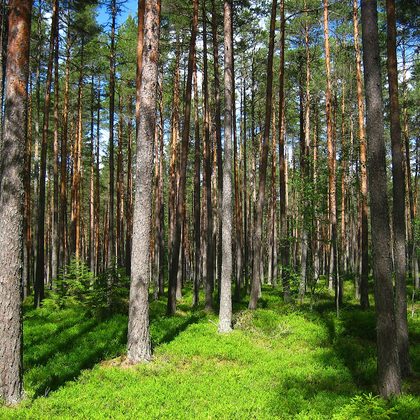
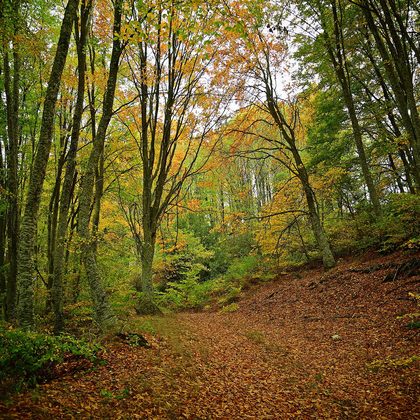
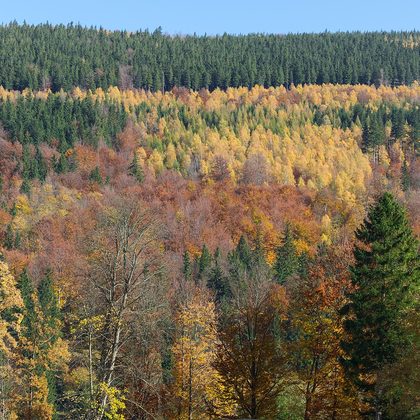
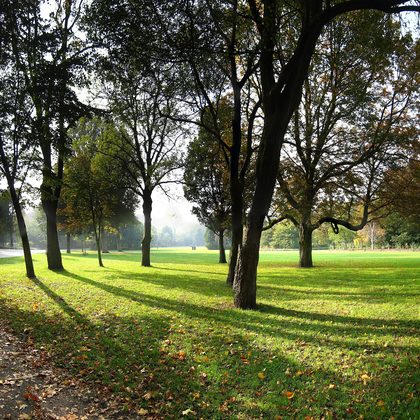
Mature woodland with tall, thick trees for the nest and open land, clear-fell or woodland edge for hunting: conifer plantations on sandy soils, old estate woodland, mixed forest along rivers. Increasingly also city parks and cemeteries, where pigeons and crows supply the food. Hunts by surprise, low along the wood edge or in a short stoop, taking pigeons, corvids, magpies and rabbits.
Where the bird is most at home, classified with EUNIS — the European standard for habitats.
Range and movements
In the Netherlands a widespread resident of the wooded districts: the Veluwe, Drenthe, the Achterhoek and the Brabant and Limburg forests, plus a number of pairs in urban parks in Amsterdam and The Hague. In Spain it is widespread in the mountain forests of the Pyrenees, the Cantabrian range and the Iberian System and in pine and oak woods beyond them, but everywhere scarcer and more retiring than in the Netherlands.
- Resident
- Breeding (summer)
- Winter
- Passage
- dark = core range, pale = thinly spread
Where and when to look
Pick a clear, windless morning between mid-February and late March and take a viewpoint overlooking a large block of forest, roughly between ten and one, when the first thermals get going. That is when birds display above the canopy with slow, exaggerated deep beats and spread white undertail coverts. Later in the year sightings are mostly luck: a Goshawk scattering a flock of pigeons or shooting low along a wood edge.
Conservation status
Not globally threatened (IUCN: Least Concern). European numbers recovered strongly after the DDT ban and the reduction of persecution, but in the Netherlands and Germany the species has declined again over the past twenty years, probably through a combination of less prey in the forest, predation by Eagle Owls and continuing illegal persecution around shooting estates and pigeon lofts. Forestry that retains old trees, and quiet around nests in spring, matter most.