All species › Swifts › Swifts › Pacific swift
Pacific swift
Apus pacificus | Siberische gierzwaluw | Vencejo del Pacífico
The Pacific Swift breeds from western Siberia to Kamchatka and Japan and winters in Australia and Indonesia; in Europe it is a major rarity. It is the only swift that combines a white rump band with a long, deeply forked tail, which makes it identifiable — provided you see it for long enough.

Voice
A fast rippling trill, tsiririri, or a harsher spee-eer; the sound is softer and less shrill than the Common Swift's srreee and comes over as buzzing rather than screaming. In Europe the species has almost always been seen silent, so voice is of little help in nailing a vagrant.
No freely licensed recording is available for this species yet.
Identification
Slightly larger and longer winged than a Common Swift, with a narrower looking body. The most obvious feature is a white band across the rump, one to two centimetres deep, curling round onto the flanks; it is a narrow crescent rather than a square patch. The tail is long and deeply forked, far deeper than a Common Swift's, but the fork only shows when the bird spreads it — held closed it looks like a long, tapering point. The throat patch is large, white and more sharply defined than a Common Swift's. The underparts are heavily scaled with broad white feather fringes, so that from below the bird looks greyish rather than evenly dark. Flight is easy and measured, with long glides; juveniles show pale fringes to the wing feathers that adults lack.
Confusion species
Common Swift has a dark rump and a short, shallowly forked tail, evenly sooty brown underparts and a small, vague throat patch; its wingbeats are faster and more flickering. Pallid Swift is browner, with a stronger head and throat pattern, broader-based wings and a disyllabic scream, but it too has no white on the rump. White rumps do occur in two smaller species of southern Europe and North Africa: Little Swift, much smaller and compact, with a square white rump patch and a short, straight-ended tail, and White-rumped Swift, smaller and slimmer, with a narrow white crescent on the rump and likewise a deeply forked tail — the last is the dangerous confusion and calls for judgement of size, throat patch and belly scaling. Horus Swift of Egypt and the Levant also has a broad white rump band, but is smaller and shorter tailed. Alpine Swift is far bigger, brown above and white on belly and throat. It is only honest to say that a white-rumped swift going past is often not safely nameable: without a view of tail length, throat patch and belly scaling it stays a probability.
Habitat
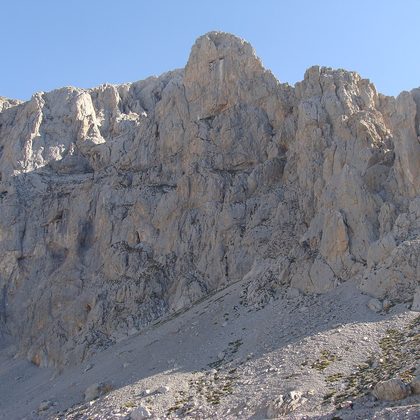
Breeds colonially in crevices and cavities of inland cliffs, sea cliffs and gorges, and freely under the eaves of buildings as well, into cities such as Vladivostok and across the Japanese islands. Feeds high over open country, forest, rivers and sea, on average higher than the Common Swift where the two occur together. Within the map area it turns up over coastal headlands, bird islands and the open North Sea.
Where the bird is most at home, classified with EUNIS — the European standard for habitats.



Range and movements
Breeds across Siberia and eastern Asia, from the Ob to Kamchatka, Sakhalin and Japan, and winters in Indonesia, Melanesia and Australia. In Europe it is a vagrant with a small number of accepted records, spread across Britain, Ireland, Denmark, Sweden and Spain; the first British record came in 1981 over the North Sea, on a gas platform, and later birds have reached Kent, Norfolk, Shetland and Aberdeenshire. Nearly all European records fall between late May and July, when an eastern overshoot rides in with warm weather.
Where and when to look
To have a chance of this species in Europe, stand at a coastal watchpoint or on a bird island in June or July where large parties of swifts pass — Fair Isle, Shetland, Helgoland, the Irish south coast — and work through every group for rump and tail. Photograph anything odd: the white rump band is often easier to judge on an image than in the field, and the tail fork only reveals itself in the moment the bird banks.
Conservation status
Not threatened (IUCN: Least Concern): the range covers more than ten million square kilometres, the species is common on the breeding grounds and no decline has been shown. For Europe the category has no practical meaning, since only stray individuals are involved. The forms leuconyx, salimalii and cooki have been treated as separate species since 2011, so older literature under this name describes a wider area than now applies.