All species › Waders, gulls and terns › Gulls and terns › Pallas's gull
Pallas's gull
Ichthyaetus ichthyaetus | Reuzenzwartkopmeeuw | Gavión cabecinegro
A gull the size of a Great Black-backed with the hood of a Mediterranean Gull and a bill like a banana. Pallas's Gull belongs to the inland seas and steppe lakes running from the Black Sea to Mongolia, and in western Europe it remains one of the most wanted vagrants on anyone's list.

Voice
Deep and nasal: a hoarse, grating aaargh and a barking kau-kau, strikingly low for a gull and closer in timbre to a heron than to a Herring Gull. Colonies keep up a continuous raw clamour that carries for kilometres over flat steppe lakes. Vagrants in western Europe are almost always silent.
No freely licensed recording is available for this species yet.
Identification
A heavy, long-bodied gull with a high forehead and a flat rear crown, giving an almost rectangular head. Summer adults have a black hood broken by sharp white eyelid crescents above and below the eye, a long orange-yellow bill with a black band and red tip, and yellow legs. The mantle is pale blue-grey and the wingtip is remarkably pale for a large gull: white tips with only a narrow black bar set in from the end, not a solid black wedge. Winter birds lose the hood down to a dark mask around the eye; immatures are scaly brown with a white rump and clean black tail band, but already show the massive bill and long, angular head.
Confusion species
Great Black-backed Gull matches it for bulk but has a slate-black mantle, pink legs and never a dark hood, and its bill is shorter and blunter, without the black band and red tip. Mediterranean Gull provides the other half of the comparison: the same black hood and white eye crescents, but a bird barely larger than a Black-headed Gull, with a short blood-red bill and a plain white wingtip. On Pallas's Gull hold on to the combination of sheer size, the high forehead with flat rear crown, the long yellow bill with black band and red tip, and the narrow white eyelids that show against the hood like two chalk marks.
Habitat
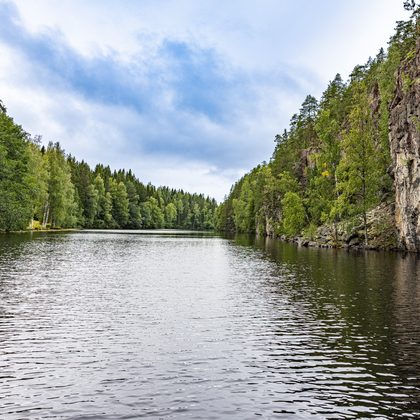
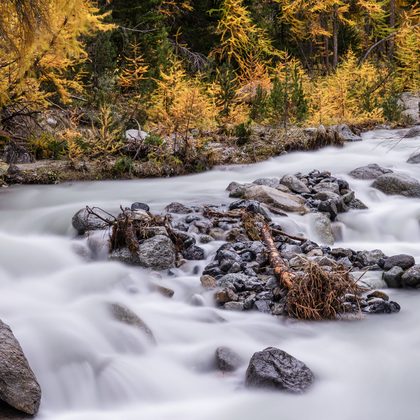
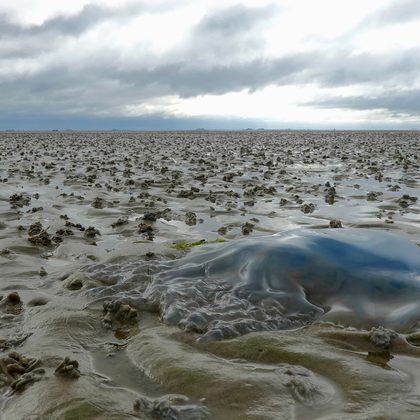
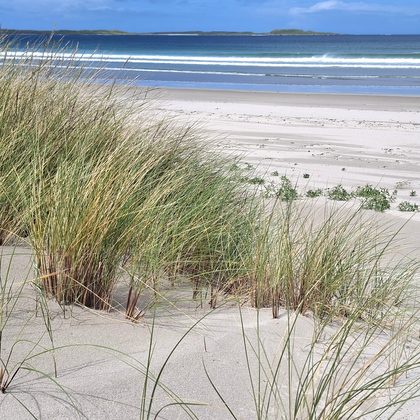
Islands in inland seas, brackish steppe lakes and large reservoirs, plus sandbars and islets in big rivers and deltas. Outside the breeding season it uses coasts, tidal flats, lagoons, harbours and fish ponds. Food is largely fish, but also rodents, insects and the eggs and chicks of other colonial birds; over steppe it will hunt well away from water.
Where the bird is most at home, classified with EUNIS — the European standard for habitats.
Range and movements
Breeds from the Black Sea and the Sea of Azov east through the Caspian and the Kazakh steppe lakes to Mongolia, the European colonies concentrated around the Sivash and in the Volga delta. The Danube delta in Romania is the westernmost place where the species is met with any regularity. It winters on the coasts of the eastern Mediterranean, the Red Sea, the Persian Gulf and the Indian subcontinent, and reaches Britain, the Netherlands and the North Sea only as a handful of records.
- Breeding (summer)
- Winter
- Passage
- dark = core range, pale = thinly spread
Where and when to look
The Danube delta is the practical introduction: take a boat from Tulcea or Sfântu Gheorghe in May or June and check the sandbars at the river mouths among Yellow-legged and Caspian Gulls. In a mixed flock, work on size and head shape first, since the bird stands a head above its neighbours and carries the bill slightly drooped. Records in north-west Europe come from the same kind of situation, a large loafing gull flock worked slowly, but expect to put in years rather than days.
Conservation status
Not threatened; the world population is stable to increasing and the species is spreading west in the Black Sea region. The main pressures are fluctuating water levels in the steppe lakes, which strand breeding islands and open them to foxes, disturbance at colonies, and the drying of water bodies in Central Asia. Because the birds nest in a few very large colonies, a single failed season can cost a large share of that year's young.