All species › Passerines › Vireos › Red-eyed vireo
Red-eyed vireo | Vireo olivaceus
Roodoogvireo | Vireo ojirrojo
The Red-eyed Vireo belongs in the deciduous woods of North America, where it sings its short, questioning phrases through the whole summer day. In Europe it is an autumn vagrant that crosses the ocean on westerly gales, and of all American songbirds it is by far the one most often found here.

Voice
On the breeding grounds it is one of the most obtrusive sounds of the wood: short phrases of two to five syllables with a pause between them, as if the bird asks a question and then answers it — cherr-weet … chu-wee … weet-wee? — sometimes tens of thousands of times in a day, and still going in the flat heat of midday when everything else has stopped. Here it does not sing. The most you will hear is a short, nasal, complaining chway, which can betray a bird hidden inside a hawthorn.
Recording: Jonathon Jongsma — CC BY-SA 4.0 · Wikimedia Commons
Identification
A chunky, rather deliberate warbler-like bird of twelve to thirteen centimetres, olive-green on the back, wings and tail and white on throat, breast and belly, with a faint yellow wash on the flanks and undertail coverts. The head pattern makes the bird: a smooth grey crown, below it a broad white supercilium bordered above and below by a black line, and a dark eye-stripe. The iris is deep red in adults, though at range or in shade it simply looks dark; first-year birds — which is what almost every vagrant here is — still have a brown iris. The bill is heavy for a small songbird, blue-grey, with a small hook at the tip; the legs are stout and blue-grey. No wing bars.
Confusion species
At first glance a Willow Warbler or a Garden Warbler, and that is usually how one is found. But the Willow Warbler is smaller and finer, with a thin pointed bill, a vague supercilium without black borders and pale legs, and the Garden Warbler is plain grey-brown with a mild, featureless face. A Melodious or Icterine Warbler gives a pale greenish impression, but lacks the grey crown and the double-edged supercilium and has a longer, broad-based bill. The combination of grey crown, sharply outlined white brow, hook-tipped heavy bill and that slow, hanging, hopping way of feeding belongs to no European species.
Habitat
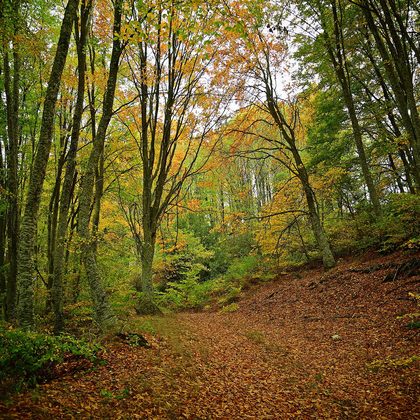
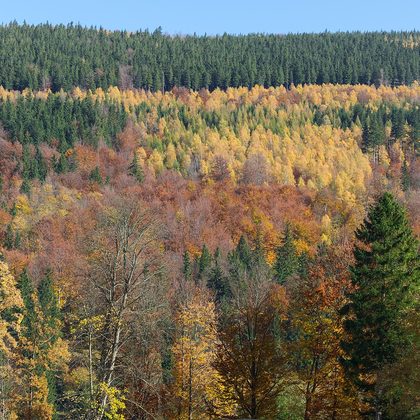
In North America a bird of extensive deciduous forest with a closed canopy, preferring large-leaved trees such as maple and oak, and beyond that mixed woodland, old parks and cemeteries with heavy timber, and the tall growth along rivers. It forages slowly and methodically high in the leaves, working caterpillars from leaf to leaf and walking more than it flies; in autumn it switches to berries and fruit. The nest is a neat cup slung in the fork of a side branch.
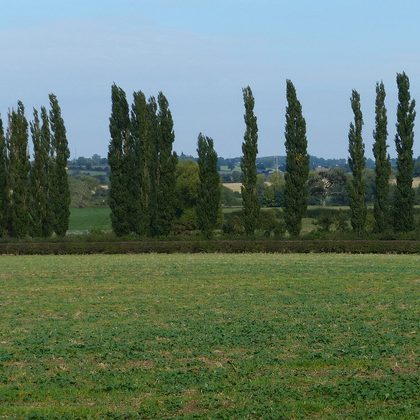
Where the bird is most at home, classified with EUNIS — the European standard for habitats.
Range and movements
It breeds from British Columbia and the Canadian forest belt through the east and south of the United States, and winters in Amazonian South America. Autumn migration takes part of the population over the Atlantic seaboard and out across open water, which is exactly why a deep low with a hard westerly puts birds ashore here. Britain and Ireland hold over a hundred records, in most years at least one, concentrated on the Isles of Scilly, in Cornwall and along the south-west coast of Ireland. The Netherlands has nine accepted records, from 1985 to 2018, all between late September and late October and most of them on the Wadden islands.
Where and when to look
In the first week of October, two to four days after a deep Atlantic low, work the cover on the outer islands: overgrown gardens, sycamore clumps, elder thickets and the willows behind a nursery or a lighthouse. The bird often stays put for a long time in one place and gives itself away by a slow movement among the leaves rather than by sound. Look at the head first: grey crown with a sharp white brow is enough, and the red iris only comes into it once the bird turns into the light.
Conservation status
Not globally threatened (IUCN: Least Concern) and one of the most numerous songbirds of the North American deciduous forest, with a large and fairly steady population. Forest loss in the wintering range and collisions with lit buildings on night migration are the best-known problems. The number of European records says nothing about that population: it follows the weather over the Atlantic, and the birds that make landfall here arrive under their own power.