All species › Passerines › Orioles › Eurasian Golden Oriole
Eurasian Golden Oriole
Oriolus oriolus | Wielewaal | Oropéndola europea
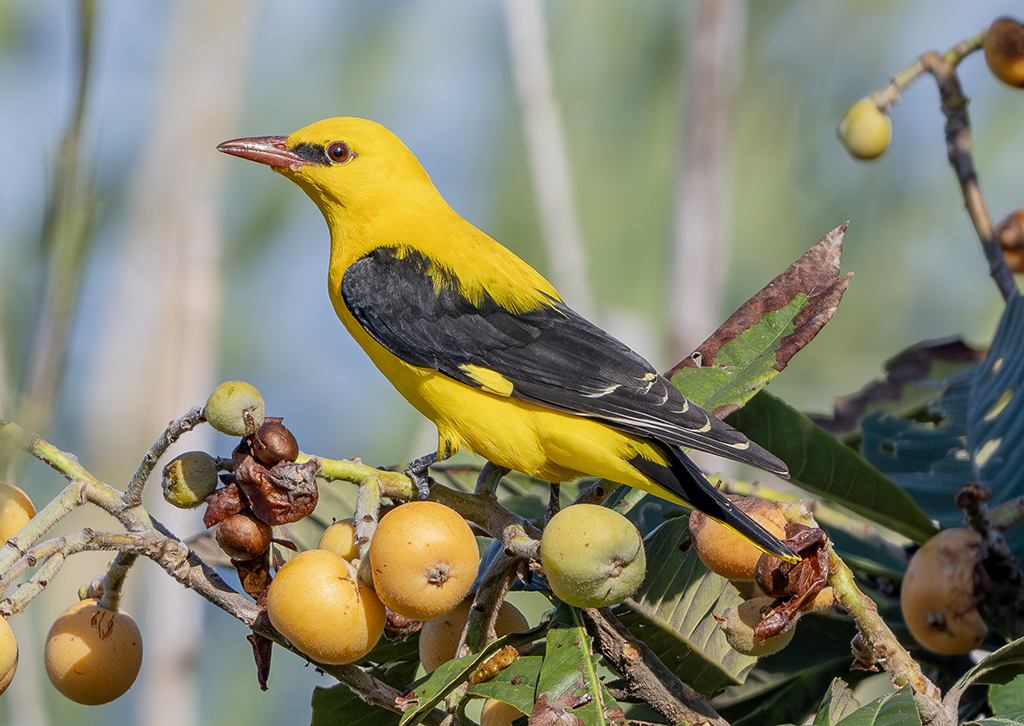
The Golden Oriole is Europe's most tropical-looking songbird and at the same time one of the hardest to see. It lives high in the canopy of mature deciduous woodland and almost always announces itself by voice first.
Voice
The song is a loud, liquid, almost human whistle, classically rendered weela-weeoo, given from early May to mid-July and strongest at dawn. The alarm is utterly different: a harsh, cat-like screech, khraaaah, and it is often the first clue that a pair is present.
Recording: Joost van Bruggen — CC BY-SA 4.0 · Wikimedia Commons
Identification
The male is brilliant golden yellow with black wings and a black tail with yellow corners, a red-brown bill and a black loral stripe. The female is greenish yellow above, off-white and finely streaked below, with dull yellow tail corners. Juveniles resemble females but are duller and more heavily streaked; young males only turn yellow in their second summer.
Confusion species
Females and immatures are surprisingly often taken for Green Woodpecker, but that species has a bounding flight, a red crown and a pale rump. The oriole flies fast and only slightly undulating, rather like a large thrush. Apart from escaped cagebirds there is no genuine confusion species.
Habitat
Tall mature deciduous woodland with a closed canopy: poplar plantations, oak woods, old estate parkland, ash-rich stream valleys and osier beds. In southern Europe also riverine gallery forest and even large orchards and tall-treed olive groves along watercourses.
Range and movements
Breeds across nearly all of continental Europe north to southern Scandinavia; winters in tropical and southern Africa. In the Netherlands mainly on the Veluwe, in the river district and in old poplar stands in Flevoland and Noord-Brabant. In Spain widespread in gallery woodland and dehesa, scarce in the driest steppes.
- Breeding (summer)
- Passage
- Migration direction
- dark = core range, pale = thinly spread
Where and when to look
Go to old poplar or oak woodland at sunrise in the second half of May or early June and listen first. Stand back and scan the topmost branches: males often cross from crown to crown in a single fast, straight flight, and that is when the gold flares.
Conservation status
Not globally threatened (IUCN: Least Concern). Dutch numbers have fallen sharply since the 1980s, probably through the felling of old poplar woods, drying out of stream valleys and problems along the migration route. Populations in southern Europe appear more stable.