All species › Waterfowl › Ducks, geese and swans › Ring-necked duck
Ring-necked duck
Aythya collaris | Ringsnaveleend | Porrón acollarado
The most frequently found Nearctic duck in western Europe, and the only one you can hope to see several of in a single Irish winter. Its name refers to a chestnut neck ring that is essentially never visible in the field; everything hangs on the bill and the head shape. Almost every bird is sitting inside a flock of Tufted Duck.

Voice
Effectively always silent in Europe. On the breeding grounds a displaying drake gives a soft high whistle and the female a low grunting krrr much like a Tufted Duck's. Do not count on hearing anything: a vagrant among Tufted Ducks stays quiet.
No freely licensed recording is available for this species yet.
Identification
Slightly smaller and slimmer than a Tufted Duck, with an angular head peaking towards the rear of the crown, so that the hindcrown forms a sharp point above a steeply rising forehead. There is no crest. The drake has a black back, black breast, grey flanks and, the best mark of all, a clean white wedge rising in front of the folded wing between breast and flank. The bill is blue-grey with a narrow white ring round the base, a broad white band immediately before the black tip, and the iris is yellow. The female is brown with a dark crown, a greyer face, a bold white eye-ring and a pale line running back from it, usually some white around the bill base, and the same white bill band. In flight the wing bar is grey, not white.
Confusion species
Tufted Duck and both scaup. Tufted Duck also has a black back, but its flanks are white with no white wedge, its head is round with a tuft or nape bump rather than a peak at the rear of the crown, and its bill is plain blue-grey with only a black nail. Greater Scaup has a pale grey vermiculated back and a rounded head. In flight the wing bar settles it: brilliant white the length of the wing on Tufted Duck and Scaup, grey and barely visible on Ring-necked Duck. On females the sticking point is the white at the bill base, because female Tufted often show some and female Scaup show a great deal, so that character cannot be used. Fall back on the peaked rear crown, the white eye-ring with its trailing line, the white band before the bill tip and, once the bird flies, the grey wing bar. Also keep Tufted × Pochard hybrids in mind, which can show a pale bill band and an angular head.
Habitat
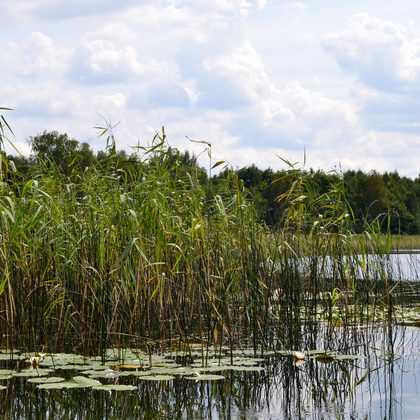
Lakes, loughs, reservoirs and old clay pits, preferring waters with a vegetated margin and floating-leaved plants; the species likes smaller and shallower water than Scaup and is more often close in to the bank. It is nearly always among Tufted Duck and Pochard, diving in two to four metres of water. In North America it breeds beside shallow forest lakes and peat pools.
Where the bird is most at home, classified with EUNIS — the European standard for habitats.


Range and movements
Breeds across Canada and the northern United States and winters as far south as Central America. In Europe it has been the standard Nearctic duck since the 1970s. The British list opens with a drake at Slimbridge, Gloucestershire, on 12 to 14 March 1955; the species was dropped from the BBRC rarity list at the end of 1993, the British wintering total now runs to a few dozen birds, and occupied 10-km squares roughly quadrupled between the 1981–84 and 2007–11 atlases. Ireland does better still, with birds annual on the larger loughs from October to March and fifteen together on Inishmore in the autumn of 2008. The Netherlands has over sixty accepted records and Spain a few dozen, mostly in the Canaries and the north-west, the first in 1978. Escapes from collections are known, but the pattern of autumn and winter arrivals fits genuine transatlantic movement.
- Breeding (summer)
- Winter
- Passage
- Migration direction
- dark = core range, pale = thinly spread
Where and when to look
Irish and Scottish loughs, the reservoirs of south-west England and Wales, and the Dutch and Danish lakes all reward the same routine: work every Tufted Duck flock from November to March. Pick up first on the white wedge in front of the wing, which catches the light even on dull days, then confirm the head shape and the bill band. Birds return to the same water year after year, so an old record is a good tip for the coming winter.
Conservation status
Least Concern globally, with an increasing North American population that has spread its breeding range eastwards. In Europe it is not the subject of any management. The pressures in North America are acidification and loss of shallow forest waters and lead poisoning from ingested shot; in Europe the relevant one is disturbance of wintering diving-duck flocks by watersports and fishing.